What Are SQDCP Boards?
Introduction to SQDCP Boards
SQDCP Boards are structured visual management tools used by organisations to monitor and improve operational performance across key business areas including SQCDP (Safety, Quality, Cost, Delivery, People). These boards provide teams with a centralised system for tracking daily activities, operational KPIs, workplace issues, and continuous improvement actions.
Modern businesses increasingly rely on SQDCP Boards to improve communication, strengthen accountability, and create greater operational visibility across departments. By displaying performance information clearly, organisations can identify problems quickly and respond more effectively to operational challenges.
SQDCP Boards are widely used in manufacturing, logistics, warehousing, engineering, healthcare, retail, and service industries where operational consistency and team coordination are essential.
The primary purpose of SQDCP Boards is to align employees with business objectives while supporting structured daily management processes. Teams can review performance data regularly and maintain focus on operational priorities throughout the working day.
Many organisations use both physical and digital SQDCP Boards to support visual management activities. Digital boards provide real-time updates and remote accessibility, while traditional boards remain highly effective for team collaboration within operational environments.
SQDCP Boards also encourage continuous improvement by helping businesses identify inefficiencies, reduce waste, and improve operational discipline. This structured approach supports long-term business stability and sustainable growth.
As organisations continue adopting smarter operational strategies, SQDCP Boards provide a practical framework for improving productivity, communication, and workforce engagement.
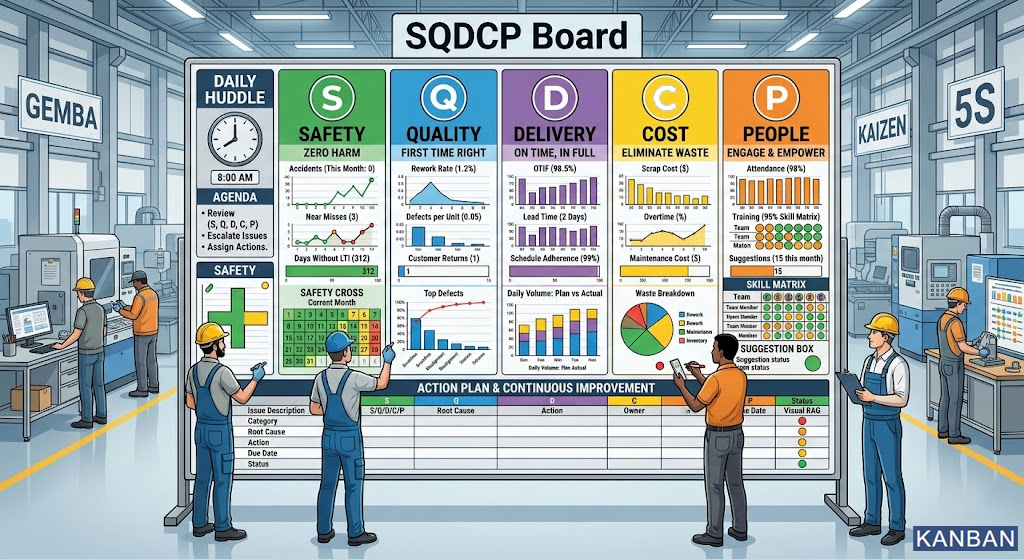
How SQDCP Boards Support Daily Operations
SQDCP Boards provide teams with a clear daily overview of operational performance and business priorities.
Managers and employees can monitor workplace safety incidents, product quality issues, delivery schedules, operational costs, and workforce performance from a single visual system.
Daily operational meetings often take place around SQDCP Boards to review targets, discuss challenges, and agree corrective actions.
This structured communication process improves collaboration and ensures that operational issues are addressed quickly before they escalate.
Clear visual reporting also reduces misunderstandings between departments and helps maintain operational consistency across the organisation.
Businesses that implement SQDCP Boards often experience improved workflow coordination, stronger team accountability, and faster operational decision-making.
As operational data becomes increasingly important, SQDCP Boards help organisations maintain greater control over performance management activities.
Why SQDCP Boards Matter in Modern Business Operations
Aligning Daily Activities with Business Objectives
SQDCP Boards help organisations align daily operational activities with wider business goals and long-term strategic priorities.
By monitoring safety, quality, delivery, cost control, and workforce performance together, businesses can maintain stronger operational balance across departments.
These boards create a direct connection between daily team activities and overall organisational success.
Employees gain greater visibility into how their work contributes towards productivity, customer satisfaction, operational efficiency, and business growth.
Clear operational alignment also improves decision-making by ensuring that teams remain focused on measurable priorities and performance targets.
Businesses can identify operational weaknesses more quickly and implement improvement actions before issues impact productivity or customer service.
SQDCP Boards also strengthen communication between management and frontline teams by providing transparent operational reporting.
As modern businesses become increasingly data-driven, SQDCP Boards provide a practical and structured approach to operational management.
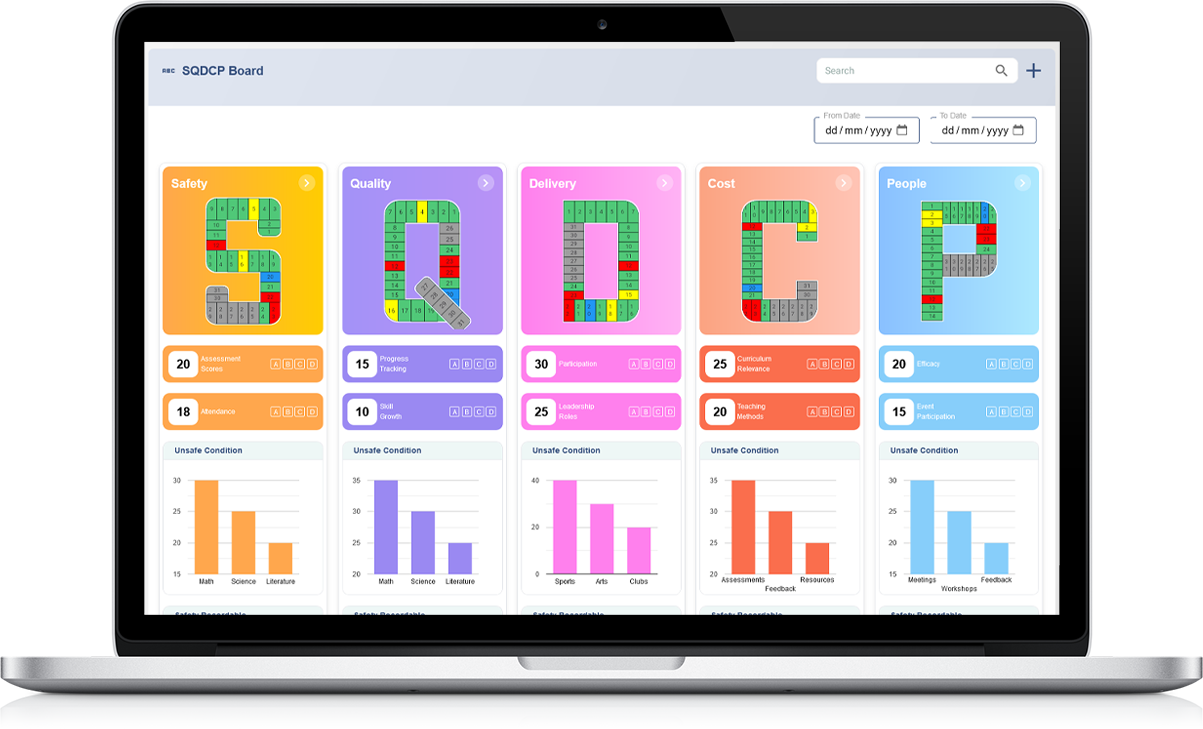
Improving Operational Visibility
One of the biggest advantages of SQDCP Boards is improved operational visibility across all business functions.
Teams can monitor live performance information, identify operational disruptions, and respond to problems more efficiently.
Visual dashboards and performance indicators help employees understand current priorities and maintain focus on operational targets.
Greater visibility also strengthens accountability because operational data remains accessible to both managers and frontline teams.
Businesses can improve transparency, reduce communication delays, and support more proactive operational management.
Improved visibility also supports stronger planning, forecasting, and resource allocation across departments.
Organisations that maintain clear operational visibility are often better positioned to improve productivity and reduce operational waste.
Improving Workplace Safety with SQDCP Boards
Safety forms the foundation of every successful SQDCP Board system and remains one of the most important priorities within business operations.
SQDCP Boards help organisations monitor workplace incidents, near misses, compliance activities, risk assessments, and health and safety performance in real time.
Daily safety reviews encourage employees to remain aware of workplace hazards and follow established operational procedures consistently.
Visual safety reporting improves communication across teams and ensures that safety information remains highly visible throughout the workplace.
Businesses can identify safety concerns quickly and implement corrective actions before incidents occur.
Structured safety monitoring also supports stronger regulatory compliance and reduces the likelihood of operational disruption caused by workplace accidents.
Employees often feel more confident and engaged when organisations demonstrate a strong commitment to workplace safety.
SQDCP Boards encourage greater workforce participation in safety improvement activities and help create a proactive safety culture.
Improved workplace safety also contributes towards lower absenteeism, reduced downtime, and improved operational stability.
As businesses continue adopting digital technologies, many organisations now integrate SQDCP Boards with automated alerts, digital inspections, and live safety reporting systems.
This modern approach strengthens operational control while supporting long-term business resilience and workforce wellbeing.
Strengthening Team Performance Through SQDCP Boards
People management is a critical element of SQDCP Boards and plays a major role in improving operational performance and workforce engagement.
Businesses use SQDCP Boards to monitor attendance, training activities, communication effectiveness, productivity levels, and team collaboration.
Structured workforce management helps organisations create a more motivated, accountable, and productive working environment.
Employees become more engaged when operational goals, responsibilities, and performance expectations are clearly communicated.
Regular team discussions around SQDCP Boards strengthen collaboration and encourage employees to contribute towards operational improvement initiatives.
Businesses can also identify skills gaps more effectively and develop targeted training programmes that support workforce development.
Continuous employee development is essential for maintaining operational efficiency within modern and increasingly digital workplaces.
SQDCP Boards also support stronger communication between departments by ensuring that operational priorities remain visible to all teams.
Improved communication helps reduce operational confusion and strengthens overall workplace coordination.
Organisations that invest in workforce engagement often experience improved morale, lower staff turnover, and stronger long-term productivity.
As operational environments continue evolving, engaged and skilled employees remain essential for achieving sustainable business growth.
Enhancing Quality and Delivery Performance with SQDCP Boards
Quality and delivery performance are essential for maintaining customer satisfaction and operational reliability.
SQDCP Boards help organisations monitor product quality, service consistency, delivery schedules, and operational deadlines more effectively.
Teams can quickly identify quality issues, production delays, or service disruptions and implement corrective actions before customer satisfaction is affected.
Visual quality tracking improves accountability and encourages employees to maintain higher operational standards.
Delivery monitoring also helps organisations improve planning accuracy and maintain stronger control over operational schedules.
Businesses that consistently deliver high-quality products and services are more likely to build stronger customer relationships and improve brand reputation.
SQDCP Boards also support continuous quality improvement by helping organisations analyse recurring issues and identify long-term improvement opportunities.
Improved delivery performance reduces operational disruption and strengthens overall business efficiency.
As customer expectations continue increasing, businesses rely on SQDCP Boards to maintain consistent operational performance and service reliability.
Reducing Operational Costs Using SQDCP Boards
Cost control is one of the key benefits of implementing SQDCP Boards within business operations.
SQDCP Boards help organisations identify operational inefficiencies, reduce waste, improve resource utilisation, and strengthen financial performance.
By monitoring operational activities daily, businesses can identify unnecessary costs before they become larger operational problems.
Improved operational visibility also supports better budgeting, forecasting, and resource planning across departments.
Businesses can reduce downtime, improve workflow efficiency, and minimise process variation through structured operational management.
SQDCP Boards encourage teams to focus on continuous improvement activities that support long-term cost reduction strategies.
Clear performance monitoring also helps organisations make more informed operational and financial decisions.
Reducing operational waste not only improves profitability but also supports sustainability initiatives and environmental responsibility goals.
As businesses face increasing operational pressures, effective cost management remains essential for maintaining competitiveness and long-term growth.
Improving Customer Satisfaction Through Visual Management
Customer satisfaction depends heavily on operational consistency, product quality, service reliability, and effective communication.
SQDCP Boards help businesses maintain stronger operational control and improve customer outcomes by providing real-time performance visibility.
Teams can identify service delays, quality concerns, and operational disruptions more quickly, allowing faster corrective action.
Improved communication between departments also reduces the risk of customer issues caused by operational misalignment.
Businesses that maintain clear operational visibility are often better positioned to respond to changing customer expectations.
Visual management systems support stronger accountability and help ensure that operational standards remain consistent across all business activities.
SQDCP Boards also encourage continuous improvement initiatives that directly support improved customer experience.
Customers are more likely to trust businesses that consistently deliver reliable products, services, and communication.
As competition increases across industries, customer satisfaction remains one of the most important drivers of long-term business success.
Tools and Technologies for Digital SQDCP Boards
Modern businesses increasingly use digital SQDCP Boards to improve operational monitoring, communication, and reporting capabilities.
Digital systems provide real-time updates, remote accessibility, automated reporting, and improved integration with wider business technologies.
Many organisations combine SQDCP Boards with production software, ERP systems, IoT sensors, cloud platforms, and business intelligence tools.
These integrated technologies provide greater operational visibility and support more accurate decision-making.
Digital dashboards allow teams to monitor KPIs instantly and respond more quickly to operational issues.
Automated alerts and notifications also improve responsiveness by informing teams immediately when operational targets are missed.
Cloud-based SQDCP systems improve accessibility for multi-site organisations and support remote operational management.
Businesses can also use mobile devices, touchscreen displays, and interactive dashboards to improve workforce engagement with operational data.
As digital transformation continues across industries, SQDCP Boards are becoming increasingly advanced and data-driven.
These technologies help businesses improve operational efficiency, strengthen communication, and support continuous improvement initiatives more effectively.
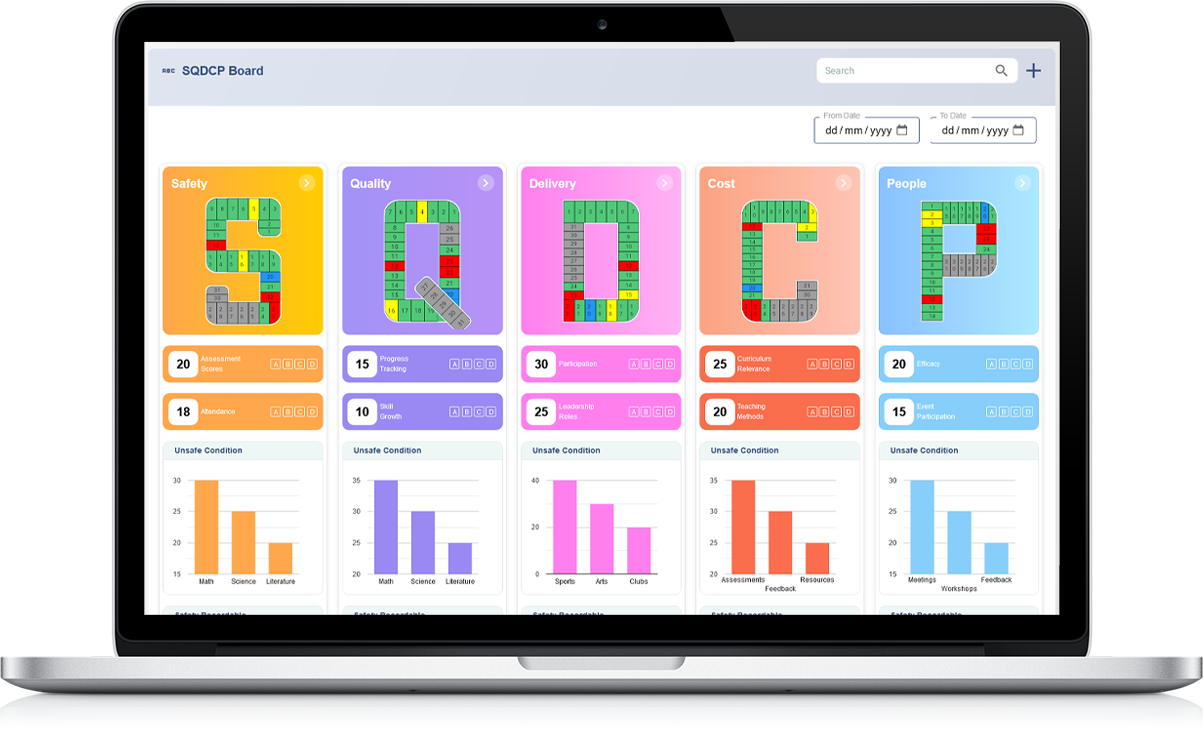
By implementing SQDCP Boards across business operations, organisations can monitor critical performance metrics in real time, enabling faster decision-making, improved communication, and more effective problem-solving across all operational activities.
Key Business KPIs Tracked with SQDCP Boards
Key Performance Indicators (KPIs) are essential for measuring operational performance and supporting continuous business improvement. SQDCP Boards help organisations monitor critical business metrics across Safety, Quality, Delivery, Cost, and People management activities.
Businesses use SQDCP Boards to track workplace safety incidents, customer complaints, operational delays, productivity levels, employee attendance, training completion, and cost performance.
Real-time KPI visibility helps organisations identify operational problems quickly and respond before issues impact wider business performance.
Safety KPIs may include near misses, workplace incidents, compliance activities, and risk assessment completion rates.
Quality KPIs commonly focus on defect levels, customer feedback, service consistency, and process accuracy.
Delivery KPIs monitor on-time completion, scheduling performance, workflow efficiency, and customer response times.
Cost KPIs help organisations monitor operational waste, overtime expenses, resource utilisation, and productivity performance.
People-focused KPIs measure employee engagement, absenteeism, workforce development, and team collaboration.
SQDCP Boards provide a structured visual system that makes KPI monitoring easier for both management teams and frontline employees.
Clear visibility of business performance encourages accountability and supports more accurate operational decision-making.
Many organisations now integrate digital dashboards with SQDCP Boards to improve reporting accuracy and provide real-time performance updates.
Businesses that consistently monitor KPIs through SQDCP Boards are often better positioned to improve efficiency, reduce operational waste, and strengthen long-term performance.
As business operations become increasingly data-driven, KPI tracking remains essential for maintaining competitiveness and operational stability.
Standardising Processes with SQDCP Boards
Standardised processes are essential for maintaining operational consistency, improving efficiency, and reducing unnecessary variation across business activities.
SQDCP Boards help organisations establish structured workflows that improve communication, accountability, and operational discipline.
By displaying clear operational priorities and performance expectations, SQDCP Boards support consistent working practices across departments.
Employees gain a clearer understanding of procedures, responsibilities, and business objectives through visual management systems.
Standardised reporting also improves communication between teams because operational information is presented consistently.
Businesses can reduce operational errors, improve productivity, and strengthen service quality by following structured operational processes.
SQDCP Boards support daily operational reviews that help organisations identify process inconsistencies and improvement opportunities quickly.
Clear visual systems also make employee training more effective because procedures and operational standards remain visible throughout the workplace.
As organisations grow, standardised operational processes become increasingly important for maintaining consistency across multiple departments and locations.
Digital SQDCP Boards further strengthen standardisation by providing automated reporting, live updates, and centralised operational visibility.
Structured operational management improves planning accuracy, workflow coordination, and overall business stability.
Businesses that successfully standardise processes through SQDCP Boards often experience improved productivity, reduced waste, and stronger operational resilience.
This consistent approach supports sustainable business growth while improving operational performance across the organisation.
The Role of Digital Transformation in SQDCP Board Adoption
Digital transformation is changing the way organisations manage operational performance, communication, and continuous improvement activities.
Businesses increasingly adopt digital SQDCP Boards to improve operational visibility, reporting accuracy, and decision-making speed.
Traditional whiteboards and manual reporting systems are gradually being replaced by cloud-based dashboards and real-time digital management platforms.
Digital SQDCP Boards allow organisations to monitor operational data instantly across multiple departments and locations.
Automated reporting systems reduce manual administrative tasks and improve the accuracy of operational information.
Real-time dashboards help businesses identify operational issues more quickly and implement corrective actions without delay.
Digital technologies also improve communication by ensuring that operational information remains accessible to both office-based teams and frontline employees.
Cloud-based systems support remote access, making it easier for leadership teams to monitor business performance from different locations.
Many organisations integrate SQDCP Boards with ERP software, workflow systems, IoT devices, and analytics platforms to improve operational coordination.
Automated alerts and notifications further strengthen responsiveness by informing teams immediately when operational targets are missed.
Digital SQDCP Boards also support environmental sustainability by reducing paper usage and improving operational efficiency.
As businesses continue investing in digital transformation strategies, SQDCP Boards are becoming more interactive, intelligent, and data-driven.
Organisations that successfully adopt digital SQDCP systems often achieve improved productivity, stronger communication, and better long-term operational control.
Integrating SQDCP Boards with Business Systems
Integrating SQDCP Boards with wider business systems helps organisations achieve stronger operational visibility and improved decision-making.
Connected systems allow operational data to be shared across departments including operations, finance, HR, customer service, and logistics.
This integrated approach improves communication, reduces reporting delays, and supports more accurate business planning.
SQDCP Boards are commonly integrated with ERP software, workforce management systems, CRM platforms, production software, and business intelligence tools.
Integrated systems help businesses monitor operational performance in real time and improve coordination between departments.
Automated data sharing also reduces the risk of inconsistent reporting and improves overall operational transparency.
Businesses can monitor productivity, delivery performance, workforce activities, and customer service metrics from a centralised management platform.
Cloud-based integration platforms improve accessibility by allowing operational information to be shared securely across multiple business locations.
Integrated digital systems also strengthen forecasting, budgeting, and operational planning activities.
Real-time operational visibility enables organisations to respond more quickly to changing customer demands and business challenges.
Advanced analytics tools can combine SQDCP data with wider business intelligence systems to identify operational trends and long-term improvement opportunities.
As businesses become increasingly connected and data-driven, integrated SQDCP systems provide stronger operational flexibility and improved business agility.
Organisations that integrate SQDCP Boards successfully often experience improved efficiency, reduced operational waste, and stronger customer service performance.
Steps to Implement SQDCP Boards in Your Organisation
Successful SQDCP Board implementation requires a structured approach that aligns operational goals with wider business objectives.
The first step involves identifying key operational challenges, communication gaps, and business improvement priorities.
Organisations should define clear KPIs for safety, quality, delivery, cost management, and workforce performance.
These KPIs should reflect both short-term operational targets and long-term strategic business goals.
Businesses must then decide whether to use physical visual boards, digital dashboards, or a combination of both systems.
Digital SQDCP Boards are increasingly popular because they provide real-time reporting, remote accessibility, and automated updates.
Employee training is essential during implementation because teams need to understand how to use the boards effectively and respond to operational data.
Leadership involvement also plays a critical role in maintaining engagement and encouraging consistent operational discipline.
Daily operational meetings should be introduced to review KPIs, discuss performance issues, and agree improvement actions.
Clear accountability must be assigned to ensure operational problems are monitored and corrective actions are completed efficiently.
Businesses should review SQDCP Board performance regularly to identify trends, process inefficiencies, and opportunities for improvement.
Continuous communication between departments strengthens collaboration and supports long-term implementation success.
As organisations become more familiar with SQDCP methodologies, the boards naturally become integrated into daily operational routines.
This structured implementation approach helps businesses improve operational stability, communication, and continuous improvement performance.
Common Challenges When Introducing SQDCP Boards
Although SQDCP Boards provide many operational benefits, organisations may face several challenges during implementation and long-term adoption.
One of the most common challenges involves resistance to change from employees who may be unfamiliar with structured visual management systems.
Some teams may initially view SQDCP Boards as additional administrative work rather than valuable operational improvement tools.
Clear communication and effective training are essential for helping employees understand the long-term benefits of SQDCP methodologies.
Another challenge involves maintaining accurate and consistent operational data across departments.
Incomplete reporting or inconsistent KPI monitoring can reduce the effectiveness of visual management systems.
Businesses must ensure that operational information remains accurate, relevant, and updated regularly.
Leadership consistency is also important because SQDCP systems require ongoing engagement and operational discipline.
Without regular review meetings and management support, SQDCP Boards may gradually lose effectiveness.
Some organisations may struggle with monitoring too many KPIs simultaneously, leading to unnecessary complexity and reduced operational focus.
Businesses should prioritise meaningful metrics that directly support operational goals and business performance.
Technology integration challenges may also arise when introducing digital SQDCP Boards alongside existing business systems.
Despite these challenges, organisations that adopt a structured implementation strategy often achieve significant long-term operational improvements.
By addressing barriers proactively, businesses can maximise the value of SQDCP Boards while strengthening operational resilience and workforce engagement.
Leadership’s Role in SQDCP Board Success
Strong leadership is essential for ensuring the successful adoption and long-term effectiveness of SQDCP Boards within any organisation.
Leaders help establish operational priorities, define business expectations, and align daily activities with wider organisational objectives.
Visible leadership involvement encourages employees to remain engaged with operational improvement activities and performance management processes.
Managers and supervisors play a critical role in maintaining accountability and supporting structured daily review meetings.
Leadership teams must also ensure that employees receive the training, guidance, and support required to use SQDCP Boards effectively.
Clear communication from leadership strengthens operational consistency and reduces confusion across departments.
Leaders help create a workplace culture where continuous improvement, collaboration, and operational transparency become part of daily business routines.
Regular participation in SQDCP reviews also demonstrates organisational commitment towards operational excellence and workforce engagement.
Strong leadership support improves employee confidence and encourages greater involvement in improvement initiatives.
Businesses with engaged leadership teams often experience higher productivity, improved communication, and stronger operational stability.
As organisations continue evolving, leadership adaptability remains essential for managing change and supporting continuous operational improvement.
Successful leaders encourage innovation, teamwork, and proactive problem-solving throughout the organisation.
Leadership remains one of the most important factors in ensuring long-term SQDCP Board success and sustainable business growth.
Driving Continuous Improvement with SQDCP Boards
Continuous improvement is one of the most important benefits of implementing SQDCP Boards within business operations.
SQDCP Boards provide organisations with structured operational visibility that helps identify inefficiencies, workflow disruptions, and improvement opportunities.
Daily performance reviews encourage teams to analyse operational challenges and implement corrective actions quickly.
Businesses can use SQDCP Boards to monitor recurring issues, track improvement activities, and measure operational progress consistently.
Continuous improvement strengthens communication between departments and encourages collaborative problem-solving.
Employees become more engaged when they can contribute directly towards operational improvements and see measurable progress over time.
Structured improvement activities help organisations reduce waste, improve productivity, and strengthen operational consistency.
Trend analysis and KPI monitoring also support more accurate operational planning and resource management.
SQDCP methodologies encourage businesses to adopt a proactive approach towards operational management rather than reacting only when problems occur.
Small operational improvements achieved consistently often lead to significant long-term business benefits.
Digital SQDCP systems further accelerate continuous improvement by providing real-time reporting, automated alerts, and detailed operational analytics.
Businesses that embed continuous improvement into daily operations often achieve stronger competitiveness and improved operational resilience.
This structured improvement culture supports sustainable growth while helping organisations adapt more effectively to changing business conditions.
Boosting Employee Engagement Through Visual Management Boards
Visual management boards play a major role in improving employee engagement and operational communication across organisations.
SQDCP Boards provide employees with clear visibility into operational performance, team objectives, workplace priorities, and improvement activities.
When employees can clearly see operational information, they better understand how their work contributes towards wider business success.
Visual systems improve communication by making important operational data accessible across all departments and teams.
Daily operational meetings around SQDCP Boards encourage collaboration, accountability, and active participation in improvement initiatives.
Employees are more likely to contribute ideas and support operational improvements when performance expectations remain visible and measurable.
Visual reporting systems also reduce misunderstandings and improve consistency across business activities.
Digital dashboards further strengthen engagement by providing real-time updates, interactive reporting, and improved operational transparency.
Training activities become more effective when employees can interact directly with visual operational information.
Engaged employees often demonstrate stronger teamwork, improved productivity, and greater ownership of operational responsibilities.
Businesses that combine visual management with workforce development initiatives typically experience higher morale and lower staff turnover.
As workplaces become increasingly digital, visual management systems continue supporting stronger communication and operational alignment.
This people-focused approach improves both employee satisfaction and long-term business performance.
Benefits of Using SQDCP Boards Across Your Business
SQDCP Boards provide organisations with a complete operational management framework that improves communication, accountability, and overall business performance.
One of the biggest advantages is improved operational visibility across safety, quality, delivery, cost management, and workforce performance activities.
Businesses can monitor operational KPIs in real time and respond more quickly to performance issues or operational disruptions.
SQDCP Boards also improve communication between departments by ensuring that operational priorities and business targets remain clearly visible.
Structured visual management supports better decision-making and strengthens overall operational coordination.
Businesses often achieve improved productivity because operational issues are identified and resolved more efficiently.
Quality performance improves through stronger process monitoring and clearer operational accountability.
Delivery reliability also becomes more consistent when operational planning and workflow coordination are monitored effectively.
SQDCP Boards support cost reduction initiatives by helping organisations identify waste, improve resource utilisation, and strengthen productivity performance.
Employee engagement improves because teams become more involved in operational reviews and continuous improvement activities.
Digital SQDCP systems provide additional benefits through real-time reporting, automated alerts, and remote accessibility.
Businesses that successfully implement SQDCP Boards often experience stronger operational resilience, improved customer satisfaction, and greater long-term competitiveness.
This structured operational approach supports sustainable business growth while helping organisations adapt to changing market conditions more effectively.
Future Trends in SQDCP Boards and Smart Business Management
The future of SQDCP Boards will be shaped by increasing digital transformation, automation, advanced analytics, and smarter operational management technologies.
Businesses are increasingly moving towards fully digital SQDCP systems that provide live reporting, cloud-based access, and automated operational insights.
Artificial intelligence and machine learning technologies are expected to play a larger role in analysing operational data and identifying business improvement opportunities.
Predictive analytics will help organisations anticipate operational risks, workforce challenges, and performance disruptions before they occur.
IoT-connected devices and smart sensors will continue improving operational visibility across production, logistics, and workplace environments.
Cloud-based SQDCP platforms will strengthen collaboration by allowing operational data to be shared instantly across multiple locations and departments.
Interactive dashboards, mobile applications, and touchscreen technologies will improve employee engagement with operational information.
Automation technologies will further improve reporting accuracy while reducing manual administrative tasks.
Sustainability reporting is also expected to become increasingly integrated into SQDCP methodologies as businesses focus more heavily on environmental responsibility.
Future SQDCP systems may include additional KPI tracking for energy efficiency, carbon reduction, and sustainable operational performance.
As organisations become increasingly data-driven, SQDCP Boards will continue evolving into more intelligent and integrated business management systems.
Businesses that invest in modern visual management technologies are likely to achieve stronger operational agility, improved productivity, and greater long-term resilience.
The future of SQDCP Boards will continue supporting smarter business operations, stronger workforce collaboration, and sustainable organisational growth.
Conclusion: Why Every Business Needs SQDCP Boards
SQDCP Boards have become an essential operational management tool for organisations seeking to improve communication, operational visibility, workforce engagement, and overall business performance.
By providing structured monitoring across Safety, Quality, Delivery, Cost, and People management activities, SQDCP Boards help businesses maintain stronger operational control and continuous improvement.
These visual management systems improve accountability by ensuring that operational information remains visible, measurable, and accessible across all departments.
Businesses can identify operational problems more quickly, implement corrective actions efficiently, and strengthen long-term operational stability.
SQDCP Boards also support better teamwork, stronger communication, and improved employee engagement through structured daily operational reviews.
Digital SQDCP systems provide additional advantages including real-time reporting, cloud accessibility, automated alerts, and improved business integration.
As organisations continue adapting to changing customer expectations and increasingly competitive markets, operational visibility and continuous improvement become more important than ever.
Businesses that successfully implement SQDCP Boards often achieve improved productivity, stronger customer satisfaction, reduced operational waste, and better long-term business resilience.
Whether implemented through physical boards or advanced digital platforms, SQDCP methodologies provide a practical and effective framework for managing modern business operations.
This structured operational approach helps organisations remain agile, efficient, and competitive while supporting sustainable growth and long-term business success.