What is PQVC Board?
Introduction to PQVC Board
In modern business environments, PQVC Board (Performance, Quality, Variation, Control) is a structured and highly effective visual management tool focused on monitoring key operational metrics and driving continuous improvement. It provides a clear, step-by-step framework for tracking performance, maintaining quality standards, identifying process variations, and ensuring operational control. Unlike traditional management methods, PQVC Boards emphasize real-time visibility, accountability, and data-driven decision-making, enabling organizations to align daily activities with strategic goals.
PQVC Boards are widely used across industries such as manufacturing, healthcare, IT, logistics, and services. Their flexibility allows organizations of all sizes to adopt this approach and achieve measurable improvements in efficiency, quality, and team performance.
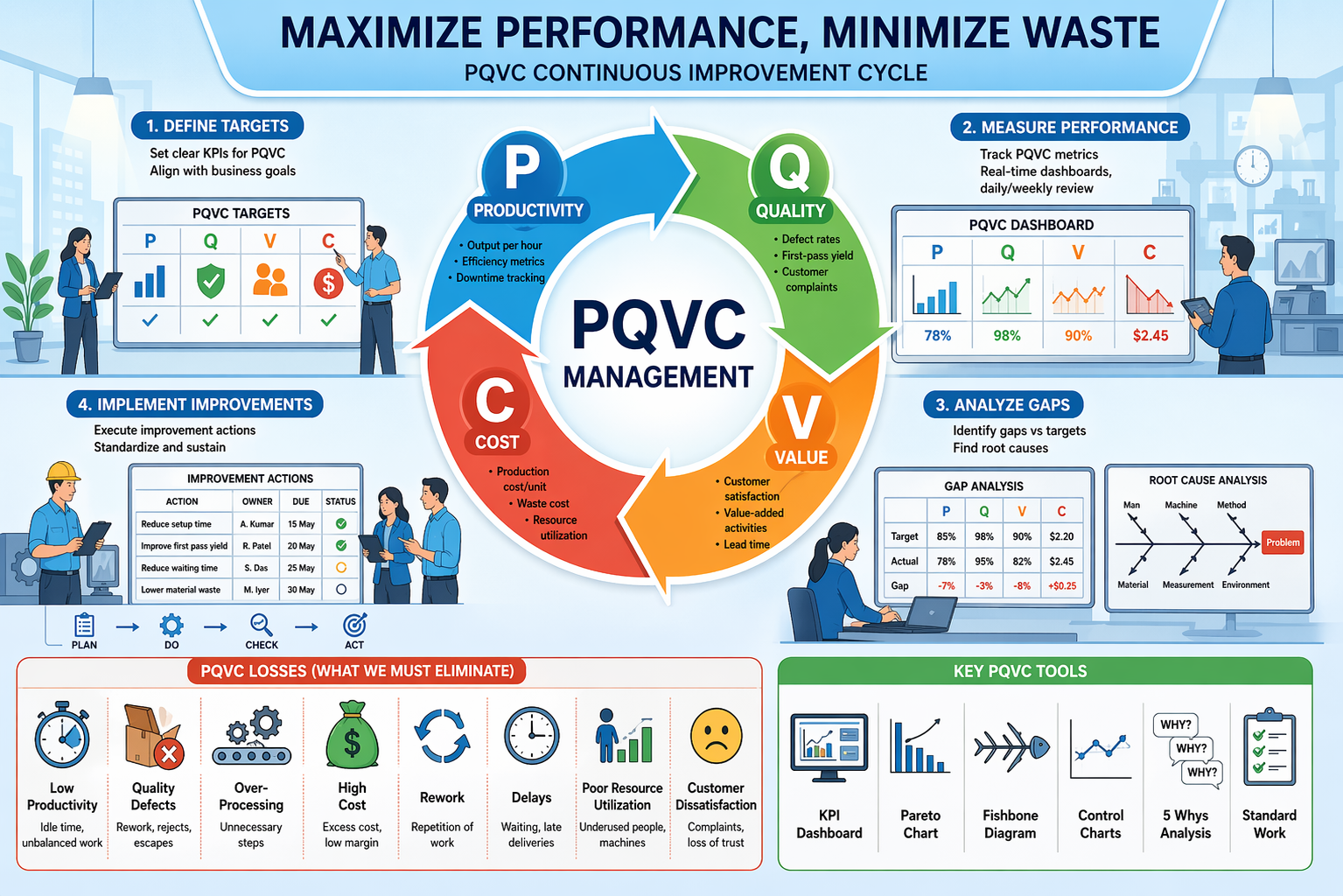
Step-by-Step Visibility: Clear and Structured Performance Monitoring
The strength of a PQVC Board lies in its structured and visual approach to monitoring operations. Teams can clearly track performance metrics, assess quality levels, identify variations, and ensure process control in a single view.
By organizing data into clear sections, organizations can focus on improvements without confusion. This structured visibility supports better planning, communication, and execution.
Real-Time Monitoring and Improvement
PQVC Boards enable continuous, real-time monitoring of key metrics. This allows teams to quickly identify issues, take corrective actions, and improve operational performance.
Real-time insights help organizations stay proactive, ensuring that small deviations are addressed before they impact overall performance.
Core PQVC Elements: Performance, Quality, Variation, and Control
PQVC Boards are built around four key elements—Performance (tracking targets and results), Quality (ensuring standards are met), Variation (identifying gaps or deviations), and Control (maintaining consistency and discipline).
These elements work together to create a balanced system that drives efficiency, quality, and continuous improvement.
Enhancing Accountability and Team Collaboration
PQVC Boards promote accountability by clearly displaying responsibilities and performance outcomes. They improve communication across teams and encourage collaboration, ensuring alignment toward common goals.
This transparent environment empowers employees to take ownership and actively contribute to process improvements.
Why PQVC Board is Important for Businesses
Aligning Operations with Business Goals
PQVC Boards play a critical role in aligning daily operations with organizational objectives.
They simplify complex data into clear visual insights.
This ensures teams stay focused on performance and quality targets.
It also helps maintain consistency across processes.
Ultimately, it improves efficiency and business outcomes.
By aligning activities with strategic goals, organizations can achieve sustainable growth and improved performance.
Improving Operational Visibility
PQVC Boards enhance visibility by providing a real-time overview of performance, quality, and process control.
Teams can quickly identify issues and inefficiencies.
This transparency supports faster problem-solving.
It also improves coordination across departments.
Better visibility leads to quicker and more effective improvements.
Clear insights also support informed decision-making at all levels.
Enhancing Data-Driven Decision-Making
PQVC Boards encourage data-driven decision-making through continuous tracking of key metrics.
Managers can identify trends and variations easily.
This reduces delays and improves responsiveness.
It supports faster and more accurate decisions.
Overall, it boosts operational performance.
Reliable data also helps in forecasting and planning improvements effectively.
Ensuring Standardisation and Process Control
PQVC Boards promote standardization by maintaining consistent monitoring of processes.
This makes performance easier to evaluate and improve.
It supports adherence to quality standards.
Standardized monitoring reduces variability and errors.
Ultimately, it strengthens operational control.
Standardization also creates a strong foundation for scaling and maintaining consistency across teams.
Core Components of PQVC Board
Understanding the PQVC Framework
PQVC Board is built on a structured framework that focuses on monitoring performance and driving continuous improvement.
Key components include Performance tracking, Quality monitoring, Variation analysis, and Control mechanisms.
This framework ensures a systematic approach to operational excellence.
It also promotes accountability and efficiency.
Overall, it creates a culture of continuous improvement.
Organizations using PQVC Boards can consistently refine their processes and achieve better outcomes.
Building a Structured Monitoring System
PQVC Boards help organizations establish a clear and structured system for tracking and improving performance.
Each component supports the next to ensure consistency.
This makes it easier to identify improvement areas.
It also enhances teamwork and collaboration.
Ultimately, it drives sustainable efficiency and performance.
A structured monitoring system ensures improvements are maintained over time rather than being temporary.
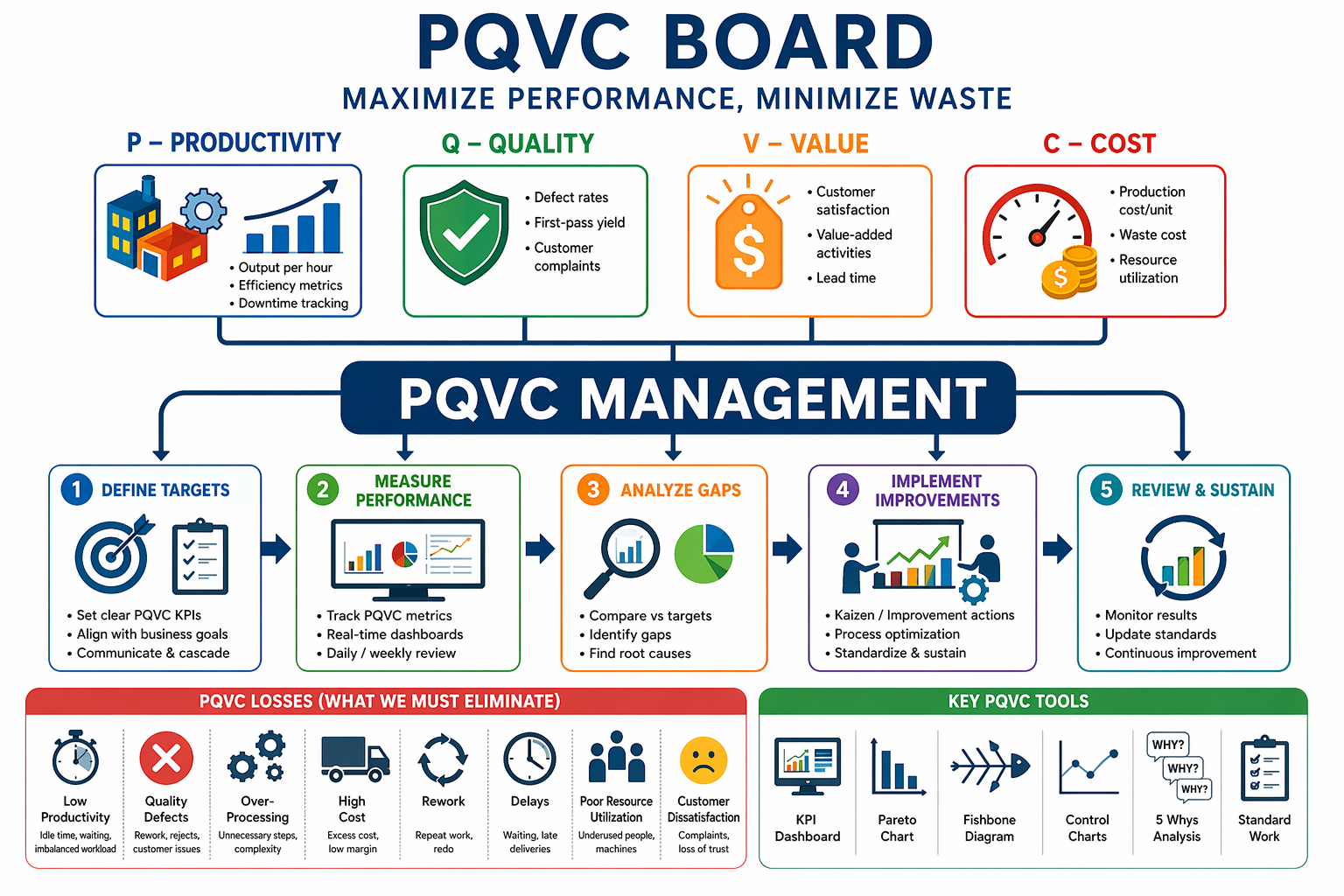
Step-by-Step PQVC Board Implementation: Driving Performance and Control
Implementing a PQVC Board involves a systematic approach to improving performance, maintaining quality, controlling variations, and enhancing operational efficiency. The process begins with defining performance metrics, followed by monitoring quality standards, identifying variations, establishing control mechanisms, and continuously improving processes.
Each step builds a strong foundation for the next, ensuring improvements are sustainable and aligned with business objectives.
Key focus areas include tracking key metrics, identifying deviations, improving process stability, reducing errors, and optimizing overall performance.
With continuous monitoring, organizations can quickly detect issues and take corrective actions.
The structured nature of PQVC Boards ensures better coordination, transparency, and decision-making.
By following a step-by-step PQVC approach, businesses can improve efficiency, maintain quality, and achieve consistent results.
Over time, this leads to a strong culture of continuous improvement where teams actively contribute to performance enhancement and innovation.
Step 2: Monitor Variation and Identify Gaps
Monitoring variation is a critical step in understanding how processes perform under real conditions using a PQVC Board.
It helps organizations visualize deviations from expected performance and identify inconsistencies.
By tracking variation, teams can quickly detect gaps between planned targets and actual outcomes.
This clarity enables faster corrective actions and better control of processes.
It also improves communication by providing a shared understanding of performance issues.
Visual representation of variation simplifies complex data for teams.
Teams can identify trends, recurring issues, and root causes more efficiently.
Additionally, variation tracking supports proactive decision-making.
Regular monitoring ensures continuous process stability and improvement.
Over time, reducing variation leads to more predictable and reliable operations.
Organizations that actively monitor variation can prevent small issues from escalating into major problems.
This step also strengthens data-driven culture and enhances operational discipline.
Step 3: Ensure Quality Standards
Ensuring quality is a core function of the PQVC Board, focusing on maintaining consistent standards across processes.
Organizations track quality metrics such as defects, errors, and compliance levels.
This helps in identifying areas where standards are not being met.
Maintaining quality improves customer satisfaction and trust.
It also reduces rework and operational costs.
Quality monitoring ensures that processes deliver consistent outcomes.
Teams can implement corrective actions quickly when quality issues arise.
This improves overall process reliability.
Continuous quality checks support long-term performance improvements.
Strong quality focus leads to higher efficiency and reduced risks.
Organizations can also use quality insights to improve training and skill development.
This step builds a strong foundation for sustainable growth and operational excellence.
Step 4: Establish Process Control
Process control ensures that operations remain stable, consistent, and aligned with defined standards.
PQVC Boards help teams maintain control by monitoring key metrics and identifying deviations.
This reduces the risk of errors and inefficiencies.
Control mechanisms ensure that improvements are sustained over time.
It also enhances accountability within teams.
Clear control measures improve process discipline.
Organizations can implement standard procedures and checkpoints.
This ensures consistency across different operations.
Process control supports compliance and quality assurance.
Ultimately, it leads to more reliable and predictable outcomes.
Strong control systems enable organizations to scale operations effectively.
They also help in maintaining performance even during changes or disruptions.
Step 5: Drive Continuous Improvement
Continuous improvement is a key objective of implementing a PQVC Board.
Organizations must regularly evaluate performance, quality, variation, and control.
This helps in identifying opportunities for enhancement.
Improvement efforts focus on increasing efficiency and reducing inefficiencies.
Teams are encouraged to contribute ideas and solutions.
Regular reviews ensure consistent progress.
This creates a culture of ongoing development.
Small improvements can lead to significant long-term gains.
Continuous improvement enhances competitiveness and adaptability.
It ensures that organizations remain responsive to changing demands.
Encouraging innovation and learning further strengthens improvement initiatives.
Over time, this approach leads to sustained operational excellence.
Essential PQVC Board Tools and Techniques
PQVC Boards use various tools and techniques to support performance monitoring and improvement.
Common tools include dashboards, visual charts, KPI trackers, and root cause analysis methods.
These tools help in identifying performance gaps and implementing solutions.
They provide structured approaches to managing operations effectively.
Each tool serves a specific purpose within the PQVC framework.
Using the right tools improves overall efficiency.
Training teams on these tools is essential for success.
Consistent use ensures long-term benefits.
These techniques also promote data-driven decision-making.
Advanced tools such as digital dashboards enhance real-time monitoring capabilities.
Organizations can also integrate predictive analytics for better insights.
This strengthens the overall effectiveness of PQVC implementation.
Key Performance Indicators in PQVC Board
KPIs are essential for measuring the effectiveness of a PQVC Board.
They provide insights into performance, quality, variation, and control.
Common KPIs include productivity rates, defect levels, deviation trends, and process stability.
These metrics help identify improvement areas.
Regular monitoring ensures alignment with goals.
KPIs support data-driven decisions.
They improve transparency and accountability.
Organizations can track progress over time.
This leads to better outcomes and efficiency.
Clearly defined KPIs also help teams stay focused on priorities.
They enable benchmarking and performance comparison.
Effective KPI management drives continuous improvement and success.
Standardizing Processes Using PQVC Board
Standardization ensures consistency and efficiency in operations using PQVC Boards.
It involves defining clear processes and maintaining them across teams.
Standard processes reduce variation and improve quality.
They make training and onboarding easier.
Clear standards improve execution and understanding.
Standardization supports long-term improvements.
It provides a baseline for optimization.
Organizations can refine standards continuously.
This ensures operational stability.
Consistent processes also improve collaboration and coordination.
They help maintain performance even during growth or scaling.
Standardization strengthens control and efficiency across the organization.
Digital Transformation in PQVC Board Management
Digital transformation enhances PQVC Boards by integrating modern technology into performance management.
Digital tools provide real-time data and improved visibility.
This enables faster and more accurate decision-making.
Automation reduces manual effort and errors.
Cloud-based systems improve accessibility and collaboration.
Digital PQVC Boards support scalability and flexibility.
They enhance tracking and reporting capabilities.
Organizations can leverage analytics for better insights.
Overall, digital transformation strengthens PQVC implementation.
It allows organizations to respond quickly to changes.
Digital systems improve transparency and connectivity.
Over time, technology-driven PQVC Boards drive efficiency and innovation.
Integrating PQVC Board with Existing Systems
Integrating a PQVC Board with existing systems ensures seamless data flow across the organization.
It eliminates information silos and improves overall coordination.
Integration enables better tracking of performance, quality, variation, and control metrics.
Real-time data sharing enhances responsiveness and decision-making.
Organizations can align PQVC practices with business strategies effectively.
This improves operational efficiency and performance.
Integration supports scalability as the organization grows.
It ensures consistency across different departments.
Ultimately, it drives continuous improvement.
Integrated systems allow organizations to monitor operations holistically.
They also improve collaboration between cross-functional teams.
This alignment ensures all teams work toward shared goals.
Additionally, integration with ERP and digital tools enhances reporting accuracy.
It also reduces manual errors and improves data reliability.
Over time, integrated PQVC systems create a more connected and efficient work environment.
Detailed Steps to Implement PQVC Board Successfully
Successful PQVC Board implementation requires a structured and systematic approach.
Organizations must define clear performance and quality goals.
Teams should be trained on PQVC concepts and usage.
Leadership support is essential to drive adoption.
Continuous monitoring ensures progress and improvement.
Employee involvement increases engagement and ownership.
Regular reviews help identify challenges and opportunities.
Clear communication ensures alignment across teams.
Organizations should focus on sustainability and long-term success.
This ensures consistent benefits over time.
Developing a clear implementation roadmap improves effectiveness.
Organizations should also invest in digital tools for better tracking.
Feedback loops help refine processes continuously.
Setting measurable KPIs ensures accountability and progress tracking.
Over time, structured implementation leads to strong operational discipline.
Common Challenges in PQVC Board Implementation
Organizations may face several challenges when implementing a PQVC Board.
Resistance to change is one of the most common issues.
Employees may hesitate to adopt new monitoring systems.
Lack of training can impact effectiveness.
Maintaining consistency across teams can be difficult.
Data accuracy and reliability may also be concerns.
Clear communication helps overcome these challenges.
Leadership support is critical for successful adoption.
Regular training improves understanding and usage.
Overcoming challenges leads to better results.
Organizations must also address cultural barriers to ensure acceptance.
Providing continuous support helps teams adapt more effectively.
Building a collaborative environment reduces resistance.
Strong change management strategies improve implementation success.
Over time, overcoming these challenges strengthens organizational performance.
Role of Leadership in PQVC Board Management
Leadership plays a vital role in the successful implementation of a PQVC Board.
Leaders define direction and set clear expectations.
They ensure alignment with organizational goals.
Strong leadership promotes accountability and transparency.
Regular performance reviews help identify improvements.
Leaders provide training and support to teams.
They encourage collaboration and innovation.
This drives long-term success and sustainability.
Leaders also play a key role in building a performance-driven culture.
They must lead by example and actively participate in reviews.
Effective leadership ensures consistent use of PQVC Boards.
It also motivates teams to achieve higher performance standards.
Strong leadership fosters trust, engagement, and continuous improvement.
Over time, leadership commitment ensures long-term success.
Driving Continuous Improvement with PQVC Board
Continuous improvement is a core objective of PQVC Board implementation.
Organizations must regularly evaluate performance, quality, variation, and control.
This helps identify opportunities for improvement.
Teams are encouraged to suggest and implement solutions.
Regular feedback supports ongoing progress.
Continuous improvement drives innovation and efficiency.
It ensures adaptability to changing business needs.
This creates a culture of operational excellence.
Small improvements lead to significant long-term gains.
Organizations can use structured methods to support improvements.
This approach ensures improvement becomes part of daily operations.
Consistent monitoring ensures sustained results.
Over time, continuous improvement enhances competitiveness.
It also ensures better customer satisfaction and performance outcomes.
Enhancing Workforce Engagement through PQVC Board
PQVC Boards improve workforce engagement by involving employees in performance tracking and improvement.
Employees clearly understand their roles and responsibilities.
This increases accountability and motivation.
Transparent data improves communication.
Team collaboration is strengthened.
Recognition of performance boosts morale.
Employees feel empowered to contribute ideas.
This leads to better outcomes and innovation.
Engaged employees are more productive and committed.
Organizations should encourage feedback and participation.
This improves job satisfaction and performance.
A strong engagement culture leads to higher retention.
It also fosters innovation and continuous improvement.
Over time, engaged teams drive organizational success.
Benefits of Using PQVC Board
PQVC Boards improve visibility and control over operations.
They enhance performance monitoring and quality management.
Organizations can quickly identify and address issues.
This reduces inefficiencies and operational risks.
Decision-making improves with real-time data.
PQVC Boards support continuous improvement.
This leads to long-term success.
Organizations become more efficient and competitive.
They also improve customer satisfaction.
PQVC Boards help reduce errors and improve consistency.
They enable better resource utilization.
Overall, they support sustainable growth.
Organizations can achieve higher productivity and performance.
Over time, PQVC Boards create a culture of excellence.
Future Trends in PQVC Board Management
The future of PQVC Boards is driven by digital transformation and advanced analytics.
Organizations are adopting real-time dashboards and automation tools.
Predictive analytics will improve performance monitoring.
PQVC systems will become more data-driven.
Integration with advanced technologies will increase efficiency.
Organizations will become more agile and responsive.
Continuous innovation will drive growth.
PQVC Boards will remain essential for operational excellence.
Artificial intelligence will enhance data analysis capabilities.
Machine learning will help predict and prevent issues.
Organizations will use insights for proactive decision-making.
This will lead to smarter and faster operations.
Future PQVC Boards will be more interactive and user-friendly.
Over time, technology will further strengthen performance management systems.