What is 3M in Lean Manufacturing? Understanding 3M in Lean Six Sigma
Introduction to the 3M Concept in Lean
In Lean manufacturing and Lean Six Sigma, the concept of 3M refers to three major sources of inefficiency that prevent organisations from achieving optimal productivity and quality. The three elements are Muda (Waste), Mura (Unevenness), and Muri (Overburden). These principles help businesses identify operational problems that slow down production, create unnecessary costs, and reduce overall efficiency. Understanding and addressing these three issues is a key step in building a more streamlined and effective workflow.
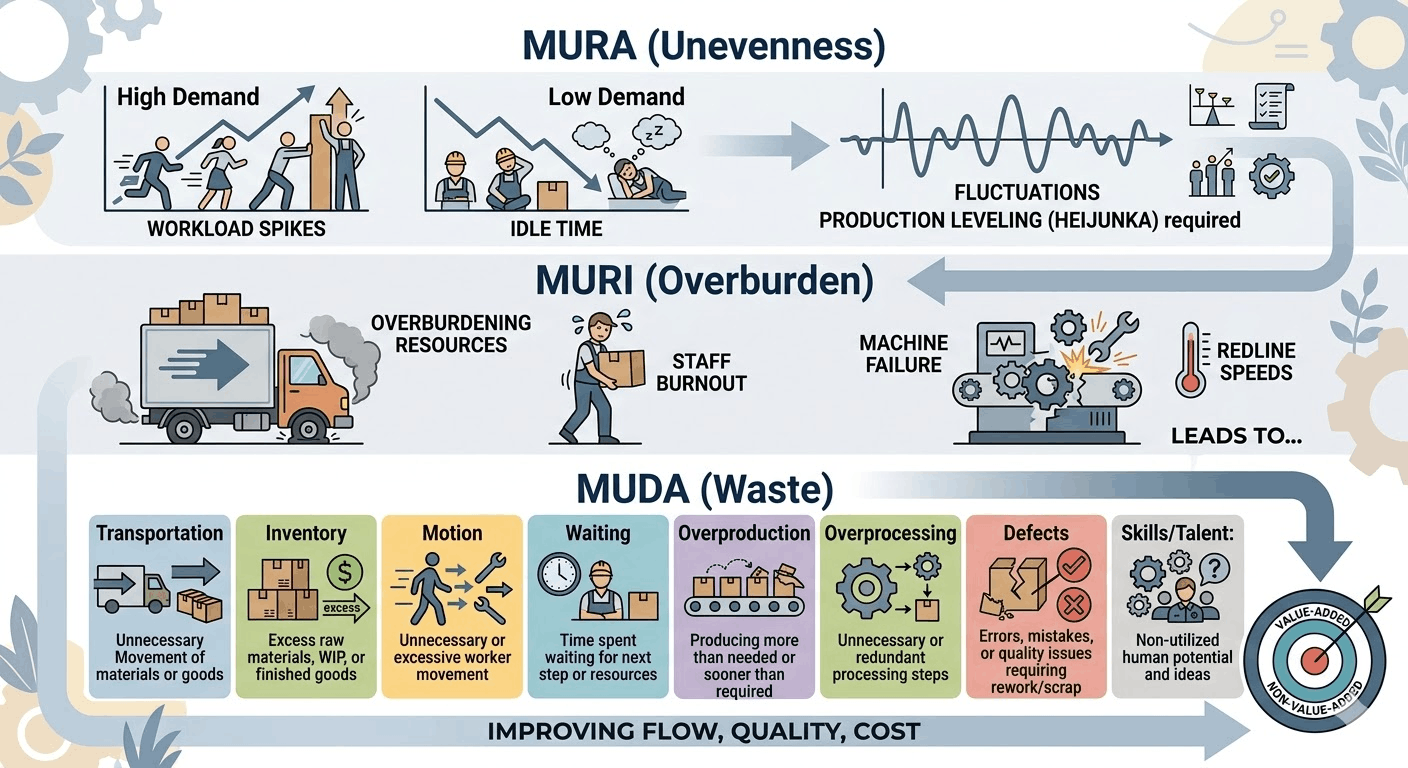
Muda: Eliminating Waste from Processes
Muda represents activities that consume resources but do not add value to the final product or service. In Lean thinking, removing waste is essential for improving efficiency and reducing operational costs. Examples of Muda include excess inventory, unnecessary movement, waiting time, overproduction, and product defects. By identifying and eliminating these non-value-adding activities, organisations can create smoother processes and deliver greater value to customers.
Mura: Addressing Unevenness in Workflow
Mura refers to irregularities or inconsistencies in production schedules, workloads, or demand. When work processes are uneven, some teams may be overloaded while others remain idle, leading to bottlenecks and delays. Lean systems aim to balance workloads and create consistent flows of work so that operations remain stable and predictable.
Muri: Preventing Overburden on People and Machines
Muri occurs when employees, equipment, or systems are pushed beyond their reasonable capacity. Overburden can lead to employee fatigue, increased error rates, machine breakdowns, and reduced product quality. Lean manufacturing encourages organisations to design processes that match the realistic capabilities of their workforce and equipment, ensuring sustainable productivity over time.
Why Understanding 3M Matters in Lean Six Sigma
By addressing Muda, Mura, and Muri, organisations can build more efficient, balanced, and reliable processes. Eliminating these three sources of inefficiency improves productivity, reduces waste, enhances product quality, and supports continuous improvement. In Lean Six Sigma environments, the 3M framework serves as a powerful foundation for identifying operational challenges and driving long-term performance improvements.
Understanding 3M in Lean Six Sigma
Why the 3M Concept Matters
In Lean Six Sigma, the concept of 3M helps organisations identify the root causes of inefficiency within their processes. The three elements—Muda (Waste), Mura (Unevenness), and Muri (Overburden)—represent common operational problems that reduce productivity, increase costs, and affect product quality. By recognising and addressing these issues, organisations can streamline workflows and create more reliable production systems.
How 3M Supports Continuous Improvement
The 3M framework plays an important role in continuous improvement initiatives. It encourages teams to examine their processes carefully and identify activities that do not add value. When organisations actively reduce waste, balance workloads, and prevent overburden, they create smoother operations and reduce the likelihood of errors or delays.
Connecting 3M with Lean Six Sigma Principles
Lean Six Sigma focuses on improving efficiency while maintaining high levels of quality. The 3M approach supports this goal by highlighting the conditions that often lead to defects or inefficiencies. Eliminating waste, stabilising workflows, and protecting employees and equipment from excessive strain helps maintain consistent performance across production systems.
Building a Stronger Operational Culture
Understanding and applying the 3M concept encourages teams to take responsibility for improving their work environments. Employees become more aware of inefficiencies and are more likely to suggest improvements. Over time, this awareness helps build a culture that values efficiency, collaboration, and continuous process improvement.
Muda: Identifying and Eliminating Waste in Processes
Understanding the Meaning of Muda
Muda refers to any activity that consumes resources but does not add value to the final product or service. In Lean manufacturing, waste is considered one of the biggest barriers to efficiency. Identifying and removing unnecessary actions allows organisations to improve productivity, reduce costs, and deliver greater value to customers.
Common Sources of Waste in Operations
Waste can appear in many forms across manufacturing and service processes. Examples include excess inventory, unnecessary movement of materials, waiting time between tasks, defects that require rework, and overproduction beyond customer demand. Each of these issues consumes time, labour, and resources without contributing to the final outcome.
Improving Efficiency Through Waste Reduction
By focusing on eliminating Muda, organisations can create smoother workflows and more efficient operations. Removing unnecessary steps simplifies processes and reduces delays, allowing teams to complete tasks more effectively. This improvement not only reduces operational costs but also enhances customer satisfaction.
Encouraging Teams to Identify Waste
Employees who work directly with processes are often best positioned to spot waste. Encouraging their participation in improvement initiatives helps organisations uncover hidden inefficiencies. When teams are actively involved in identifying and removing waste, continuous improvement becomes a natural part of everyday work.
The Seven Types of Muda (Waste) in Lean Manufacturing
Recognising the Seven Categories of Waste
Lean manufacturing traditionally identifies seven major types of waste that affect operational efficiency. Understanding these categories helps organisations recognise where improvements can be made and which processes require attention.
Overproduction and Waiting
Overproduction occurs when items are produced before they are needed, leading to excess inventory and increased storage costs. Waiting happens when workers or machines remain idle due to delays in materials, information, or workflow coordination.
Transportation, Motion, and Inventory
Transportation waste refers to unnecessary movement of materials between locations. Motion involves excessive physical movement by workers that does not contribute to value creation. Inventory waste occurs when organisations store more materials or products than required.
Defects and Overprocessing
Defects lead to rework, scrap, or customer dissatisfaction. Overprocessing happens when extra work is performed that does not increase the product’s value. By identifying these wastes, organisations can redesign processes to operate more efficiently.
Mura: Understanding Unevenness in Workflow and Production
What Causes Mura in Operations
Mura refers to unevenness or inconsistency in workflow, demand, or production schedules. It often arises when workloads fluctuate dramatically, causing periods of intense activity followed by periods of inactivity. This imbalance disrupts efficiency and increases the risk of delays.
The Impact of Uneven Workflows
When production is uneven, resources may not be used efficiently. Some employees may be overloaded while others have little work to do. Machines may also experience inconsistent usage, which can lead to scheduling challenges and reduced productivity.
Creating a Balanced Production Flow
Lean practices aim to reduce Mura by balancing workloads and maintaining a consistent pace of work. Techniques such as demand forecasting, production leveling, and improved scheduling help ensure that tasks are distributed evenly across teams and resources.
Benefits of Reducing Mura
When unevenness is minimised, operations become more predictable and stable. Teams can plan their work more effectively, and production systems run more smoothly. This stability ultimately leads to improved quality, lower operational costs, and better customer satisfaction.
Muri: Avoiding Overburden on Employees and Machines
Understanding the Concept of Muri
Muri refers to overburden or excessive stress placed on employees, equipment, or systems. When work demands exceed reasonable limits, it can lead to fatigue, mistakes, and operational breakdowns.
Common Causes of Overburden
Overburden often occurs when organisations attempt to increase productivity without adjusting resources or processes. Tight deadlines, unrealistic expectations, and insufficient staffing can push employees and machines beyond their capacity.
Protecting Workforce Well-Being
Lean manufacturing encourages organisations to design processes that match realistic capabilities. By distributing tasks evenly and maintaining manageable workloads, companies protect employee well-being and reduce the risk of errors or accidents.
Maintaining Equipment Reliability
Avoiding Muri also protects machinery and production systems. When equipment operates within its intended limits, it experiences less wear and tear. This reduces maintenance costs, prevents breakdowns, and ensures smoother production operations.
How Muda, Mura, and Muri Work Together in Lean Systems
The Interconnected Nature of the 3M
Muda, Mura, and Muri are closely connected within Lean systems. When uneven workloads occur, employees or machines may become overburdened, leading to mistakes and wasted resources. Similarly, waste can increase when processes are not properly balanced.
Understanding Cause and Effect
For example, inconsistent production schedules (Mura) can force workers to rush during busy periods, causing overburden (Muri). This pressure may lead to defects or unnecessary work, which then creates waste (Muda). Addressing only one issue may not solve the entire problem.
Improving Processes Holistically
Lean organisations examine all three elements together to create balanced and efficient processes. By stabilising workflows, reducing wasteful activities, and protecting employees from excessive workloads, companies can achieve sustainable improvements.
Supporting Long-Term Operational Stability
When the three sources of inefficiency are managed effectively, operations become more reliable and easier to control. This holistic approach strengthens productivity, enhances quality, and supports continuous improvement initiatives across the organisation.
The Impact of 3M on Productivity, Quality, and Operational Efficiency
Improving Overall Productivity
Addressing the 3M principles significantly improves productivity. By eliminating waste, balancing workflows, and avoiding overburden, organisations can complete tasks more efficiently. Employees spend more time on value-adding activities, which increases output and reduces delays.
Enhancing Product and Service Quality
Reducing Muri and Mura helps create more stable working conditions. When employees are not overloaded and processes run consistently, the risk of defects decreases. This stability improves both product quality and customer satisfaction.
Strengthening Operational Efficiency
Efficient operations require clear processes, balanced workloads, and minimal waste. By focusing on the 3M framework, organisations can streamline production systems, reduce unnecessary costs, and improve resource utilisation.
Supporting Sustainable Growth
Over time, organisations that actively manage Muda, Mura, and Muri build stronger operational foundations. These improvements create an environment where innovation, efficiency, and continuous improvement can thrive, supporting long-term business success.
How to Identify 3M in Manufacturing and Service Processes
Observing Daily Workflows
Identifying the 3M begins with closely observing everyday processes. Managers and team members should watch how tasks are performed, noting delays, unnecessary steps, or uneven workloads that may indicate inefficiencies.
Using Data to Detect Patterns
Performance data can reveal patterns that highlight waste, unevenness, or overburden. For example, frequent delays may signal workflow imbalance, while recurring equipment failures could suggest excessive strain on machinery.
Encouraging Employee Feedback
Employees who interact directly with processes often have valuable insights. Encouraging open discussions and improvement suggestions helps uncover inefficiencies that may not be immediately visible to management.
Conducting Regular Process Reviews
Routine process evaluations help organisations identify emerging problems early. By reviewing workflows regularly, teams can detect signs of Muda, Mura, or Muri and implement improvements before they escalate.
Lean Tools Used to Eliminate Muda, Mura, and Muri
Applying Structured Improvement Methods
Lean manufacturing provides several tools that help organisations address the three sources of inefficiency. These tools guide teams in analysing workflows, identifying waste, and designing more efficient processes.
Using Value Stream Mapping
Value stream mapping helps visualise the entire production process from start to finish. By mapping each step, organisations can identify delays, unnecessary activities, and uneven workloads that contribute to Muda, Mura, or Muri.
Implementing Standardised Work
Standardised work ensures that tasks are performed consistently and efficiently. Clear procedures reduce variation, minimise errors, and help maintain balanced workloads across teams.
Supporting Continuous Improvement Initiatives
Lean tools work best when combined with a culture of continuous improvement. Regular reviews, employee involvement, and structured problem-solving techniques help organisations maintain efficient and sustainable processes.
The Role of Leadership in Reducing 3M in Organisations
Setting the Direction for Improvement
Leadership plays a vital role in addressing the 3M within organisations. Leaders establish the vision for efficiency and continuous improvement, ensuring that teams understand the importance of eliminating waste and balancing workloads.
Providing Resources and Support
Effective leaders ensure that employees have the resources and training required to identify and solve operational problems. This support empowers teams to participate actively in improvement initiatives.
Encouraging Collaboration Across Teams
Reducing inefficiencies often requires cooperation between departments. Leaders who encourage collaboration help break down silos and create an environment where teams work together to solve problems.
Maintaining Long-Term Commitment
Addressing Muda, Mura, and Muri is not a one-time effort. Leaders must maintain consistent focus on improvement, regularly reviewing processes and encouraging employees to identify new opportunities for efficiency.
Using Continuous Improvement to Prevent 3M
Understanding Continuous Improvement
Continuous improvement is a core principle of Lean and Lean Six Sigma. It focuses on making small, consistent enhancements to processes over time, preventing inefficiencies from developing.
Encouraging Incremental Changes
Instead of waiting for large problems to occur, organisations should encourage employees to make incremental improvements whenever opportunities arise. Small changes can gradually eliminate waste and stabilise workflows.
Creating a Problem-Solving Culture
A culture that encourages questioning existing processes helps identify inefficiencies early. Teams should feel comfortable suggesting improvements and discussing challenges openly.
Maintaining Process Stability
Continuous improvement ensures that operations remain stable and efficient. By regularly evaluating processes and addressing emerging issues, organisations can prevent the recurrence of Muda, Mura, and Muri.
Encouraging Employee Participation in Eliminating Waste
Recognising the Value of Employee Insights
Employees often have firsthand knowledge of inefficiencies within their daily tasks. Encouraging their participation in improvement initiatives helps organisations uncover hidden opportunities to reduce waste and improve workflows.
Creating Channels for Suggestions
Suggestion programs, team meetings, and improvement workshops allow employees to share their ideas openly. These channels ensure that valuable insights are captured and considered during process improvements.
Providing Recognition and Support
Recognising employees who contribute improvement ideas motivates others to participate as well. Positive reinforcement strengthens engagement and reinforces the importance of continuous improvement.
Building a Collaborative Improvement Environment
When employees feel that their contributions are valued, they become more committed to improving processes. This collaborative approach helps organisations eliminate waste, stabilise workflows, and create more efficient operations.
Benefits of Eliminating 3M in Lean Six Sigma Practices
Reducing Operational Costs
Removing waste, unevenness, and overburden significantly reduces operational costs. Efficient processes require fewer resources, minimise errors, and improve overall productivity.
Improving Employee Satisfaction
Balanced workloads and well-designed processes reduce stress on employees. When teams operate in a supportive and efficient environment, job satisfaction and morale improve.
Enhancing Customer Value
Efficient production systems allow organisations to deliver products and services more quickly and reliably. Customers benefit from improved quality, shorter lead times, and more consistent results.
Strengthening Competitive Advantage
Companies that effectively eliminate inefficiencies gain a strong competitive advantage. Their ability to produce high-quality outputs efficiently helps them remain responsive and successful in competitive markets.
Applying 3M Principles Beyond Manufacturing
Extending Lean Thinking to Service Industries
Although the 3M concept originated in manufacturing, it is equally valuable in service industries. Offices, healthcare systems, logistics operations, and digital services can all experience waste, uneven workflows, and overburden.
Improving Administrative Processes
Administrative tasks such as approvals, documentation, and communication often contain inefficiencies. Applying 3M principles helps organisations simplify these processes and improve productivity.
Enhancing Customer Service Operations
Service organisations can reduce waiting times, improve scheduling, and balance workloads by addressing Muda, Mura, and Muri. This leads to better customer experiences and more reliable service delivery.
Supporting Digital Transformation and Innovation
Modern organisations that combine Lean principles with digital tools can monitor workflows more effectively and identify inefficiencies quickly. Applying the 3M framework ensures that innovation focuses on creating efficient, balanced, and sustainable processes.