What is SQCDP Daily Visual Management Board- A Guide
Introduction to SQCDP Visual Management
In modern operational environments, the SQCDP (Safety, Quality, Cost, Delivery, People) Daily Visual Management Board is a structured framework used to track and improve daily performance.
It provides a clear and visual way to monitor key metrics, identify issues, and ensure alignment with organisational goals.
SQCDP boards support a culture of continuous improvement by making performance visible, measurable, and actionable.
By presenting information in a simple and accessible format, teams can quickly understand priorities and respond effectively to challenges as they arise.
This approach reduces complexity and ensures that performance management becomes part of everyday operations rather than a periodic activity.
Visual Management Approach
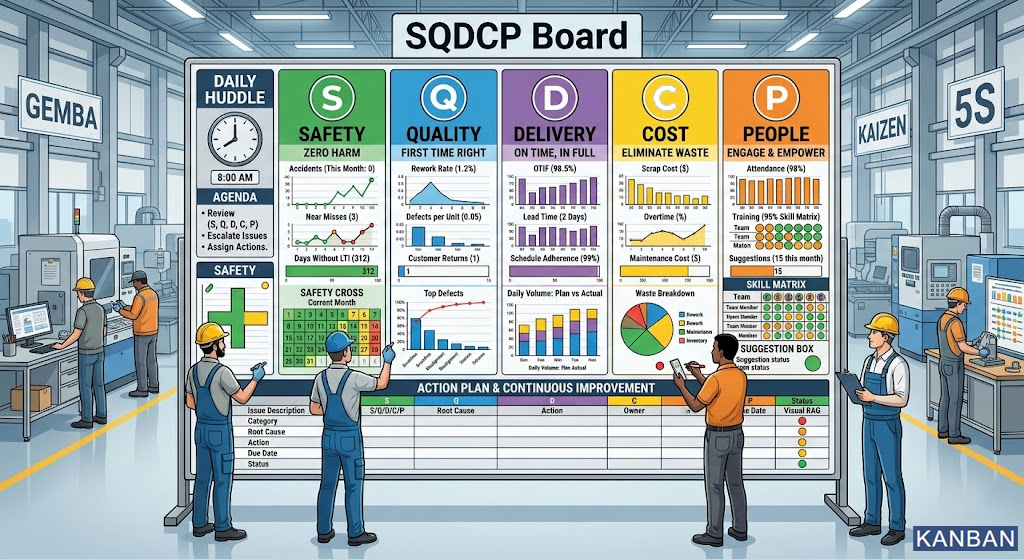
The SQCDP board displays critical performance indicators across safety, quality, cost, delivery, and people.
This visual approach helps teams quickly understand performance status and take immediate action when needed.
Colour coding, charts, and simple indicators are often used to highlight issues and priorities clearly.
This makes it easier for both management and frontline staff to stay aligned and informed at all times.
Daily Tracking and Performance Review
Digital SQCDP boards allow real-time updates, while physical boards are updated during daily meetings.
Both methods ensure consistent monitoring and encourage team accountability.
Regular reviews provide an opportunity to discuss performance openly and identify areas for improvement.
This routine fosters discipline and ensures that issues are addressed before they escalate.
Core Elements of SQCDP
The five pillars—Safety, Quality, Cost, Delivery, and People—provide a balanced view of operations.
Each element contributes to improving efficiency, reducing risks, and enhancing overall performance.
Focusing on these areas ensures that organisations do not overlook critical aspects of their operations.
Together, they create a comprehensive framework for sustainable growth and operational excellence.
Improving Accountability and Engagement
SQCDP boards clearly display targets, results, and responsibilities.
This transparency encourages ownership, improves communication, and strengthens team collaboration.
Employees become more engaged when they can see how their work contributes to overall performance.
This leads to a more proactive workforce and a stronger culture of continuous improvement.
Why SQCDP Daily Visual Management Board- A Guides Matter
Aligning Daily Work with Business Goals
SQCDP boards connect daily operations with strategic objectives.
They simplify complex performance data into clear insights.
This ensures teams stay focused on key priorities.
Alignment improves consistency and long-term results.
It also helps organisations maintain direction and avoid unnecessary deviations from their goals.
Improving Visibility of Performance
SQCDP provides instant visibility into operational performance.
Teams can quickly identify gaps and inefficiencies.
This leads to faster decisions and timely corrective actions.
Improved visibility also enhances accountability across all levels of the organisation.
It ensures that performance issues are not overlooked or ignored.
Supporting Data-Driven Decisions
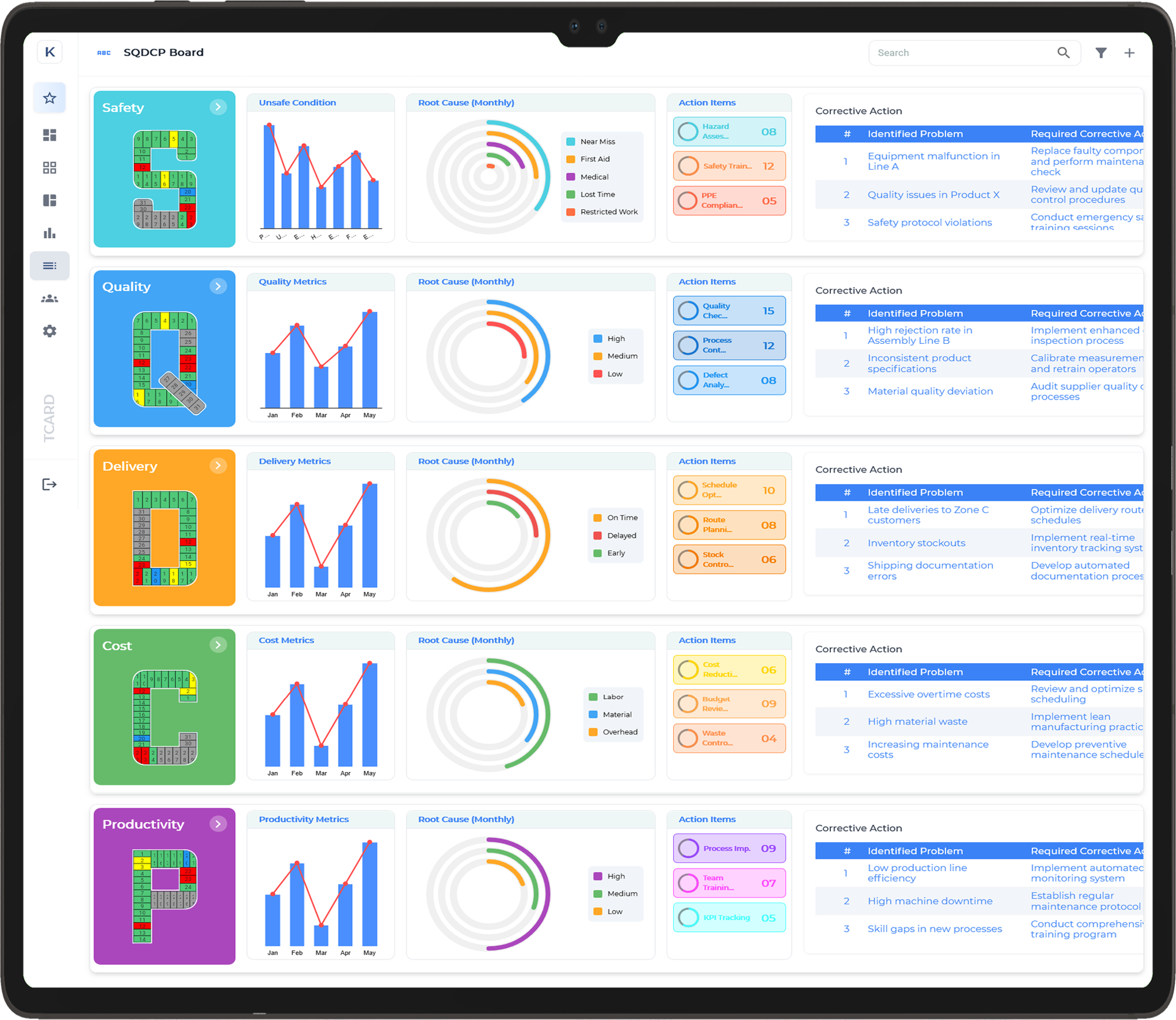
Digital SQCDP systems offer real-time data and analytics.
Managers can track trends and address issues proactively.
Physical boards support structured team discussions.
Both methods strengthen continuous improvement.
Data-driven insights help organisations make informed decisions rather than relying on assumptions.
Ensuring Standardization
SQCDP promotes consistent processes and monitoring.
It reduces variation and improves quality outcomes.
Standardization supports scalability and control.
It also ensures that best practices are followed across different teams and departments.
This consistency is essential for maintaining high performance over time.
How to Implement SQCDP Daily Visual Management Board- A Guide
Implementing an SQCDP board starts with defining key performance indicators across Safety, Quality, Cost, Delivery, and People.
Organisations should choose between physical boards, digital tools, or a hybrid approach based on operational requirements.
The board should be placed in a visible location for easy team access and engagement.
Employee training is essential to ensure proper understanding and consistent usage.
Daily or regular review meetings should be conducted to monitor performance, identify root causes, and take corrective actions.
It is also important to establish clear ownership for each metric to ensure accountability and follow-through.
Organisations should continuously review and refine their SQCDP processes to adapt to changing business needs.
Over time, SQCDP boards help build a culture of transparency, accountability, and continuous improvement, leading to better operational performance.
This structured approach ultimately supports long-term growth, improved efficiency, and sustained competitive advantage.
Safety Tracking in SQCDP Daily Visual Management Board- A Guide
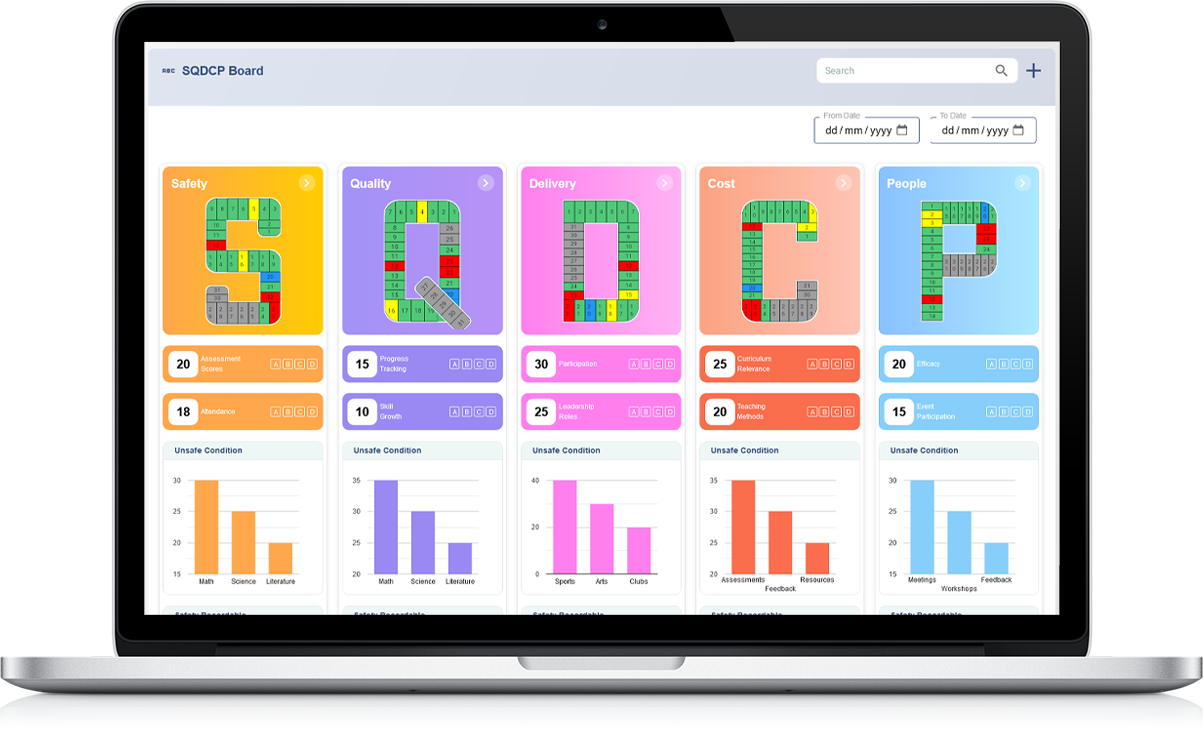
Safety is the first and most important pillar of the SQCDP Daily Visual Management Board- A Guide, forming the foundation of all operational activities.
Organisations use SQCDP boards to track safety metrics such as incidents, near misses, and unsafe conditions in a structured and visible way.
This consistent monitoring helps teams identify risks early and take preventive action before issues escalate.
By making safety performance visible, organisations promote a proactive and responsible workplace culture.
Clear safety tracking also improves awareness and accountability at every level.
Regular reviews of safety data ensure that risk management remains a continuous priority.
Teams can respond quickly to hazards and implement corrective measures effectively.
Ongoing monitoring helps identify recurring issues and supports long-term prevention strategies.
Over time, this leads to improved compliance and a safer working environment.
Strong safety performance reduces disruptions and enhances overall operational stability.
Cost Monitoring Using SQCDP Boards
Cost is a key component of the SQCDP Daily Visual Management Board- A Guide, focusing on efficient use of resources and financial performance.
Organisations track actual costs against planned targets to identify inefficiencies and areas for improvement.
This structured visibility enables better financial control and supports informed decision-making.
Reducing waste and optimising resource utilisation are central to effective cost management.
Improved cost awareness helps teams maintain budget discipline.
Regular monitoring of cost data allows organisations to respond quickly to financial challenges.
Teams can identify opportunities for cost savings and process improvements.
Better cost control contributes directly to profitability and long-term sustainability.
Continuous evaluation ensures that financial performance remains consistent.
Strong cost management supports overall operational efficiency and growth.
Quality and Delivery Tracking in SQCDP
Quality and delivery are critical elements of the SQCDP Daily Visual Management Board- A Guide, directly influencing customer satisfaction.
Organisations track defects, rework, and delivery performance to maintain high standards.
Comparing actual performance with targets helps ensure consistency and reliability.
This structured approach enables early identification of issues and supports timely corrective action.
Maintaining quality and delivery performance is essential for operational success.
Regular monitoring helps identify bottlenecks and inefficiencies in processes.
Improving quality reduces waste, rework, and associated costs.
Reliable delivery ensures that customer expectations are consistently met.
Continuous improvement in these areas strengthens overall performance.
Strong quality and delivery management enhances customer trust and satisfaction.
Driving Continuous Improvement Through SQCDP
The SQCDP Daily Visual Management Board- A Guide is designed to drive continuous improvement by providing clear visibility of performance.
It enables teams to identify gaps, analyse root causes, and implement corrective actions systematically.
Regular reviews ensure that improvements are tracked and sustained over time.
This structured approach promotes consistency and operational discipline.
Continuous improvement becomes part of daily activities rather than a separate initiative.
Teams are encouraged to take ownership of performance and contribute to improvements.
Data-driven insights support better decision-making and prioritisation.
Ongoing monitoring ensures that progress is maintained.
Small, consistent improvements lead to significant long-term benefits.
This approach strengthens organisational performance and competitiveness.
Enhancing Customer Focus with SQCDP Boards
Customer focus is a key outcome of the SQCDP Daily Visual Management Board- A Guide, ensuring that operations align with customer expectations.
Organisations monitor feedback, complaints, and service performance as part of their tracking process.
This helps identify areas for improvement and ensures prompt response to customer needs.
Maintaining a strong customer focus supports long-term relationships and trust.
It also ensures that quality and delivery standards remain consistent.
Insights from customer data help refine processes and improve performance.
Teams can adapt quickly to changing requirements and expectations.
Consistent service delivery enhances customer experience and satisfaction.
Continuous focus on customers drives business growth and competitiveness.
This strengthens brand reputation and customer loyalty over time.
Tools and Techniques for SQCDP Implementation
Successful implementation of the SQCDP Daily Visual Management Board- A Guide requires the use of structured tools and techniques.
Visual management tools display performance metrics clearly and effectively.
Digital systems provide real-time data, analytics, and reporting capabilities.
Standard templates ensure consistency in tracking and communication.
These tools simplify performance management and improve accuracy.
Training ensures that teams understand how to use these tools effectively.
Advanced analytics provide deeper insights into operational performance.
Structured methodologies improve efficiency and reduce errors.
Combining different tools enhances overall effectiveness.
This integrated approach supports continuous improvement initiatives.
Key KPIs in SQCDP Boards
Key performance indicators (KPIs) are essential for measuring the effectiveness of the SQCDP Daily Visual Management Board- A Guide.
Common KPIs include safety incidents, quality defects, delivery performance, cost efficiency, and employee engagement.
These metrics provide a clear and measurable view of operational performance.
Teams can identify gaps and take corrective actions based on this data.
Well-defined KPIs ensure alignment with organisational goals.
Regular monitoring improves transparency and accountability.
Trend analysis helps predict future performance and potential risks.
Clear metrics enable teams to focus on priorities.
Consistent KPI tracking supports informed decision-making.
Effective KPI management drives continuous improvement.
Standardizing Processes with SQCDP
Standardisation is essential for sustaining improvements within the SQCDP Daily Visual Management Board- A Guide.
It ensures that processes are consistent across teams and departments.
Clear standards reduce variability, errors, and inefficiencies.
This leads to improved quality and operational stability.
Standardisation provides a foundation for continuous improvement.
Consistent processes simplify training and execution.
They establish a baseline for measuring progress.
Organisations can refine and optimise processes over time.
Standardisation supports scalability and long-term growth.
It strengthens operational control and governance.
Role of Digital Transformation in SQCDP Systems
Digital transformation enhances the SQCDP Daily Visual Management Board- A Guide by improving data visibility and accuracy.
Real-time tracking enables faster and more effective decision-making.
Automation reduces manual effort and minimises errors.
Cloud-based systems improve accessibility and collaboration.
This makes performance data available to all relevant stakeholders.
Advanced analytics provide deeper insights into trends and performance.
Technology supports predictive and proactive improvements.
Digital tools enable flexibility and scalability.
This improves overall operational efficiency.
Digital transformation accelerates continuous improvement efforts.
Integrating SQCDP with Business Systems
Integrating the SQCDP Daily Visual Management Board- A Guide with business systems ensures seamless data flow across the organisation.
This eliminates data silos and improves coordination between departments.
Real-time data sharing enhances visibility and decision-making.
Integration aligns operational activities with strategic objectives.
This creates a more efficient and connected organisation.
Organisations gain a comprehensive view of performance across all functions.
Improved collaboration leads to better problem-solving.
Integration supports scalability and long-term growth.
It ensures that systems work together effectively.
This strengthens overall efficiency and continuous improvement.
Steps to Implement an SQCDP Daily Visual Management Board- A Guide
Implementing an SQCDP Daily Visual Management Board- A Guide requires a structured and well-planned approach to ensure effectiveness.
Organisations must begin by defining clear key performance indicators across Safety, Quality, Cost, Delivery and People.
These metrics should be simple, measurable and aligned with overall business objectives.
Proper planning ensures that the framework delivers meaningful insights and supports decision-making.
A clear implementation strategy helps avoid confusion and ensures consistency.
Training is essential so that teams fully understand how to use the SQCDP board and interpret performance data.
Leadership support plays a crucial role in driving adoption and maintaining focus.
The board should be placed in a visible and accessible location to encourage daily use and engagement.
Regular review meetings should be conducted to monitor progress and identify improvement opportunities.
This structured approach builds discipline and embeds continuous improvement into daily operations.
Challenges in Adopting SQCDP Methodology
Adopting the SQCDP Daily Visual Management Board- A Guide can present several challenges for organisations.
Resistance to change is one of the most common barriers, particularly when teams are unfamiliar with structured performance tracking.
Employees may initially find it difficult to adapt to new processes and responsibilities.
Data accuracy and consistency can also be challenging, especially in the early stages of implementation.
Without proper guidance, these issues may affect the effectiveness of the system.
Providing adequate training and clear communication helps overcome these challenges.
Strong leadership support ensures that teams remain motivated and aligned.
Establishing clear processes and responsibilities improves adoption and consistency.
Regular feedback and continuous refinement help address issues over time.
Overcoming these challenges ultimately strengthens operational performance and resilience.
Leadership’s Role in SQCDP Success
Leadership plays a vital role in the successful implementation of the SQCDP Daily Visual Management Board- A Guide.
Leaders are responsible for setting clear direction, expectations and performance standards.
They ensure that SQCDP aligns with organisational goals and strategic priorities.
Regular performance reviews led by leadership reinforce accountability and transparency.
Strong leadership ensures that the system is consistently applied across the organisation.
Leaders also provide the necessary resources, tools and support required for implementation.
They encourage collaboration, innovation and continuous improvement among teams.
Effective leadership builds trust, engagement and commitment.
It reinforces discipline and consistency in daily operations.
Ultimately, leadership drives the culture required for sustained improvement and long-term success.
How SQCDP Boards Enable Continuous Improvement
The SQCDP Daily Visual Management Board- A Guide is designed to enable continuous improvement by providing a clear and structured view of performance.
Teams regularly evaluate results across all five pillars, allowing them to identify gaps and opportunities for improvement.
This ongoing assessment ensures that issues are addressed promptly and effectively.
Structured tracking helps maintain focus on key priorities.
It also ensures that improvement efforts are consistent and measurable.
Employees are encouraged to contribute ideas and participate in problem-solving activities.
Regular feedback loops support ongoing learning and development.
Small, incremental improvements accumulate into significant long-term gains.
Continuous monitoring ensures that progress is sustained over time.
This approach builds a strong culture of operational excellence and continuous improvement.
Workforce Engagement Through SQCDP Practices
The SQCDP Daily Visual Management Board- A Guide enhances workforce engagement by involving employees directly in performance tracking and improvement activities.
Teams gain a clear understanding of their roles, responsibilities and performance expectations.
This clarity increases accountability and motivation among employees.
Transparent data encourages open communication and collaboration.
Engaged employees are more likely to contribute to organisational success.
Employees are encouraged to share ideas and participate in improvement initiatives.
Recognition of achievements helps boost morale and confidence.
Stronger engagement leads to higher productivity and better performance outcomes.
It also improves employee satisfaction and retention.
Over time, an engaged workforce becomes a key driver of continuous improvement.
Benefits of SQCDP Daily Visual Management Board- A Guides
The SQCDP Daily Visual Management Board- A Guide provides a structured and effective approach to performance management.
It improves visibility of key metrics and enhances control over daily operations.
Teams can quickly identify issues and implement corrective actions.
This leads to faster and more accurate decision-making.
Improved visibility ensures that performance remains aligned with organisational goals.
SQCDP also enhances productivity, efficiency and operational consistency.
It supports sustainable improvement by embedding performance tracking into daily routines.
Organisations become more responsive and competitive in dynamic environments.
Customer satisfaction improves through better quality and delivery performance.
Overall, SQCDP contributes to long-term business success and growth.
Future Trends in SQCDP and Visual Management
The future of the SQCDP Daily Visual Management Board- A Guide is closely linked to advancements in digital technology.
Real-time dashboards, automation and integrated systems are becoming standard in modern organisations.
These innovations improve accuracy, efficiency and accessibility of performance data.
Digital transformation is enabling faster and more informed decision-making.
Organisations are increasingly adopting smart solutions to enhance performance tracking.
Emerging technologies such as artificial intelligence and machine learning will further strengthen SQCDP systems.
These tools will help predict risks, identify opportunities and support proactive decision-making.
Future systems will be more interactive, user-friendly and data-driven.
Organisations will become more agile and responsive to change.
Technology will continue to play a key role in driving continuous improvement and operational excellence.