Why Real-Time OEE Tracking Machine Monitoring Solution
Common Reasons Behind Scorecard Failure
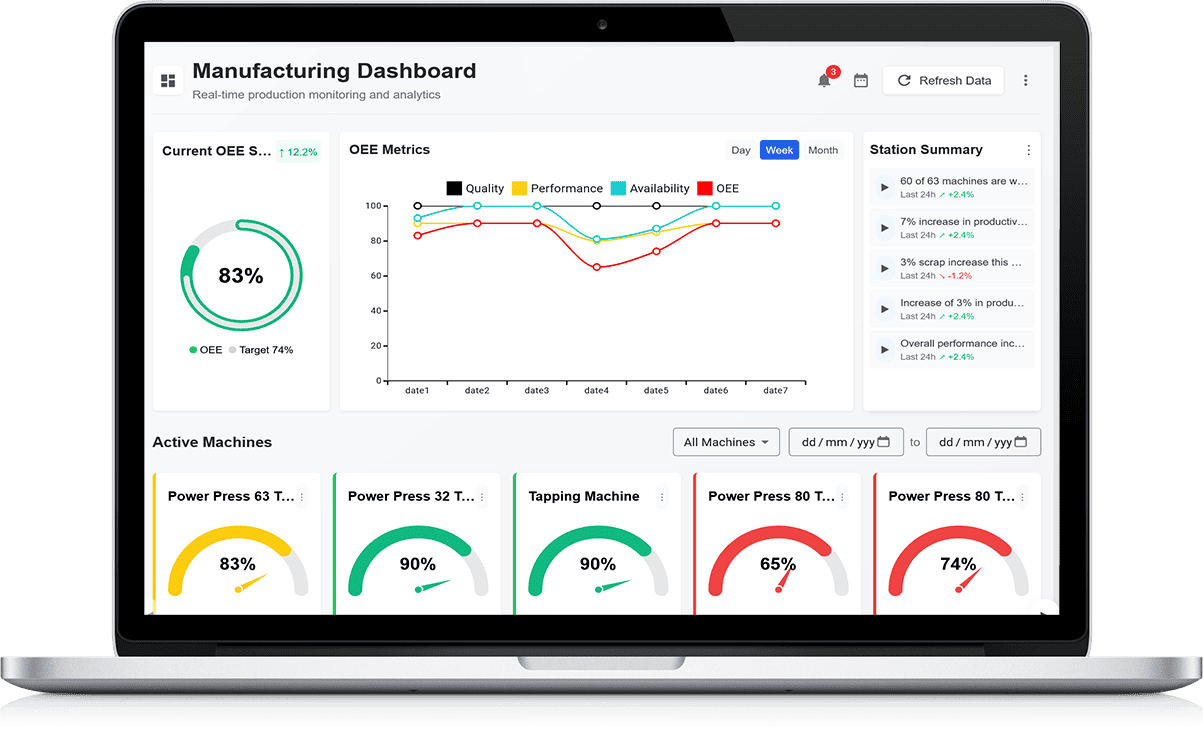
Real-Time OEE Tracking Machine Monitoring Solution can underperform when it is introduced as a standalone technology rather than part of a broader operational improvement plan. A frequent challenge is relying solely on automated data without establishing standardized production processes first. If downtime reasons, cycle times, and quality parameters are not clearly defined, the system may generate inconsistent or misleading insights.
Aligning the Software with Real Strategic Needs
To get Real-Time OEE Tracking right, organisations must ensure it reflects their true priorities. This starts with building a clear, documented strategy that sets out the main objectives and expected outcomes. Once this foundation is in place, KPIs can be selected to match these goals. When teams see how their daily actions connect to the overall strategy, they are more likely to use the system effectively and consistently.
Building Engagement Across Departments
Scorecard success relies heavily on cross-department involvement. Each team should understand the role they play in achieving the organisation’s goals. By involving department leaders early, organisations foster ownership and create a shared sense of responsibility. Regular reviews, simple dashboards, and clear communication help maintain focus and ensure progress is monitored continuously.
Strengthening Long-Term Adoption
Finally, ongoing training and support are essential for keeping the scorecard alive. When users feel confident, the system becomes part of daily routines rather than a one-time project. With clear goals, shared accountability, and strong leadership support, real-time oee tracking becomes far more effective and delivers meaningful results.
Why Real-Time OEE Tracking Fails — And How Manufacturers Can Get It Right
Lack of Clear Operational Goals
Real-Time OEE Tracking - Machine Monitoring Solution initiatives often fail when manufacturers implement the technology without defining clear production goals. Without specific targets for availability, performance, and quality, the system becomes a passive reporting tool rather than a driver of improvement.
Establishing measurable benchmarks before implementation ensures that OEE data directly supports operational efficiency, cost control, and delivery commitments.
Organizations that define target OEE percentages, downtime thresholds, and quality benchmarks before deployment are far more likely to achieve measurable improvements.
Misalignment Between Data and Action
When teams collect data but fail to act on insights, OEE dashboards lose impact. Success depends on connecting real-time metrics to daily decision-making and continuous improvement initiatives.
Structured follow-up processes and accountability frameworks help transform insights into measurable production gains.
Clear escalation procedures and defined responsibilities ensure that every performance drop is investigated and resolved quickly.
Limited Cross-Department Involvement
OEE success requires collaboration between production, maintenance, and quality teams. Without shared ownership, improvements remain isolated and inconsistent.
Creating joint performance reviews and shared KPIs strengthens cooperation and drives sustainable results.
Cross-functional communication reduces downtime causes that originate outside a single department.
Many manufacturers also underestimate the importance of change management during implementation. Without proper communication and phased rollout planning, resistance to new monitoring systems can slow adoption.
Successful organizations treat OEE tracking as a long-term operational strategy rather than a short-term technology upgrade.
Benchmarking current performance before implementation provides a clear baseline for measuring improvement.
Continuous feedback loops between operators and management strengthen system effectiveness.
When technology, people, and processes are aligned, real-time OEE tracking becomes a powerful driver of measurable productivity gains.
Defining Clear Production Metrics Before Implementing an OEE Monitoring Solution
Establishing Meaningful KPIs
Before deploying a machine monitoring solution, manufacturers must define accurate cycle times, downtime categories, and quality standards. Clear metrics ensure reliable OEE calculations.
Documented standards prevent inconsistencies and create a stable foundation for performance comparison.
Clearly categorized downtime reasons also make root cause analysis significantly more effective.
Aligning Metrics with Business Objectives
Production metrics should directly support cost reduction, throughput improvement, and customer satisfaction goals.
When KPIs align with broader objectives, real-time monitoring becomes a strategic advantage rather than just an operational metric.
This alignment ensures that improvements in OEE directly contribute to revenue growth and margin improvement.
Standard operating procedures should clearly document how each KPI is calculated and reviewed.
Defining acceptable performance ranges helps teams quickly recognize deviations.
Involving supervisors in KPI development increases ownership and accountability.
Accurate baseline measurements improve forecasting and capacity planning.
Well-defined metrics reduce confusion and improve cross-functional communication.
Securing Leadership Buy-In for Successful OEE Implementation
Leadership Drives Adoption
Strong executive support ensures Real-Time OEE Tracking becomes part of strategic planning, not just a shop-floor tool.
Visible involvement from senior management reinforces accountability and long-term commitment.
Leadership participation in performance meetings signals the importance of consistent system usage.
Setting the Tone for Accountability
When leaders actively review OEE dashboards and act on insights, teams recognize the importance of consistent usage.
This top-down engagement accelerates adoption and strengthens performance culture.
Executive-driven improvement initiatives help sustain long-term operational focus.
Leaders should communicate how OEE improvements support overall company growth objectives.
Allocating sufficient budget and resources demonstrates organizational commitment.
Executives can reinforce adoption by linking OEE targets to performance incentives.
Consistent leadership messaging reduces uncertainty during implementation phases.
When leadership models data-driven decision-making, teams are more likely to follow.
Aligning Production, Maintenance, and Quality Teams Around OEE Goals
For a Real-Time OEE Tracking - Machine Monitoring Solution to deliver meaningful results, production, maintenance, and quality teams must operate with shared performance objectives. OEE is not owned by a single department—it reflects the combined impact of machine availability, operational efficiency, and product quality.
Production teams focus on output and cycle times, maintenance teams ensure equipment reliability, and quality teams monitor defect rates. When these functions work in isolation, performance gaps remain unresolved. Aligning them around common OEE targets encourages collaboration, reduces blame culture, and promotes faster problem resolution.
Shared dashboards and regular cross-functional review meetings help all departments interpret the same real-time data. This transparency ensures that downtime causes, speed losses, and quality issues are addressed collectively rather than independently.
When teams are aligned around clear OEE goals, communication improves, corrective actions become more coordinated, and overall operational efficiency increases sustainably across the entire manufacturing environment.
Clear communication channels prevent misunderstandings between departments.
Joint root cause analysis sessions encourage collaborative problem-solving.
Shared accountability reduces delays in addressing equipment or quality issues.
Unified performance targets eliminate conflicting departmental priorities.
Strong alignment enhances operational stability and consistent output quality.
Reducing Downtime with Accurate Real-Time Machine Monitoring
Identifying Downtime Root Causes
Live monitoring detects machine stoppages instantly, allowing faster response and reduced production losses.
Immediate alerts enable supervisors to deploy corrective action before minor issues escalate.
Root cause tagging improves future prevention strategies and knowledge sharing.
Preventing Recurring Issues
Analyzing downtime trends supports preventive maintenance planning and long-term reliability improvements.
Data-backed maintenance scheduling reduces unexpected breakdowns and enhances asset lifespan.
Historical trend analysis enables predictive maintenance and improved spare parts planning.
Automated alerts reduce reaction time during unexpected breakdowns.
Visual dashboards help supervisors monitor multiple machines simultaneously.
Data transparency improves coordination between maintenance and production staff.
Tracking micro-stoppages uncovers hidden productivity losses.
Proactive monitoring strengthens overall equipment reliability and uptime consistency.
Training Operators to Use Real-Time OEE Dashboards Effectively
Successful implementation of a Real-Time OEE Tracking - Machine Monitoring Solution depends heavily on operator understanding and engagement. Proper training ensures that operators can accurately interpret availability, performance, and quality data in real time.
Hands-on sessions should focus on how to log downtime reasons correctly, respond to system alerts, and identify performance gaps quickly. When operators clearly understand how their actions influence OEE results, they become proactive contributors to production improvement rather than passive system users.
Ongoing refresher programs and clear usage guidelines further ensure consistent data entry and reliable reporting across all shifts.
Interactive training modules improve knowledge retention and engagement.
Clear visual aids simplify understanding of performance indicators.
Encouraging operator feedback enhances dashboard usability.
Recognition programs can motivate accurate data reporting.
Empowered operators contribute significantly to sustained OEE improvement.
Integrating OEE Tracking with Existing ERP, MES, and Shop-Floor Systems
Integrating OEE tracking with ERP, MES, and other shop-floor systems creates a unified data environment that improves operational visibility. Seamless integration eliminates data silos and reduces the need for manual data entry.
Automated machine connectivity ensures accurate data capture directly from equipment, improving reporting reliability. When systems are connected, managers can analyze production, maintenance, and inventory data together for better decision-making.
This integration enhances workflow efficiency and ensures that real-time machine data supports broader business objectives.
System integration reduces duplicate data entry and administrative workload.
Connected platforms improve traceability across production processes.
Real-time synchronization enhances planning accuracy.
Integrated analytics provide deeper operational insights.
A unified data ecosystem supports smarter, faster management decisions.
Building a Culture of Continuous Improvement with Live Production Data
Real-Time OEE Tracking - Machine Monitoring Solution supports continuous improvement by providing instant visibility into production performance. Teams can quickly identify inefficiencies, bottlenecks, and recurring downtime patterns.
When live production data is consistently reviewed, it fosters a proactive mindset focused on solving problems before they escalate. Teams begin to rely on evidence-based decisions rather than assumptions.
Embedding daily performance discussions around OEE results strengthens accountability and drives long-term operational excellence.
Daily stand-up meetings can incorporate OEE performance reviews.
Visual performance boards encourage transparency and accountability.
Continuous improvement initiatives become more measurable with accurate data.
Employee involvement strengthens long-term operational commitment.
Data-driven cultures adapt more effectively to changing production demands.
Conducting Regular Performance Reviews Using Real-Time OEE Insights
Regular performance reviews ensure that OEE data leads to measurable improvements. Weekly or monthly review meetings help track trends, evaluate targets, and prioritize corrective actions.
By analyzing real-time insights, management teams can identify production gaps, adjust maintenance strategies, and allocate resources effectively.
Structured review cycles ensure that performance tracking remains active and aligned with operational goals.
Structured agendas ensure focused and productive review meetings.
Trend analysis helps identify recurring operational patterns.
Documented action plans increase follow-through and accountability.
Reviewing both short-term and long-term metrics provides balanced insight.
Consistent evaluations sustain continuous performance improvement.
Communicating Production Targets Clearly Across Manufacturing Teams
Clear communication of production targets is essential for maximizing the impact of Real-Time OEE Tracking. Live dashboards should display daily, weekly, and monthly performance goals across departments.
When operators and supervisors understand specific OEE targets, they are better positioned to take immediate action if performance declines.
Transparent communication builds accountability and ensures that every team member understands their role in achieving production objectives.
Clear visual goal displays improve workforce alignment.
Digital signage keeps targets visible throughout production shifts.
Transparent reporting encourages shared responsibility.
Immediate performance feedback supports rapid corrective action.
Well-communicated objectives increase overall team motivation.
Using Live Machine Monitoring for Complete Operational Visibility
Live machine monitoring provides real-time visibility into equipment status, including running, idle, or downtime conditions. This instant transparency allows managers to respond quickly to disruptions.
Complete operational visibility helps identify bottlenecks, optimize production flow, and improve resource allocation decisions.
With accurate and immediate insights, manufacturers can maintain greater control over operations and reduce unexpected production losses.
Centralized dashboards simplify multi-line monitoring.
Mobile access enables managers to track performance remotely.
Instant notifications reduce response delays.
Live visibility supports better shift transition management.
Comprehensive monitoring strengthens production stability and predictability.
Avoiding Common Mistakes When Deploying a Machine Monitoring Solution
One common mistake when deploying an OEE monitoring solution is overcomplicating metrics with excessive KPIs. Keeping calculations clear and focused ensures faster adoption and easier interpretation.
Another challenge is neglecting operator engagement and training, which can lead to inaccurate data and low system usage.
Successful deployment requires clear objectives, reliable data collection processes, leadership support, and continuous improvement practices to ensure long-term value.
Starting with pilot projects minimizes implementation risks.
Gradual scaling improves long-term adoption success.
Clear user training reduces data inconsistencies.
Regular system reviews prevent performance stagnation.
Continuous evaluation ensures sustained operational value.
Ensuring Accurate Machine Data for Reliable OEE Calculations
Standardizing Data Inputs
Consistent definitions for downtime and production counts improve data reliability.
Standard processes minimize discrepancies across shifts and departments.
Automated data capture from machines further reduces the risk of human error.
Regular Data Validation
Periodic audits help maintain accuracy and trustworthy insights.
Verification procedures ensure long-term confidence in reported performance metrics.
Reliable data strengthens leadership trust and supports strategic decision-making.
Calibration of sensors improves measurement precision.
Routine system checks prevent data discrepancies.
Clear documentation supports consistent reporting standards.
Automated validation alerts highlight unusual data trends.
Reliable data forms the foundation of credible performance reporting.
Measuring ROI: How Real-Time OEE Tracking Improves Manufacturing Performance
Quantifying Performance Gains
Improved uptime, higher throughput, and reduced defect rates directly impact profitability.
Clear ROI metrics demonstrate the financial value of operational improvements.
Reduced scrap rates and optimized labor utilization further enhance cost efficiency.
Supporting Long-Term Operational Excellence
By aligning production data with business strategy, Real-Time OEE Tracking - Machine Monitoring Solution delivers measurable returns and sustainable growth.
Continuous monitoring ensures manufacturers remain competitive in demanding markets.
Over time, consistent OEE improvements strengthen customer satisfaction and on-time delivery performance.
Financial impact assessments strengthen executive confidence.
Comparing pre- and post-implementation metrics highlights progress.
Cost savings from reduced downtime improve margin stability.
Higher efficiency supports scalable production growth.
Demonstrated ROI justifies continued investment in digital transformation initiatives.