Obeya Board focuses on developing intelligent automated machinery that supports efficient, waste-free production. By combining lean manufacturing principles with advanced automation technologies, organizations can create streamlined production systems that improve productivity, maintain consistent quality, and reduce operational costs.
Key Focus Areas
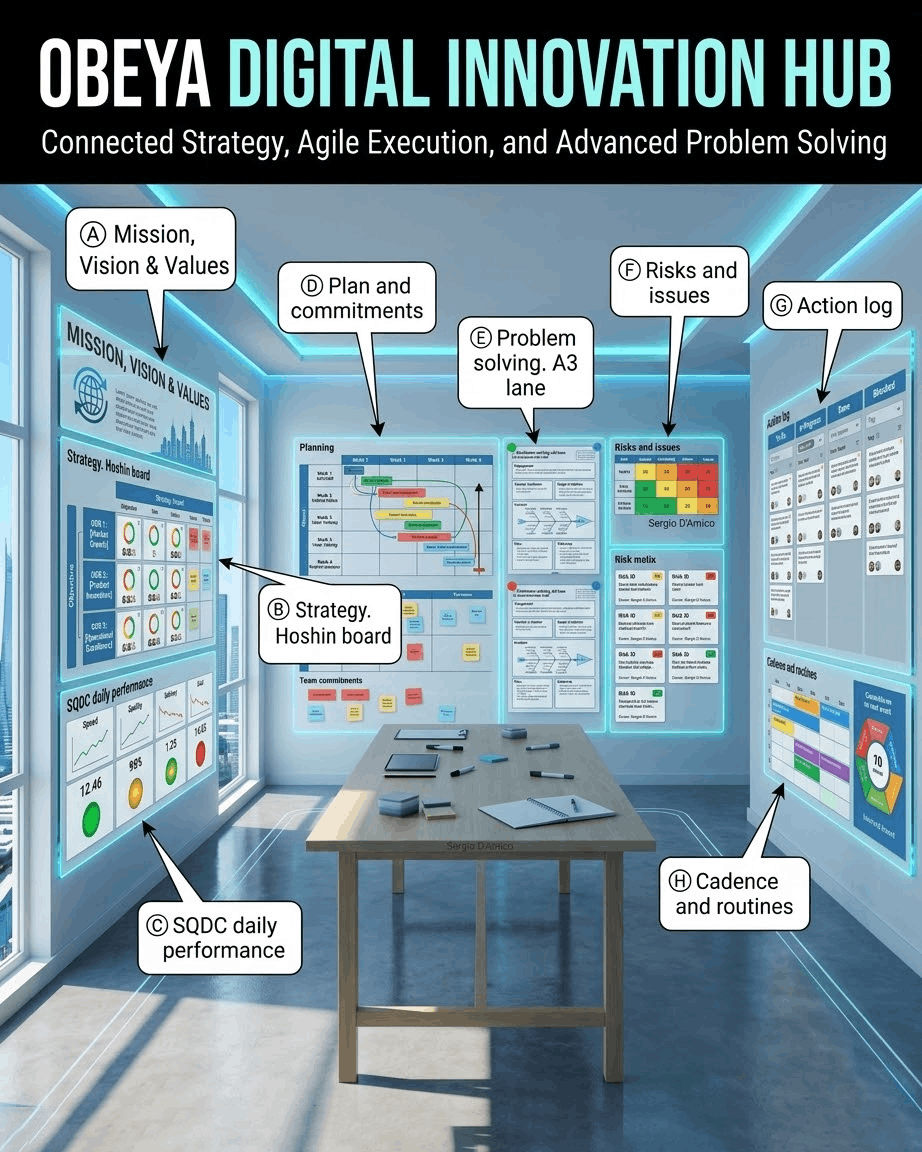
The Obeya Board highlights the main components that drive lean automation success, including automated production systems, industrial robotics, and smart control technologies. These solutions enable manufacturers to automate repetitive tasks, improve precision, and maintain efficient production flow. Real-time monitoring and sensor-based systems also help teams track machine performance and identify improvement opportunities.
Operational Benefits
Through lean automation, organizations can streamline production processes, eliminate unnecessary activities, and increase manufacturing efficiency. Automation technologies such as automated assembly systems, predictive maintenance, and data-driven monitoring help reduce downtime, improve equipment reliability, and support continuous improvement across production operations.
Strategic Direction
The Obeya Board supports collaboration and transparency by allowing teams to visualize goals, track progress, and address operational challenges. As manufacturing continues to evolve with smart technologies and connected systems, lean automation will remain a key driver of scalable, efficient, and future-ready production environments.
Lean Principles in Automation Machinery Design
Focus Area
Lean machinery design emphasizes eliminating waste, reducing energy consumption, and improving production efficiency. Equipment is engineered to support streamlined workflows and minimize unnecessary production steps.
Designing machinery with lean thinking ensures that every component and process contributes directly to value creation. Engineers focus on simplifying machine operations, reducing complexity, and improving usability for operators and maintenance teams.
Operational Goal
Create machinery that enables continuous production flow, reduces bottlenecks, and improves overall resource utilization.
By focusing on production flow, manufacturers can ensure smoother operations across production lines, resulting in reduced delays and higher equipment utilization.
Continuous Improvement
Machines designed with lean principles allow upgrades, optimization, and adjustments to support evolving production requirements.
This flexibility enables organisations to implement improvements quickly without redesigning entire systems, supporting long-term operational efficiency.
Lean Principles in Automation Machinery Design
Focus Area
Lean machinery design emphasizes eliminating waste, reducing energy consumption, and improving production efficiency. Equipment is engineered to support streamlined workflows and minimize unnecessary production steps.
Designing machinery with lean thinking ensures that every component and process contributes directly to value creation. Engineers focus on simplifying machine operations, reducing complexity, and improving usability for operators and maintenance teams.
Operational Goal
Create machinery that enables continuous production flow, reduces bottlenecks, and improves overall resource utilization.
By focusing on production flow, manufacturers can ensure smoother operations across production lines, resulting in reduced delays and higher equipment utilization.
Continuous Improvement
Machines designed with lean principles allow upgrades, optimization, and adjustments to support evolving production requirements.
This flexibility enables organisations to implement improvements quickly without redesigning entire systems, supporting long-term operational efficiency.
Industrial Automation Systems
Objective
Implement automation technologies that control machinery and production processes with minimal manual intervention.
Automation systems integrate programmable controllers, sensors, and digital monitoring tools that coordinate machine functions and maintain consistent operational performance.
Key Benefits
Improved production speed, consistent product quality, and higher operational reliability through precise automated control.
Automation reduces variability in production processes and ensures that manufacturing standards are maintained across large production volumes.
Strategic Value
Automation systems support scalable and efficient manufacturing environments.
They also enable manufacturers to respond quickly to changing market demands while maintaining operational stability.
Custom Machinery Engineering
Focus
Develop tailored machinery solutions designed to meet the specific production needs of different industries.
Each manufacturing environment has unique requirements, and custom-designed machines ensure that production processes operate efficiently within those conditions.
Engineering Approach
Combine mechanical design, automation technology, and intelligent control systems to create reliable and efficient production equipment.
Engineering teams work closely with production managers to ensure that machine design aligns with operational goals and process requirements.
Outcome
Flexible and adaptable machinery that improves productivity and operational performance.
Custom solutions also allow companies to integrate new technologies as production systems evolve.

Automated Assembly Line Solutions
Production Focus
Automated assembly lines integrate machines, robotics, and control systems to streamline repetitive production tasks.
These systems enable manufacturers to maintain consistent production speeds while reducing process variability.
Operational Impact
Improved production speed, consistent quality, and reduced reliance on manual labor.
Automation also allows workers to focus on higher-value tasks such as system monitoring and process improvement.
Application
Ideal for high-volume manufacturing environments requiring efficiency and accuracy.
Industries such as electronics, automotive, and consumer goods rely heavily on automated assembly systems.
Industrial Robotics Integration
Automation Capability
Robotic systems perform repetitive and precision-based tasks with high consistency.
Robots are capable of performing complex manufacturing tasks such as welding, packaging, assembly, and material handling.
Safety Improvement
Robots handle hazardous or complex tasks, improving workplace safety.
By reducing human exposure to dangerous processes, robotics contributes to safer manufacturing environments.
Operational Flexibility
Robotic automation supports adaptable manufacturing processes.
Modern robotic systems can be reprogrammed to support different production tasks as manufacturing requirements change.
Smart Manufacturing Systems
Connected Production
Smart manufacturing integrates digital technologies with industrial machinery to create connected production environments.
Machines, sensors, and control systems communicate with each other to ensure efficient coordination across production operations.
Real-Time Monitoring
Production performance and equipment conditions can be monitored continuously through data systems.
Managers and engineers can access dashboards that provide insights into machine efficiency, downtime, and productivity.
Decision Support
Real-time insights help management teams make faster and more informed operational decisions.
Data-driven decision-making improves resource allocation and process optimization.
Process Optimization Initiatives
Objective
Improve production workflows by eliminating inefficiencies and optimizing manufacturing processes.
Lean automation systems help identify delays, redundancies, and process gaps that limit productivity.
Data-Driven Improvement
Automation systems collect operational data to identify improvement opportunities.
Advanced analytics allow teams to measure performance and implement targeted improvements.
Continuous Improvement
Lean automation supports ongoing refinement of production systems.
Regular process reviews and improvement initiatives ensure that production operations remain efficient.
Automated Quality Inspection
Quality Control
Automated inspection systems ensure products meet quality standards during production.
Quality checks are integrated directly into production lines, allowing issues to be detected early.
Advanced Technologies
Sensors, cameras, and AI-based detection tools identify defects early.
These technologies enable accurate inspection without slowing down production processes.
Customer Value
Consistent quality improves reliability and customer satisfaction.
Reliable quality control processes strengthen brand reputation and product trust.
Material Handling Automation
Operational Focus
Automated systems manage the movement of materials, components, and finished goods across production facilities.
Efficient material flow ensures that production lines receive the necessary inputs without delays.
Efficiency Impact
Conveyors, robotic handling systems, and automated storage improve workflow efficiency.
These technologies help maintain a continuous flow of materials throughout the production cycle.
Safety Benefit
Reduced manual handling improves workplace safety.
Automation minimizes physical strain on workers and reduces accident risks.
Energy Efficient Manufacturing Systems
Energy Optimization
Energy-efficient machinery reduces power consumption while maintaining production performance.
Advanced motors, optimized machine cycles, and intelligent control systems contribute to reduced energy usage.
Sustainability Goals
Modern machinery supports environmentally responsible manufacturing practices.
Reducing waste and energy usage helps companies meet sustainability targets.
Operational Advantage
Reduced energy use lowers operational costs.
Energy-efficient operations also improve long-term financial sustainability.
Industry 4.0 Integration
Digital Manufacturing
Automation systems connect with digital technologies to create intelligent manufacturing environments.
Industrial IoT devices enable machines to communicate and share operational data.
Real-Time Data
Connected machines share operational data for performance monitoring and optimization.
This connectivity improves transparency across manufacturing operations.
Smart Factory Development
Integration supports the transition toward fully connected smart factories.
Smart factories improve production visibility, efficiency, and automation capabilities.
Predictive Maintenance Strategy
Equipment Monitoring
Sensors and data analytics monitor machinery health in real time.
Continuous monitoring allows maintenance teams to detect early signs of wear or malfunction.
Failure Prevention
Predictive insights help detect potential issues before breakdowns occur.
This proactive approach prevents costly equipment failures.
Operational Reliability
Proactive maintenance reduces downtime and extends equipment lifespan.
Reliable machinery performance ensures consistent production output.
Scalable Production Systems
Flexible Capacity
Automation systems allow manufacturers to adjust production capacity according to market demand.
Production lines can be expanded or modified without major disruptions.
Operational Flexibility
Modern manufacturing infrastructure supports product variation and production changes.
This flexibility allows companies to respond quickly to customer needs.
Growth Enablement
Scalable systems support long-term industrial expansion.
Businesses can increase production capabilities while maintaining operational efficiency.
Future of Lean Automation
Innovation Direction
Future automation systems will integrate smarter technologies and digital connectivity.
Artificial intelligence and advanced analytics will play a larger role in manufacturing optimization.
Efficiency Goals
Manufacturers will focus on higher productivity, reduced waste, and intelligent production systems.
Automation will continue to improve operational efficiency across industries.
Next Generation Manufacturing
Lean automation will continue driving the evolution of modern, connected, and sustainable factories.
Organizations that adopt these technologies early will gain a strong competitive advantage.
How to build an Obeya Room?
To build an Obeya Room, you must create a dedicated workspace—physical or digital—that serves as a "single source of truth" for your team. The goal is to move from status reporting to collaborative decision-making by making complex workflows and strategy visible to everyone.
1. Define the Purpose
Before choosing a room, identify the specific problem you are trying to solve such as aligning strategy with execution or improving product discovery.
- Identify Stakeholders: Involve representatives from different departments such as Engineering, Marketing, and UX to ensure a holistic view of the project.
- Choose the Format: Decide whether to use a Physical room for co-located teams, a Digital board (such as Miro or Mural) for remote teams, or a Hybrid approach that combines both environments.
2. Set Up the "Six-Panel" Layout
The most common way to organize an Obeya room is by dividing the walls into six functional zones that display key information and guide team discussions.
- Vision Panel: Displays long-term direction, strategic objectives, and high-level goals such as OKRs.
- Customer Panel: Shows customer insights, user personas, journey maps, and feedback trends.
- Product / Service Panel: Highlights the product roadmap, new ideas, and development progress.
- Plan Panel: Presents tactical timelines, sprint backlogs, and priority activities.
- Performance Panel: Displays KPIs, quality metrics, and operational results that reveal the true performance status.
- Improvement Panel: Tracks PDCA (Plan-Do-Check-Act) cycles and countermeasures for solving identified problems.
3. Assign Key Roles
A successful Obeya requires clear ownership to ensure that information remains accurate and the space continues to support decision-making.
- Obeya Builder: Responsible for setting up the physical or digital layout and maintaining the structure of the board.
- Obeya Host: Facilitates meetings, encourages team participation, and ensures discussions remain focused.
- Team Members: Responsible for updating their respective data and insights before each meeting.
4. Establish Meeting Rituals
The Obeya room is effective only when it becomes part of the team’s regular collaboration process. Establish a consistent rhythm of meetings.
- Daily Huddles: Short 10–15 minute stand-up meetings to review daily activities and identify immediate blockers.
- Weekly Gallery Walks: Cross-functional discussions that review overall progress and strategic alignment.
- Monthly Strategic Reviews: In-depth reviews of performance metrics and long-term objectives with key stakeholders.
5. Start Simple and Iterate
Do not wait for a perfect setup. Begin with simple tools such as whiteboards, sticky notes, and visual boards. As the team learns what information is most useful, the Obeya environment can evolve and improve over time.