Lean 4.0 Strategy for Modern Manufacturing Companies
Driving Operational Excellence Through Lean and Digital Integration
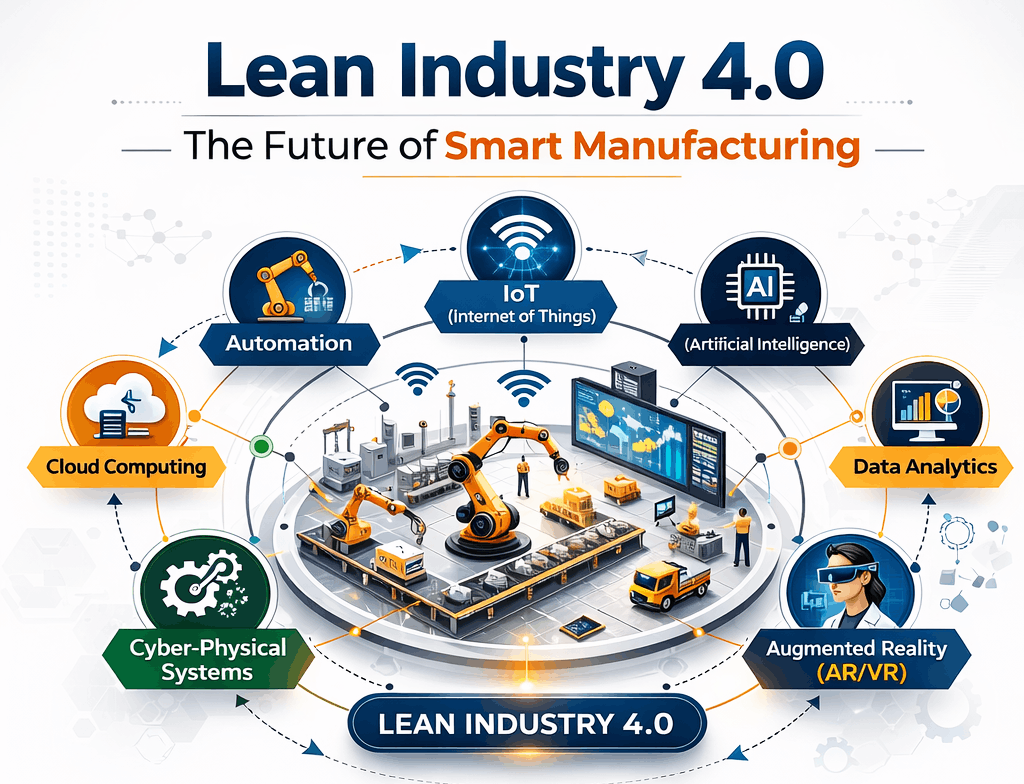
Lean manufacturing has long focused on eliminating waste, improving workflow efficiency, and maximising customer value. Lean 4.0 expands these core principles by integrating advanced digital technologies such as Industrial IoT (IIoT), automation, artificial intelligence, cloud platforms, and real-time analytics into modern manufacturing environments.
By digitally connecting machines, systems, and teams, Lean 4.0 creates a fully transparent production ecosystem. Real-time data enables leaders to detect inefficiencies instantly, optimise processes proactively, and improve overall operational performance.
Smart sensors and connected equipment continuously monitor performance metrics such as uptime, throughput, energy consumption, scrap rates, and material usage. Automated alerts ensure rapid response to deviations, minimising disruptions and maintaining stable production flow.
Intelligent process optimisation improves cycle times, balances workloads, and removes bottlenecks. This results in smoother operations, improved productivity, and better alignment between production output and customer demand.
Digital work instructions, automated quality controls, and standardised workflows reduce errors and variability. These improvements enhance consistency, increase product quality, and support continuous improvement initiatives across facilities.
Enhancing Operational Visibility with Real-Time Insights
Lean 4.0 strengthens decision-making by delivering live operational visibility across machines, workflows, and supply chains. Connected systems and intelligent dashboards provide immediate insight into production status, performance trends, and resource utilisation.
With access to accurate, real-time data, teams can respond faster to changing production conditions, adjust capacity efficiently, and maintain optimal workflow balance.
Automated monitoring ensures alignment between planning and execution, improving coordination between departments and reducing communication gaps.
Building a Culture of Continuous Digital Improvement
Lean 4.0 reinforces continuous improvement by digitising performance measurement and eliminating manual reporting. Real-time analytics support evidence-based problem solving and faster implementation of corrective actions.
Standardised digital workflows ensure consistent execution across shifts and facilities, promoting operational stability and scalable best practices.
Collaborative dashboards enable cross-functional teams to work from a single source of truth, accelerating innovation and strengthening operational discipline.
Strengthening Long-Term Competitiveness
Predictive analytics and proactive monitoring enhance equipment reliability and improve overall equipment effectiveness (OEE). These capabilities extend asset lifespan and support sustainable growth strategies.
By aligning lean methodology with digital transformation, Lean 4.0 empowers manufacturers to build agile, resilient, and future-ready production systems that remain competitive in an increasingly connected industrial landscape.
Understanding Lean 4.0 in Modern Manufacturing
Combining Lean Thinking with Digital Innovation
Lean 4.0 represents the evolution of traditional lean manufacturing by integrating advanced digital technologies into established continuous improvement frameworks. It connects machines, systems, and people through Industrial IoT (IIoT), cloud computing, automation, and advanced analytics.
This integration provides full operational visibility across production lines, enabling manufacturers to monitor performance, detect inefficiencies, and optimise workflows in real time.
By aligning lean methodology with digital capabilities, organisations create more agile, responsive, and data-driven manufacturing environments.
Lean 4.0 ensures that improvement initiatives are measurable, scalable, and strategically aligned with long-term operational objectives.
In highly competitive markets, manufacturers must adapt quickly to changing demand patterns and supply chain fluctuations. Lean 4.0 enhances responsiveness by providing instant access to operational insights, allowing faster adjustments without disrupting workflow stability.
The combination of structured lean systems and intelligent data platforms creates a transparent production ecosystem where performance gaps are identified early and corrective actions are implemented with confidence.
Integrating Digital Transformation with Lean Strategy
Creating a Connected and Intelligent Production Ecosystem
Digital transformation strengthens lean strategy by embedding real-time data collection and automated analysis directly into manufacturing processes.
Live dashboards and connected systems provide instant insight into machine performance, resource utilisation, and workflow efficiency.
Predictive analytics supports proactive decision-making, helping teams resolve issues before they disrupt production stability.
When digital systems are aligned with lean objectives, technology investments directly enhance efficiency, transparency, and operational control.
Cloud-based platforms centralise operational data, enabling cross-site comparisons and enterprise-wide performance benchmarking. This connectivity eliminates information silos and promotes coordinated decision-making.
A structured digital roadmap ensures that transformation efforts support lean goals rather than complicate processes, reinforcing simplicity while increasing technological capability.
Building on Core Lean Principles
Strengthening Continuous Improvement in a Digital Environment
Lean 4.0 builds on foundational lean principles such as waste elimination, standardisation, value stream optimisation, and respect for people.
Advanced analytics enhances traditional value stream mapping by identifying inefficiencies in material flow, cycle times, and process variation with greater accuracy.
Digital workflows standardise best practices across shifts and facilities, reducing variability and improving quality consistency.
By reinforcing core lean foundations with technology, organisations achieve structured and sustainable performance improvement.
Digital kaizen initiatives allow teams to track improvement projects in real time, monitor progress through measurable KPIs, and quantify the impact of process enhancements.
Technology does not replace lean thinking—it strengthens it by providing deeper insights and accelerating continuous improvement cycles across departments.
Implementing Smart Manufacturing and Automation
Enhancing Productivity Through Intelligent Systems
Smart manufacturing integrates robotics, collaborative automation, and AI-driven control systems into lean production environments to improve speed, precision, and reliability.
Automated systems adjust operational parameters in real time, maintaining product quality while reducing material waste and process variability.
Digital work instructions and intelligent scheduling improve coordination across departments, supporting higher overall equipment effectiveness (OEE).
With automation aligned to lean objectives, manufacturers build more efficient, resilient, and future-ready production systems.
Collaborative robots (cobots) work safely alongside employees, increasing throughput while allowing skilled workers to focus on higher-value tasks such as quality control and process optimisation.
Scalable automation strategies ensure that production systems can expand or adapt to new product lines without compromising lean performance standards.
Enhancing Operational Visibility with Real-Time Data
Lean 4.0 enables comprehensive operational visibility by capturing live data from machines, production lines, and enterprise systems. Real-time dashboards provide instant access to performance metrics, allowing managers to monitor efficiency, quality, and throughput from a single interface.
Immediate insight into operational conditions improves responsiveness and supports faster, more confident decision-making across departments.
Data transparency eliminates guesswork, replacing assumptions with measurable performance indicators that drive continuous optimisation.
With connected data streams, organisations maintain consistent control over production performance and strategic targets.
Historical trend analysis combined with live data provides deeper performance context, helping leadership teams identify recurring patterns and long-term optimisation opportunities.
Mobile-access dashboards further enhance visibility, enabling decision-makers to monitor plant performance anytime and from any location.
Creating Connected and Transparent Value Streams
Lean 4.0 digitally integrates every stage of the value stream, from suppliers to final delivery. Connected systems synchronise material flow, production schedules, and customer demand in real time.
This transparency reduces communication gaps and ensures seamless coordination across procurement, operations, and logistics.
Digital value stream mapping tools identify inefficiencies and bottlenecks with greater accuracy than traditional manual methods.
An interconnected ecosystem strengthens collaboration and improves end-to-end process reliability.
Real-time supplier data sharing enhances responsiveness to demand changes and minimises material shortages.
End-to-end traceability improves accountability and supports regulatory compliance across the production network.
Leveraging Predictive Analytics for Strategic Planning
Predictive analytics transforms historical and real-time production data into forward-looking insights. These capabilities help manufacturers anticipate demand changes, maintenance needs, and process deviations.
Data-driven forecasting improves strategic planning accuracy and reduces operational uncertainty.
Scenario modelling supports informed decision-making for capacity expansion, product launches, and resource allocation.
By anticipating risks and opportunities early, organisations strengthen long-term competitiveness.
Machine learning models continuously refine predictions as new data becomes available, increasing forecasting precision over time.
Strategic planning becomes proactive rather than reactive, improving resilience in volatile market conditions.
Reducing Downtime with Proactive Monitoring
Smart monitoring systems continuously analyse equipment performance to detect anomalies before failures occur.
Early alerts enable maintenance teams to intervene quickly, preventing extended production interruptions.
Proactive scheduling reduces unexpected stoppages and improves overall equipment effectiveness (OEE).
Stable production uptime ensures consistent output and strengthens operational reliability.
Root cause analytics prevent recurring breakdowns by identifying systemic weaknesses in equipment or processes.
Integrated maintenance planning platforms align technician availability with predicted service needs for optimal efficiency.
Improving Quality Management Through Digital Systems
Digital quality management tools monitor production parameters in real time, detecting deviations as they occur.
Automated inspection systems reduce reliance on manual checks and minimise the risk of defect propagation.
Advanced analytics identify recurring quality trends, supporting faster root cause resolution.
Consistent quality performance improves customer satisfaction and protects brand reputation.
Digital documentation ensures traceability, simplifying audits and compliance verification processes.
Integrated corrective action systems accelerate issue resolution and prevent quality-related financial losses.
Optimising Resource Utilisation with Smart Tools
Lean 4.0 platforms provide full visibility into labour, materials, energy usage, and machine capacity.
Real-time analytics highlight underutilised assets and imbalanced workloads, enabling efficient reallocation.
Intelligent scheduling systems ensure optimal deployment of resources without overburdening teams.
Efficient resource management increases throughput while maintaining cost discipline.
Capacity modelling tools assist in balancing workloads across multiple facilities or production lines.
Data-backed decisions reduce waste while maintaining operational flexibility.
Building an Agile and Flexible Manufacturing Model
Lean 4.0 supports agile production systems capable of adapting quickly to changing customer demand and market conditions.
Integrated planning platforms align supply, production, and distribution processes dynamically.
Flexible automation allows rapid product changeovers without sacrificing efficiency.
Agile manufacturing models strengthen resilience in volatile business environments.
Digital twins simulate production scenarios, enabling safe testing of process adjustments before implementation.
Agility supported by data ensures competitiveness even during supply chain disruptions or economic shifts.
Tracking KPIs with Digital Performance Dashboards
Interactive dashboards provide continuous monitoring of key performance indicators such as OEE, cycle time, scrap rates, and throughput.
Live KPI tracking enables immediate corrective action when performance deviates from targets.
Benchmarking across shifts and facilities promotes transparency and healthy competition.
Data-driven performance measurement turns improvement into an ongoing discipline.
Customisable dashboards align KPIs with departmental objectives and strategic goals.
Automated reporting reduces administrative workload and improves reporting accuracy.
Driving Continuous Improvement in a Digital Environment
Lean 4.0 enhances traditional continuous improvement initiatives by embedding analytics directly into daily operations.
Digital feedback loops shorten the time between problem detection and resolution.
Structured improvement tracking ensures accountability and measurable impact.
Technology-supported kaizen initiatives accelerate innovation across the organisation.
Collaborative digital platforms encourage employee engagement in identifying improvement opportunities.
Continuous optimisation strengthens operational stability and long-term profitability.
Aligning Lean 4.0 Strategy with Business Objectives
Operational data integrates with enterprise planning systems to align production goals with corporate strategy.
Executive dashboards translate shop-floor metrics into strategic performance insights.
Clear alignment ensures technology investments deliver measurable business value.
Strategic integration strengthens long-term profitability and sustainable growth.
Data-driven transparency improves stakeholder confidence and reporting accuracy.
Integrated strategy execution ensures operational excellence supports financial performance targets.
Integrating the Digital Supply Chain
Digitally connected supply chains provide real-time visibility into procurement, logistics, and supplier performance.
Automated replenishment systems reduce delays and improve material availability.
Collaborative data-sharing platforms enhance supplier coordination and reliability.
Integrated supply networks improve responsiveness and cost efficiency.
End-to-end tracking reduces shipment uncertainty and improves customer delivery accuracy.
Supply chain analytics support better vendor selection and performance evaluation.
Smart Inventory Management and Optimisation
Real-time inventory monitoring ensures accurate stock levels and reduces excess inventory.
Demand forecasting tools improve procurement precision and minimise stockouts.
Automated inventory controls support just-in-time production strategies.
Optimised inventory management improves cash flow and operational efficiency.
Barcode and RFID systems improve tracking accuracy across warehouses.
Inventory analytics reduce obsolete stock and enhance working capital management.
Managing Energy Efficiency in Smart Factories
Energy monitoring systems track machine-level consumption and identify inefficiencies.
Analytics platforms highlight opportunities for load balancing and energy optimisation.
Automated controls reduce unnecessary power usage during idle periods.
Improved energy efficiency supports both sustainability goals and cost performance.
Energy benchmarking across facilities promotes accountability and continuous savings.
Sustainable energy strategies strengthen corporate environmental responsibility initiatives.
Empowering the Workforce for Industry 4.0
Lean 4.0 equips employees with digital tools that enhance productivity and decision-making.
Real-time task management systems reduce confusion and improve accountability.
Training programmes aligned with digital transformation strengthen workforce capability.
An empowered workforce accelerates innovation and operational excellence.
Digital collaboration tools improve communication between production and management teams.
Upskilling initiatives ensure employees remain adaptable in technology-driven environments.
Enabling Data-Driven Decision Making
Advanced analytics convert operational data into actionable business insights.
Predictive models support smarter financial planning and capital investment decisions.
Data simulations evaluate potential outcomes before implementation.
Evidence-based decisions reduce risk and strengthen long-term performance stability.
Integrated reporting connects operational KPIs with executive-level financial metrics.
Reliable data governance ensures accuracy and consistency across decision-making processes.
Optimising Production Cycles for Competitive Advantage
Real-time monitoring identifies inefficiencies in cycle times and process flow.
Bottleneck analysis tools accelerate workflow balancing and throughput improvement.
Shorter production cycles reduce overhead and improve customer responsiveness.
Optimised cycle performance strengthens overall competitiveness in fast-moving markets.
Continuous cycle evaluation supports incremental productivity gains.
Improved lead-time management enhances customer satisfaction and market agility.