Lean Industry 4.0: The Future of Smart Manufacturing
Understanding Lean Industry 4.0 in the Digital Manufacturing Era
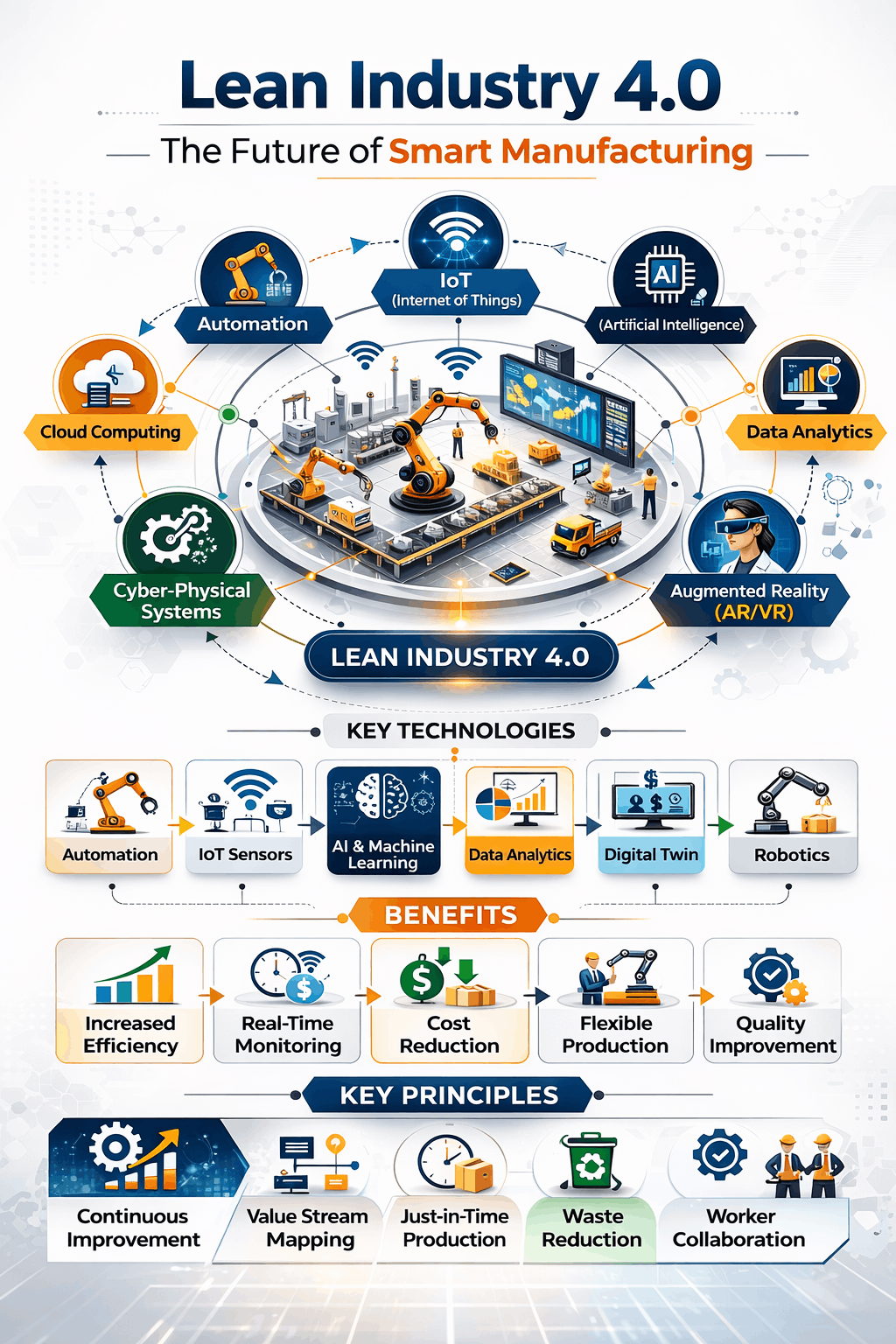
Lean Industry 4.0 represents the integration of lean manufacturing principles with advanced digital technologies such as Industrial IoT , artificial intelligence, automation, and real-time analytics. It extends traditional lean methodologies beyond manual process optimisation by embedding intelligence directly into machines, systems, and workflows. By connecting equipment, operators, and management through digital platforms, organisations gain complete visibility into production performance.
This approach ensures that waste reduction, value stream optimisation, and continuous improvement are supported by accurate, real-time data. Instead of relying solely on historical reporting, manufacturers can act immediately on live insights, improving responsiveness and operational agility.
Lean Industry 4.0 bridges the gap between physical production systems and digital intelligence. It creates a connected ecosystem where information flows seamlessly across departments and decision levels.
By combining lean thinking with smart technologies, manufacturers improve efficiency, reduce variability, and strengthen quality control. The result is a resilient, data-driven production environment built for modern market demands.
Ultimately, Lean Industry 4.0 transforms factories into intelligent, adaptive systems capable of continuous optimisation and sustainable growth.
Driving Performance Through Real-Time Smart Factory Intelligence
Lean Industry 4.0 enables real-time monitoring of machines, processes, and production lines through connected sensors and intelligent dashboards. Managers gain immediate visibility into throughput, downtime, and quality trends.
AI-powered analytics identify inefficiencies as they occur, allowing teams to respond proactively rather than reactively. This reduces performance variability and stabilises production output.
With automated alerts and predictive insights, teams can prioritise actions that deliver the greatest operational impact. Decision-making becomes faster and more accurate.
Smart performance tracking ensures that production targets are aligned with customer demand and business objectives. Data transparency strengthens operational discipline.
By leveraging real-time intelligence, organisations increase productivity while maintaining consistent quality and cost control.
Enabling Intelligent Standardisation and Cross-Functional Alignment
Lean Industry 4.0 standardises performance measurement across shifts, lines, and facilities using consistent digital metrics. This ensures alignment across all operational levels.
Automated data capture eliminates manual reporting errors and improves data reliability. Teams can trust the information used for decision-making.
Digital platforms centralise SOPs, workflows, and operational benchmarks, promoting process consistency and accountability.
Cross-functional visibility enhances collaboration between production, maintenance, and quality departments. Silos are reduced through shared data access.
Standardised, AI-enhanced monitoring strengthens operational reliability and supports scalable manufacturing growth.
Accelerating Continuous Improvement with Predictive and Data-Driven Insights
Lean Industry 4.0 continuously collects and analyses production data to uncover recurring inefficiencies and hidden bottlenecks. Trends become visible before they impact output.
Predictive analytics forecast equipment failures and capacity constraints, enabling preventive action. Downtime is reduced and resource utilisation improves.
Performance dashboards track improvement initiatives in real time, helping teams measure the effectiveness of corrective actions quickly.
By combining lean methodologies with advanced analytics, organisations eliminate waste systematically and optimise value streams.
This data-driven continuous improvement approach ensures sustained gains in productivity, agility, and competitive advantage in the era of smart manufacturing.
What Is Lean Industry 4.0?
Understanding Lean Industry 4.0
Lean Industry 4.0 combines traditional lean manufacturing principles with advanced digital technologies, including Industrial IoT, AI, automation, and real-time analytics. It creates a connected factory environment where production, machines, and operations are fully visible and optimised for efficiency.
This approach goes beyond waste reduction and continuous improvement, embedding intelligence directly into processes and workflows to enable proactive decision-making. Manufacturers gain actionable insights into every aspect of production, from throughput to quality performance.
By integrating physical systems with digital intelligence, Lean Industry 4.0 enables smarter operations that can quickly respond to disruptions, demand changes, and quality challenges. Data-driven strategies become central to daily operations.
Lean Industry 4.0 also promotes cross-functional collaboration by providing unified, real-time visibility across teams and departments, ensuring alignment with operational goals and customer demands.
The result is a factory ecosystem that is agile, resilient, and continuously improving—where performance, quality, and efficiency are maximised through intelligent technology integration.
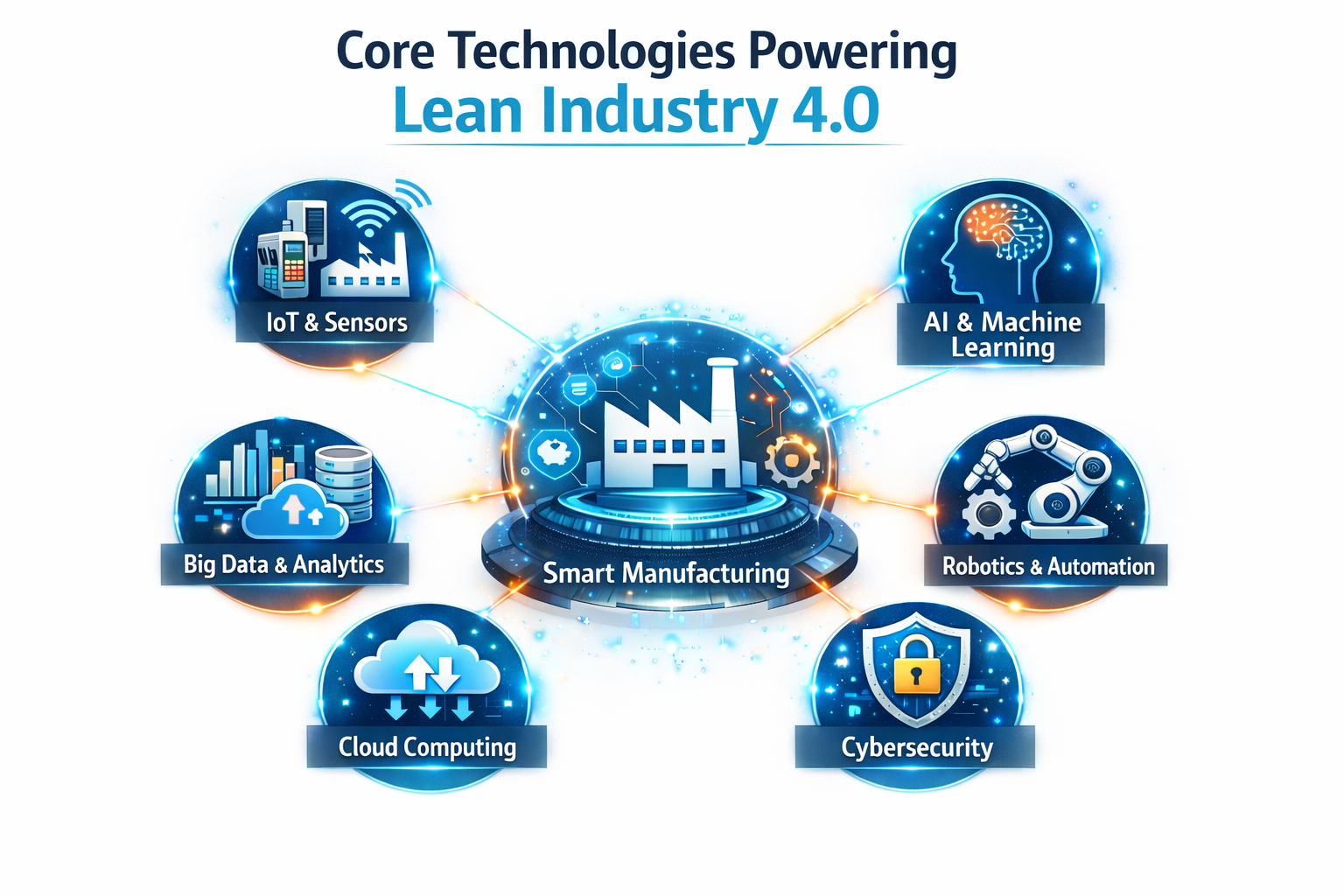
Core Technologies Powering Lean Industry 4.0
Industrial IoT Sensors
IoT sensors collect real-time data from machinery, tools, and production lines. They enable monitoring of operating conditions, performance metrics, and potential failure points across the factory floor.
Data from IoT sensors feeds into AI analytics platforms, providing actionable insights that inform maintenance, scheduling, and production optimisation decisions.
Connected devices create a live digital representation of the factory, ensuring that deviations from expected performance are immediately detected and addressed.
IoT also supports energy and resource tracking, enabling sustainable manufacturing practices and reducing unnecessary consumption.
Overall, IoT sensors form the foundation of data-driven Lean Industry 4.0 operations, supporting predictive analytics and intelligent automation.
Artificial Intelligence and Machine Learning
AI algorithms process vast amounts of production data to detect patterns, predict failures, and optimise workflows. Machine learning models continuously improve accuracy as more data is collected.
AI enables predictive maintenance, quality control, and throughput optimisation by identifying inefficiencies and suggesting corrective actions before issues impact production.
Advanced analytics can simulate different production scenarios, helping managers make data-driven decisions with minimal risk.
AI also enables real-time anomaly detection, automatically alerting teams to irregularities and supporting immediate response.
By combining AI with Lean principles, manufacturers achieve higher operational efficiency and reduced downtime.
Digital Twins
Digital twins create virtual replicas of physical systems, allowing simulation of production processes and equipment performance.
Manufacturers can test process changes, production expansions, and maintenance strategies virtually before implementation, reducing risk and improving accuracy.
Digital twins provide detailed insights into bottlenecks, resource utilisation, and potential failure points.
They enable proactive planning and optimisation, ensuring efficient use of assets and smoother production flow.
As part of Lean Industry 4.0, digital twins support continuous improvement by visualising outcomes and informing real-world decisions.
Collaborative Robots (Cobots)
Cobots automate repetitive and physically demanding tasks while safely working alongside human operators.
They enhance productivity without displacing skilled labor, allowing human workers to focus on high-value activities.
Cobots are programmable and adaptable, enabling rapid changes in production setups and supporting flexible manufacturing.
Integrated with AI and IoT, cobots respond intelligently to process variations and maintain consistent quality.
The use of collaborative robots strengthens Lean Industry 4.0 operations by improving throughput and operational safety.
Cloud Computing and Data Integration
Cloud platforms centralise data from machines, production systems, quality controls, and supply chains.
This enables real-time collaboration across departments, plants, and geographies while ensuring data security and consistency.
Cloud integration simplifies system scalability, allowing organisations to expand production lines or facilities without compromising visibility or control.
It supports advanced analytics, predictive insights, and AI-driven decision-making across the enterprise.
Cloud computing provides the backbone for fully connected, data-driven Lean Industry 4.0 operations.
How Digitalisation Enhances Waste Reduction
Real-Time Process Monitoring
Digital systems continuously monitor production processes, detecting inefficiencies as they occur. Operators receive instant alerts on deviations that could result in waste or downtime.
This proactive visibility reduces defects, rework, and scrap, helping manufacturers optimise resources and materials.
Performance dashboards provide a clear overview of all assets and production lines, highlighting underperforming areas for corrective action.
Manufacturers can prioritise issues based on impact, reducing both time and resource waste.
Real-time monitoring transforms reactive problem-solving into proactive waste prevention.
Data-Driven Decision Making
Advanced analytics provide insights into process inefficiencies, cycle time variations, and material usage.
AI identifies patterns and predicts bottlenecks, enabling teams to make informed decisions that reduce operational waste.
Historical data analysis allows the identification of recurring issues, improving long-term process efficiency.
Decision-making supported by accurate data ensures that corrective actions are targeted and effective.
Data-driven strategies make continuous improvement sustainable and measurable across production lines.
Optimised Resource and Energy Utilisation
Digital tools track energy, materials, and manpower utilisation to ensure optimal use of resources.
Identifying overuse or inefficiencies reduces operating costs and environmental impact.
Energy monitoring systems alert teams to spikes in consumption, enabling immediate adjustments.
Digitalisation ensures resources are deployed where they add the most value.
This focus on efficiency supports Lean Industry 4.0 objectives of reducing waste and increasing profitability.
Predictive Maintenance and Downtime Reduction
Predictive maintenance leverages AI to anticipate equipment failures before they occur, reducing unplanned downtime.
By preventing stoppages, manufacturers avoid wasted production time and material loss.
Digital tools schedule maintenance based on actual machine conditions rather than fixed intervals, optimising resource allocation.
Early detection of potential issues maintains production flow and quality standards.
This approach reduces both operational waste and maintenance costs while increasing equipment reliability.
Continuous Improvement and Lean Optimisation
Digitalisation supports Lean manufacturing principles by tracking metrics such as OEE, cycle time, and defect rates.
Teams can analyse trends to identify improvement opportunities and eliminate inefficiencies systematically.
Process changes are tested and validated using data, ensuring that improvements are effective and scalable.
Ongoing measurement reinforces accountability and maintains focus on waste reduction.
Overall, digitalisation accelerates continuous improvement initiatives and strengthens operational performance.
Delivering Real-Time Production Visibility
Live Dashboards and Instant Metrics
Digital dashboards display real-time performance data from all production lines, providing operators and managers with up-to-the-minute insights.
These dashboards include metrics like throughput, downtime, cycle times, and defect rates, making performance tracking seamless and actionable.
Visual alerts highlight deviations and emerging issues, enabling immediate corrective actions to maintain operational stability.
Remote access allows leadership to monitor production even from off-site locations, ensuring continuous oversight.
Live dashboards enhance transparency and accountability, making real-time visibility a cornerstone of Lean Industry 4.0.
Predictive Trend Analysis
AI interprets historical and real-time data to forecast performance trends and potential disruptions.
Predictive insights enable proactive maintenance, scheduling adjustments, and rapid resource reallocation.
Trend analysis helps prioritise critical interventions before they impact production output.
Manufacturers can plan operations more effectively, minimising delays and inefficiencies.
Proactive visibility reduces reactive firefighting and supports strategic production decisions.
Cross-Functional Collaboration
Real-time data access ensures maintenance, quality, and operations teams work with the same accurate information.
This shared visibility improves coordination, reduces miscommunication, and speeds issue resolution.
Teams can respond faster to bottlenecks, process variations, or equipment anomalies.
Centralised data fosters accountability across departments and shifts.
Collaboration enabled by real-time visibility strengthens overall operational performance.
Operational Agility and Responsiveness
Instant visibility allows production teams to adapt quickly to market demands, resource constraints, or unexpected disruptions.
Rapid detection and resolution of issues minimise downtime and maintain continuous workflow.
Agile response strategies help maintain customer commitments and quality standards.
Data-driven insights support both short-term decisions and long-term strategic planning.
Operational agility is a key benefit of Lean Industry 4.0, ensuring competitiveness in dynamic markets.
Continuous Improvement Feedback Loops
Real-time production metrics feed directly into continuous improvement initiatives.
Teams can measure the impact of process changes immediately and refine strategies based on accurate results.
Feedback loops accelerate problem-solving and promote a culture of data-driven optimisation.
Visibility across all production stages allows iterative enhancements and rapid scaling of best practices.
Continuous feedback ensures Lean Industry 4.0 operations remain efficient, resilient, and future-ready.
Enabling Predictive, Data-Driven Decision-Making
Harnessing Real-Time Operational Data
Lean Industry 4.0 collects continuous production data to provide actionable insights. By tracking Availability, Performance, and Quality metrics in real time, organisations can detect inefficiencies and potential disruptions immediately.
Predictive analytics use historical and live data to forecast equipment failures, bottlenecks, and quality deviations before they occur.
This capability allows teams to anticipate problems, allocate resources effectively, and prevent costly downtime.
Data-driven alerts support rapid, evidence-based decision-making at all levels of the organisation.
Ultimately, predictive intelligence strengthens operational resilience and enhances strategic planning capabilities.
Optimising Workflow and Resource Allocation
Predictive insights help prioritise high-impact improvements by highlighting which assets, lines, or shifts require attention.
Maintenance schedules, staffing, and material deployment can be adjusted based on AI forecasts, maximising productivity.
Data-driven optimisation ensures that resources are used efficiently and that operations remain agile.
Teams can test scenarios virtually to understand potential impacts before implementation.
Workflow optimisation reduces waste, minimises delays, and improves overall throughput.
Enhancing Proactive Problem-Solving
Predictive monitoring empowers operators to address issues before they escalate into production losses.
Early detection of quality deviations and speed losses enables timely corrective actions.
Teams can implement preventive strategies and reduce the frequency of emergency interventions.
This proactive approach encourages a culture of continuous improvement and accountability.
Proactive problem-solving ensures sustainable gains in efficiency, quality, and reliability.
Supporting Strategic Business Objectives
Predictive insights link operational performance to business goals, ensuring that production improvements align with profitability, customer satisfaction, and market responsiveness.
Data-driven forecasting helps management make informed investment and expansion decisions.
Operational planning can incorporate predictive intelligence to optimise production schedules and delivery commitments.
Strategic alignment strengthens competitiveness and reduces operational risk.
Lean Industry 4.0 transforms data into a strategic advantage across the organisation.
Continuous Learning and Improvement
Machine learning models update continuously based on new production data, improving the accuracy of predictions over time.
Each cycle of data collection and analysis reinforces operational knowledge and informs future decisions.
Continuous learning enables ongoing optimisation of equipment, processes, and human performance.
Feedback loops ensure corrective actions are validated and scaled across production lines.
This iterative process drives long-term operational excellence in Lean Industry 4.0 factories.
Turning Insights into Intelligent Automated Actions
Automated Performance Alerts
Lean Industry 4.0 platforms convert predictive insights into automated alerts for operators and managers, enabling immediate response to anomalies.
Alerts cover machine stoppages, speed losses, and quality deviations, reducing reliance on manual monitoring.
Automatic notifications ensure critical issues are prioritised, improving operational efficiency.
Teams are empowered to act quickly and consistently across production lines.
Automation ensures real-time responsiveness and reduces the likelihood of oversight.
Intelligent Workflow Adjustments
AI-driven systems can autonomously adjust machine settings, process parameters, or production sequences based on predictive insights.
This reduces downtime, prevents defects, and maintains optimal output without constant human intervention.
Workflow automation optimises energy, materials, and labour use simultaneously.
Smart actions allow consistent adherence to standardised procedures and best practices.
Overall, automation transforms insights into immediate, measurable operational improvements.
Targeted Corrective Measures
Data analysis identifies the root causes of inefficiencies and recommends precise corrective actions.
Automated workflows ensure that improvements are applied in the right location at the right time.
Targeted interventions reduce waste and maximise equipment utilisation.
Teams can monitor results instantly and adjust actions dynamically.
This process ensures that Lean Industry 4.0 operations remain efficient, adaptive, and productive.
Seamless Integration with Human Operations
Automation supports human operators rather than replacing them, enabling collaborative decision-making with AI insights.
Teams can focus on strategic tasks while repetitive or high-risk processes are handled automatically.
Human oversight ensures quality and accountability remain high.
Operators gain confidence through transparent, AI-supported actions that are easy to monitor and adjust.
Integrating humans and intelligent automation creates resilient, flexible production environments.
Measurable Operational Impact
Automated actions generate data that can be analysed to verify efficiency improvements and ROI.
Performance tracking demonstrates the effect of AI-driven interventions on throughput, quality, and downtime.
Management can quantify the impact of automation initiatives to inform further optimisation efforts.
Real-time measurement reinforces continuous improvement cycles and operational accountability.
Lean Industry 4.0 ensures automation leads to tangible, sustainable performance gains.
Detecting and Eliminating Bottlenecks Faster
Real-Time Constraint Identification
AI monitors production flow continuously to identify process constraints, slowdowns, and recurring stoppages as they occur.
Early detection prevents bottlenecks from causing significant delays or quality issues.
Visual dashboards highlight problem areas for rapid response by operators and supervisors.
Real-time insight ensures that critical production issues are addressed before escalation.
Early intervention improves overall equipment effectiveness and production consistency.
Root Cause Analysis Powered by AI
Machine learning algorithms analyse historical and live data to identify the underlying causes of production bottlenecks.
This enables teams to implement targeted solutions rather than temporary fixes.
AI identifies patterns invisible to manual monitoring, uncovering hidden inefficiencies.
Root cause clarity accelerates corrective actions and reduces recurrence.
Accurate analysis strengthens long-term process reliability and flow stability.
Optimising Production Flow
Resolved bottlenecks restore balanced workflows and increase throughput across lines.
Operational adjustments based on AI insights improve cycle times, reduce idle periods, and maintain quality standards.
Teams can simulate potential process changes before implementation to evaluate effectiveness.
Optimised flow enhances overall manufacturing efficiency and customer satisfaction.
Continuous monitoring ensures that improvements are sustained over time.
Supporting Lean and Agile Manufacturing
Bottleneck detection aligns with lean principles by reducing waste and maximizing value-added activities.
Agile operations benefit from the ability to adjust production priorities dynamically based on real-time constraints.
Teams gain visibility into capacity limitations and can plan maintenance or resource allocation proactively.
Lean Industry 4.0 enables more responsive and adaptable manufacturing processes.
This approach strengthens competitiveness and operational resilience.
Measuring Improvement Impact
AI dashboards track the effect of interventions on throughput, downtime, and cycle efficiency.
Performance metrics validate the success of bottleneck resolution and inform future optimisation efforts.
Management can quantify improvements for reporting and strategic planning purposes.
Continuous measurement supports a culture of data-driven decision-making and accountability.
Lean Industry 4.0 ensures bottleneck management contributes to sustained operational excellence.
Standardising Processes Through Digital Systems
Unified Process Metrics
Digital platforms provide consistent measurement frameworks across shifts, lines, and facilities, reducing variability in performance evaluation.
Standardised KPIs ensure all teams operate with aligned goals and shared operational objectives.
Automated data collection eliminates discrepancies arising from manual reporting.
Unified metrics simplify comparison and benchmarking across production units.
Standardisation strengthens reliability and improves production predictability.
Digital SOP Management
Standard operating procedures are embedded within digital systems, ensuring employees follow consistent workflows.
Training modules and step-by-step guidance support workforce adherence to best practices.
Updates to SOPs are implemented instantly across all systems to maintain alignment.
Digital SOPs reduce human error and enhance compliance with quality standards.
This approach ensures repeatable, reliable production outcomes in Lean Industry 4.0 factories.
Cross-Department Visibility and Alignment
Standardisation enables shared access to real-time performance data across operations, maintenance, and quality teams.
Transparent data enhances coordination and reduces miscommunication.
Teams can make aligned decisions, respond faster to disruptions, and implement improvements effectively.
Cross-functional alignment supports operational discipline and continuous improvement.
Shared visibility strengthens accountability and reinforces organisational goals.
Continuous Standard Improvement
Digital platforms allow iterative refinement of process standards based on performance feedback.
Data-driven insights identify opportunities to optimise workflows, reduce variation, and enhance efficiency.
Regular updates ensure that standardisation evolves alongside changing production demands.
Continuous refinement fosters adaptability without sacrificing consistency.
Lean Industry 4.0 ensures processes remain efficient, scalable, and aligned with operational excellence.
Supporting Compliance and Quality Goals
Digital standardisation ensures compliance with regulatory, safety, and quality requirements.
Consistent procedures reduce defects, scrap, and rework.
Performance tracking validates adherence to standards across production units.
Automation and analytics maintain a high level of operational discipline.
This systematic approach reinforces Lean Industry 4.0 objectives for quality and efficiency.
Accelerating Continuous Improvement with Smart Analytics
Performance Trend Analysis
Smart analytics continuously track production metrics, highlighting trends, deviations, and recurring inefficiencies.
Trend data provides actionable insights for targeted process improvements.
Teams can prioritise initiatives that yield the highest impact on throughput and quality.
Analysis helps identify best practices and replicate them across lines and shifts.
Continuous monitoring fosters a culture of ongoing operational enhancement.
Data-Driven Improvement Cycles
Lean Industry 4.0 integrates analytics into Kaizen and continuous improvement initiatives.
Performance data informs iterative testing of process adjustments and workflow optimisation.
Automated feedback ensures rapid assessment of implemented changes.
Teams can scale successful improvements quickly and effectively across the organisation.
Data-driven cycles accelerate overall operational efficiency and effectiveness.
Root Cause Identification
Advanced analytics help identify underlying causes of recurring production issues.
Machine learning uncovers hidden patterns contributing to inefficiencies, defects, or delays.
Root cause clarity enables precise corrective actions instead of temporary fixes.
Corrective measures improve process stability and repeatability.
Continuous learning supports ongoing refinement and operational resilience.
Collaboration and Knowledge Sharing
Analytics platforms facilitate knowledge sharing across teams by providing standardised data and insights.
Cross-functional collaboration ensures solutions are effective and widely adopted.
Shared understanding of performance trends encourages proactive engagement from all stakeholders.
Teams can leverage historical insights to prevent future issues.
Collaborative intelligence reinforces Lean Industry 4.0 objectives of efficiency and agility.
Measuring and Scaling Improvement
Smart analytics quantify the impact of process changes and improvement initiatives.
Metrics enable management to identify scalable solutions and replicate success across facilities.
Continuous measurement validates operational enhancements and informs future strategies.
Tracking outcomes fosters accountability and evidence-based decision-making.
Lean Industry 4.0 leverages analytics to sustain continuous improvement and operational excellence.
Strengthening Operational Transparency and Accountability
Real-Time Visibility Across Teams
Lean Industry 4.0 platforms provide operators, supervisors, and executives with instant access to performance metrics across all shifts and production lines. This transparency ensures that everyone is aware of current operational status and emerging issues.
Shared dashboards display key indicators like throughput, downtime, and defect rates, enabling teams to understand the impact of their actions on overall performance.
Clear visibility fosters ownership of responsibilities, encouraging proactive engagement in process improvements.
Transparent reporting helps management identify trends, best practices, and areas requiring attention.
Overall, operational transparency strengthens accountability, collaboration, and continuous performance management.
Consistent Monitoring and Feedback
Automated data collection and AI-driven analysis ensure consistent measurement of performance metrics without human error.
Regular feedback loops provide teams with actionable insights, reinforcing adherence to operational standards.
Consistent monitoring allows deviations to be detected early, supporting timely corrective actions.
Performance tracking enhances confidence in decision-making and builds a culture of continuous improvement.
Teams remain accountable for maintaining efficiency, quality, and reliability across the production floor.
Encouraging Collaborative Problem-Solving
Real-time insights enable cross-functional teams to work together effectively on resolving bottlenecks, quality issues, and inefficiencies.
Shared data promotes alignment between operations, maintenance, and quality departments.
Collaborative approaches reduce response times and ensure that corrective actions are implemented consistently.
Teams can leverage AI insights to prioritise improvements with the greatest operational impact.
This collaborative environment strengthens organisational accountability and operational excellence.
Reducing Downtime with Predictive Maintenance
Proactive Equipment Monitoring
Predictive maintenance leverages AI and sensor data to monitor equipment health in real time, identifying potential failures before they occur.
Early detection of anomalies prevents unplanned downtime and reduces costly production stoppages.
Maintenance tasks are scheduled based on actual equipment conditions rather than fixed intervals, optimising resources.
AI models predict wear and tear trends, helping teams plan repairs and replacements efficiently.
Proactive monitoring improves machine reliability and overall production stability.
Minimising Operational Disruptions
By predicting potential failures, Lean Industry 4.0 allows teams to intervene without impacting production schedules.
Automated alerts inform operators and maintenance personnel of upcoming risks, enabling timely action.
Downtime reduction enhances throughput and maintains consistent product quality.
Predictive maintenance reduces emergency interventions and reactive repairs, saving time and cost.
Overall, operational disruptions are minimised, supporting continuous and reliable production flow.
Optimising Maintenance Efficiency
Data-driven insights help prioritise maintenance activities based on criticality and potential impact on operations.
Teams can allocate resources effectively, balancing workload and minimising unnecessary interventions.
Predictive models improve planning accuracy and ensure spare parts are available when needed.
Optimised maintenance increases equipment utilisation and extends asset lifespan.
Lean Industry 4.0 transforms maintenance from reactive to strategic and proactive.
Integrating Systems for End-to-End Manufacturing Intelligence
Seamless Connectivity Across Platforms
Lean Industry 4.0 integrates MES, ERP, quality, and maintenance systems to centralise operational data.
This unified architecture provides a single source of truth for production performance and analytics.
Integration reduces data silos and improves communication across departments and facilities.
Real-time visibility supports informed decision-making at all levels of the organisation.
Connected systems enhance operational agility and responsiveness to changing production requirements.
Enabling Smarter Decision-Making
Integrated data allows AI and analytics tools to deliver actionable insights for both immediate and strategic decisions.
Teams can monitor trends, detect anomalies, and forecast operational risks with greater accuracy.
Decision-making becomes faster, more evidence-based, and aligned with business objectives.
Integration ensures that improvements and interventions are implemented consistently across the enterprise.
This connected approach strengthens overall manufacturing intelligence and competitiveness.
Supporting Scalable Operations
Integrated systems allow organisations to expand production lines or facilities while maintaining consistent performance tracking.
Standardised data structures and analytics enable scalable replication of best practices.
System connectivity ensures that production growth does not compromise visibility or operational control.
Scalable integration supports multi-site operations and global manufacturing strategies.
Lean Industry 4.0 ensures continuous operational improvement even as organisations grow.
Tracking Critical KPIs in Real Time
Live KPI Monitoring
Real-time dashboards display key performance indicators such as OEE, cycle times, throughput, and defect rates.
Operators and managers can track production health instantly, allowing proactive response to deviations.
Continuous KPI monitoring reduces downtime, quality issues, and process inefficiencies.
Accessible dashboards across devices ensure transparency for both on-site and remote teams.
Live tracking reinforces accountability and supports data-driven operational decisions.
Predictive KPI Analysis
AI models forecast performance trends, enabling teams to anticipate potential production bottlenecks or quality deviations.
Predictive insights help prioritise interventions and allocate resources effectively.
Trend analysis supports continuous improvement initiatives and long-term planning.
Managers gain confidence in scheduling and operational strategy with forward-looking visibility.
Proactive KPI management maximises throughput and efficiency while reducing waste.
Operational Discipline and Benchmarking
Real-time KPI tracking establishes consistent standards for performance evaluation across teams and shifts.
Automated reporting simplifies benchmarking and comparison between production units.
Performance metrics reinforce adherence to operational procedures and continuous improvement goals.
Teams can identify high-performing lines and replicate best practices across the facility.
KPI discipline ensures Lean Industry 4.0 objectives of efficiency, quality, and reliability are achieved.
Aligning Smart Manufacturing with Strategic Business Goals
Linking Operational Metrics to Strategy
Lean Industry 4.0 connects shop floor data with organisational objectives, including productivity, profitability, and customer satisfaction.
Performance insights ensure that operational improvements contribute directly to business goals.
Strategic alignment allows prioritisation of initiatives that yield the highest impact on outcomes.
Cross-functional visibility supports coordination between operations, finance, and supply chain teams.
Alignment ensures manufacturing efforts support long-term growth and competitive advantage.
Driving Continuous Value Creation
Smart manufacturing strategies enable teams to continuously identify and implement improvements that maximise efficiency and reduce costs.
Operational performance is constantly measured against strategic targets for accountability.
Data-driven decision-making ensures resources are focused on high-value activities.
Management can track the return on improvement initiatives and adjust priorities accordingly.
This approach guarantees sustained operational excellence in line with corporate objectives.
Enhancing Market Responsiveness
Lean Industry 4.0 enables rapid adaptation to customer demand changes, supply chain disruptions, and market fluctuations.
Real-time insights support agile production planning and proactive risk management.
Strategic alignment ensures that manufacturing decisions maintain service levels and customer satisfaction.
Teams can respond quickly without sacrificing quality or efficiency.
Market responsiveness strengthens competitiveness and reinforces the value of smart manufacturing.
Measuring the Impact of Lean Industry 4.0 on Efficiency and Agility
Quantifying Operational Improvements
Lean Industry 4.0 platforms provide measurable metrics on throughput, downtime reduction, quality performance, and overall equipment effectiveness.
Performance data allows organisations to evaluate the impact of process improvements accurately.
Quantitative insights support informed investment decisions and continuous improvement prioritisation.
Teams can assess ROI from predictive maintenance, automation, and workflow optimisation initiatives.
Measurement ensures tangible operational gains are recognised and reinforced.
Tracking Agility and Responsiveness
Data analytics measure the speed at which operations adapt to disruptions, demand changes, and process adjustments.
Lean Industry 4.0 ensures that agility improvements are visible and actionable.
Tracking responsiveness helps management identify areas requiring attention or additional support.
Continuous monitoring of operational flexibility strengthens overall manufacturing resilience.
Agility metrics provide a benchmark for long-term strategic planning and competitiveness.
Continuous Performance Assessment
Ongoing measurement of KPIs, process efficiency, and quality ensures that Lean Industry 4.0 initiatives deliver sustained improvements.
Teams can iterate on strategies, validate outcomes, and scale successful practices across lines and facilities.
Assessment data feeds into predictive models to refine future operational planning.
Continuous evaluation ensures improvements are durable and aligned with organisational goals.
Measuring impact reinforces a culture of accountability, excellence, and innovation in smart manufacturing.