What Is a Balanced Scorecard and Why It’s Vital for Strategic Planning
Understanding the Balanced Scorecard
A balanced scorecard is a strategic management tool that helps organisations translate vision and strategy into measurable objectives. It integrates financial and non-financial metrics across multiple perspectives, giving leaders a comprehensive view of organisational performance. By monitoring financial, customer, internal process, and learning and growth indicators, organisations can ensure that resources and efforts align with strategic priorities.
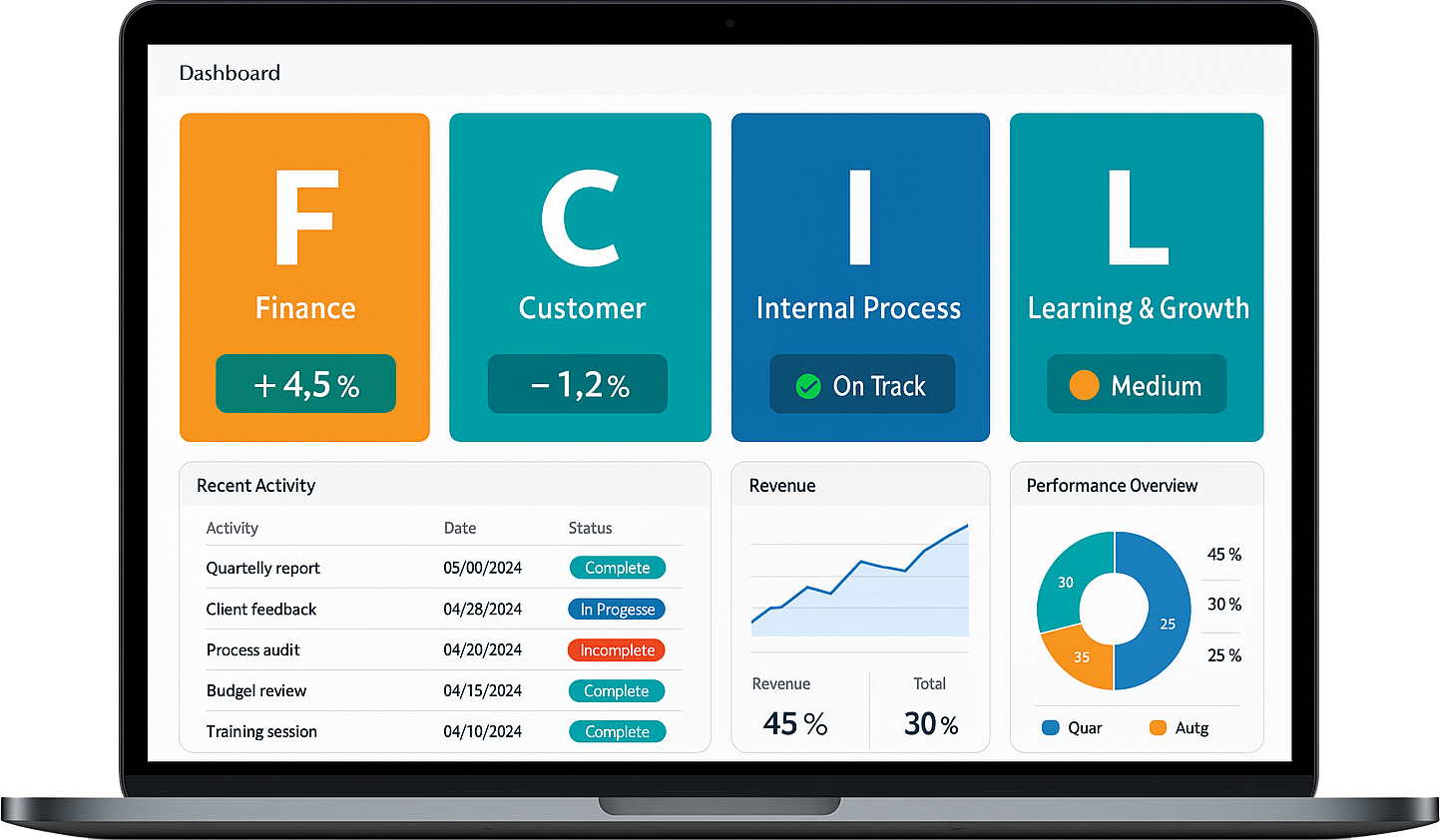
Supporting Strategic Planning
In strategic planning, the balanced scorecard acts as a framework to define objectives, set measurable KPIs, and track progress consistently. It allows organisations to identify key priorities, allocate resources efficiently, and evaluate the impact of initiatives on overall performance. This alignment ensures that planning is actionable and measurable, avoiding gaps between strategy and execution.
Enhancing Communication and Alignment
The Balanced Scorecard also strengthens internal communication by clearly linking individual and team objectives to broader organisational goals. Employees understand how their work contributes to success, fostering engagement, accountability, and alignment. This shared understanding ensures that strategic planning is not only documented but actively guides operational execution, driving long-term success.
The Four Perspectives: Financial, Customer, Internal Processes, and Learning & Growth
Financial Perspective
The financial perspective focuses on evaluating profitability, cost efficiency, revenue growth, and return on investment. Tracking these indicators ensures that the organisation’s financial resources are managed effectively and aligned with strategic objectives. Monitoring financial performance enables leaders to make informed decisions and sustain organisational stability.
Customer Perspective
This perspective measures customer satisfaction, retention, loyalty, and service quality. Understanding customer behaviour and expectations allows organisations to tailor strategies that enhance experience, build trust, and strengthen market position. Customer metrics directly influence strategic priorities and long-term growth.
Internal Processes and Learning & Growth Perspectives
The internal processes perspective assesses efficiency, quality control, cycle times, and operational effectiveness. The learning and growth perspective focuses on employee development, engagement, knowledge sharing, and innovation. Together, these perspectives ensure that both operational excellence and workforce capability drive sustainable organisational performance.
Defining Clear Strategic Objectives Before Implementation
Clarifying Organisational Goals
Before implementing a Balanced Scorecard, it is crucial to define clear strategic objectives. Objectives must be specific, measurable, achievable, relevant, and time-bound. This clarity ensures that every department understands its role in achieving the organisation’s mission and vision.
Aligning Objectives Across Perspectives
Strategic objectives should be developed across financial, customer, internal process, and learning and growth perspectives. This ensures a holistic approach to performance measurement and avoids overemphasis on a single area. Alignment across perspectives guarantees that all organisational functions contribute to the broader strategic plan.
Creating Measurable and Actionable Goals
Each objective should be paired with relevant KPIs that allow progress to be tracked effectively. By defining actionable metrics before implementation, organisations can monitor success, identify challenges early, and adjust initiatives as needed. This preparation lays the foundation for effective strategy execution.
Mapping KPIs to Strategic Goals for Effective Planning
Identifying Relevant KPIs
Mapping KPIs to strategic goals ensures that performance measurement focuses on what truly matters. KPIs should provide clear insight into progress toward objectives, allowing organisations to assess the effectiveness of initiatives and allocate resources where they have the greatest impact.
Ensuring Organisational Alignment
KPIs should cascade across departments and teams to ensure alignment with strategic priorities. When employees understand how their work contributes to larger organisational goals, engagement increases and efforts are coordinated. Visual dashboards can make these connections clear and easy to track.
Supporting Continuous Improvement
Regularly reviewing KPI performance allows organisations to identify gaps, implement improvements, and optimise processes. Linking KPIs to strategic goals ensures that every adjustment directly contributes to achieving objectives, enhancing organisational efficiency and long-term success.
Setting Targets and Benchmarks to Measure Success
Establishing Realistic Targets
Targets provide measurable benchmarks for performance. When setting targets, organisations should consider historical performance, market conditions, and resource availability. Realistic targets motivate teams while ensuring that objectives remain achievable and aligned with strategic goals.
Using Benchmarks for Comparison
Benchmarks allow organisations to compare performance against industry standards, competitors, or internal historical data. This comparison identifies strengths and weaknesses, highlighting areas for improvement and enabling data-driven decision-making.
Driving Accountability and Performance
Clear targets and benchmarks increase accountability by providing tangible measures of success. Employees understand expectations, and managers can monitor progress effectively. Regular assessment ensures that strategic initiatives remain on track, supporting organisational growth and performance improvement.
Aligning Team Performance with Organisational Strategy
Linking Individual Goals to Strategy
Alignment ensures that every team and employee understands how their contributions impact organisational objectives. Balanced scorecards provide a framework to cascade strategic goals into departmental and individual KPIs, enabling employees to see the direct impact of their work.
Enhancing Collaboration and Coordination
When performance metrics are shared across teams, collaboration improves. Teams coordinate efforts, reduce redundancy, and focus on achieving outcomes that support strategic objectives. This alignment fosters a cohesive organisational approach to strategy execution.
Driving Engagement and Accountability
Clear alignment motivates employees by showing the importance of their role in achieving organisational success. Regular feedback and monitoring reinforce accountability, encourage high performance, and ensure that team efforts remain focused on delivering strategic goals effectively.
Using Balanced Scorecards to Monitor Progress in Real Time
Visualising Performance Metrics
Real-time monitoring through balanced scorecards provides instant visibility into organisational performance. Dashboards display key metrics across financial, customer, operational, and learning perspectives, enabling leaders to track progress and make timely decisions to stay on target.
Identifying Challenges Early
Continuous monitoring allows teams to spot underperformance or emerging risks promptly. Early identification of issues enables corrective action before problems escalate, maintaining alignment with strategic objectives and improving overall organisational efficiency.
Supporting Agile Decision-Making
Real-time insights empower managers to make data-driven decisions quickly. Adjustments to resources, processes, or priorities can be implemented immediately, ensuring that daily operations remain aligned with strategic goals. This proactive approach enhances execution, accountability, and long-term performance.
Supporting Continuous Improvement (Kaizen) Through Scorecards
Understanding Continuous Improvement
Continuous improvement, or Kaizen, focuses on incremental enhancements to processes, efficiency, and quality. Balanced scorecards support this approach by providing clear, measurable indicators of performance across financial, customer, internal process, and learning perspectives. Organisations can track improvements over time and evaluate the impact of incremental changes, ensuring that every action contributes to long-term success.
Using Scorecards to Identify Improvement Opportunities
Scorecards consolidate key performance data, allowing managers to identify inefficiencies, bottlenecks, and gaps in processes. By monitoring trends and analysing KPIs regularly, teams can prioritise areas that will benefit most from improvement initiatives. This data-driven approach ensures resources are targeted effectively and process enhancements are measurable and impactful.
Embedding Kaizen in Organisational Culture
Integrating scorecard insights into daily operations encourages a culture of continuous improvement. Employees are motivated to participate in problem-solving, process optimisation, and innovation. Regular review of scorecard metrics allows teams to adjust practices in real time, creating an agile organisation that consistently evolves and improves performance across all areas.
Customising Scorecards for Different Departments and Roles
Aligning Scorecards with Department Goals
Balanced scorecards must be tailored to the specific goals and responsibilities of each department. For example, sales teams may focus on revenue growth and client retention, while operations emphasise efficiency and quality. Customised scorecards ensure that performance metrics are relevant, actionable, and aligned with departmental objectives.
Designing Role-Specific KPIs
Within departments, individual roles require specific KPIs to measure contribution to overall objectives. Tailoring scorecards for different roles ensures employees understand their responsibilities and how their performance affects organisational goals. Clear, role-specific metrics promote accountability and engagement at all levels.
Ensuring Organisational Alignment
While scorecards are customised, they must remain aligned with overall strategic objectives. Cascading KPIs from organisational goals to departmental and individual levels ensures consistency, focus, and coordination. This approach maximises efficiency, encourages collaboration, and reinforces a shared commitment to achieving strategic priorities.
Integrating Balanced Scorecards with Existing Management Systems
Creating a Unified Performance Framework
Integrating balanced scorecards with existing management systems ensures that all performance data is centralised and accessible. This integration allows organisations to consolidate financial, operational, and employee performance metrics, providing a comprehensive view of progress toward strategic objectives.
Streamlining Processes and Data Flow
Scorecard integration eliminates redundant data entry, reduces errors, and improves efficiency. By linking KPIs with established management systems, teams can automate reporting, monitor performance in real time, and respond quickly to trends or issues. This streamlined workflow enhances accuracy and reduces administrative burden.
Supporting Data-Driven Decision-Making
Integrated scorecards provide leaders with reliable, consolidated data that supports strategic decisions. Managers can track progress across departments, identify gaps, and implement corrective actions quickly. This integration ensures that strategy execution is consistent, measurable, and aligned with organisational goals.
Analysing Performance Data to Identify Strategic Gaps
Collecting and Organising Key Metrics
Balanced scorecards consolidate performance metrics across financial, customer, internal process, and learning perspectives. Organising this data allows organisations to monitor trends, evaluate performance, and identify areas where results are not meeting strategic expectations.
Identifying Gaps and Areas for Improvement
By analysing scorecard data, managers can pinpoint performance gaps, inefficiencies, or underperforming areas. Understanding these gaps enables targeted improvement initiatives that directly support strategic objectives, ensuring resources are focused where they have the greatest impact.
Enabling Strategic Adjustments
Regular data analysis allows organisations to adjust strategies and operations proactively. By reviewing KPIs and trends, leaders can make informed decisions, refine processes, and allocate resources effectively. This ensures continuous alignment between performance and strategic goals.
How Balanced Scorecards Improve Decision-Making Across Teams
Providing Clear Performance Insights
Balanced scorecards consolidate critical KPIs into a single framework, giving managers and teams a clear understanding of organisational performance. Access to accurate and up-to-date metrics enables informed decision-making that is grounded in real data rather than assumptions.
Supporting Collaborative Decisions
Scorecards allow teams to view performance metrics transparently, fostering collaboration and collective problem-solving. Shared visibility ensures that decisions are aligned with organisational objectives and supported by evidence from multiple perspectives.
Driving Timely and Effective Action
Real-time performance monitoring allows teams to act quickly when trends indicate a need for change. Managers can prioritise initiatives, allocate resources efficiently, and implement corrective actions based on data-driven insights, enhancing operational effectiveness and strategic execution.
Common Pitfalls in Strategic Planning and How to Avoid Them
Lack of Clear Objectives
One common pitfall is having vague or undefined strategic objectives. Balanced scorecards help clarify goals, ensuring that every department and employee understands expectations and how their work contributes to organisational success.
Poor Alignment Across Teams
Disconnecting strategy from operational activities is another frequent mistake. Scorecards align individual, departmental, and organisational KPIs, ensuring cohesive execution, reducing redundancies, and enhancing efficiency.
Failure to Monitor and Adjust
Failing to track progress and adapt strategies can undermine planning. Regular review of scorecard metrics allows leaders to identify gaps, evaluate performance, and implement changes proactively, ensuring strategic initiatives remain relevant and effective.
Measuring ROI and the Impact of Strategic Initiatives
Tracking Financial Outcomes
Balanced scorecards enable organisations to measure return on investment by monitoring financial KPIs, including revenue growth, cost reductions, and profitability. This data provides insight into the financial impact of strategic initiatives, allowing leaders to assess value and success effectively.
Assessing Non-Financial Impacts
Scorecards also track non-financial outcomes, such as customer satisfaction, employee engagement, and process efficiency. Evaluating these metrics alongside financial data ensures a holistic understanding of the initiative’s impact and identifies areas for improvement.
Supporting Data-Driven Resource Allocation
Measuring ROI with balanced scorecards allows organisations to allocate resources strategically, prioritising initiatives that deliver the greatest value. Continuous monitoring ensures that investments align with strategic objectives, driving sustained organisational performance and growth.
Building a High-Performance Culture Through Balanced Scorecard Insights
Embedding Strategy in Daily Work
Balanced scorecards link strategic objectives with departmental and individual KPIs, making strategy actionable at all levels. This visibility ensures employees understand how their work contributes to organisational success, fostering a culture focused on high performance and accountability.
Encouraging Engagement and Collaboration
Scorecard insights enhance transparency, allowing teams to see performance trends and opportunities. Shared metrics promote collaboration, collective problem-solving, and engagement, motivating employees to contribute effectively toward organisational goals.
Driving Continuous Improvement
Regular monitoring and analysis of scorecard data support continuous learning and improvement. Teams can identify gaps, optimise processes, and implement best practices, creating a culture of excellence that drives long-term growth and organisational success.