The integration of Artificial Intelligence (AI) and the Internet of Things (IoT)
Modern manufacturers face constant pressure to reduce waste, improve efficiency, and deliver consistent quality. By integrating Artificial Intelligence (AI) and the Internet of Things (IoT) into lean production systems, organisations can transform traditional processes into intelligent, data-driven operations. AI and IoT work together to enhance visibility, streamline workflows, and support continuous improvement without disrupting core lean principles.
IoT sensors collect real-time data from machines, materials, and production lines, providing instant insights into performance, downtime, energy usage, and output levels. AI analyses this data to identify patterns, predict potential issues, and recommend process improvements. This combination enables faster decision-making, reduced inefficiencies, and improved operational control.
Connected systems ensure that production, inventory, and quality management are digitally aligned. With complete transparency across operations, teams can quickly detect bottlenecks, minimise waste, and maintain consistent performance standards while adapting to changing customer demands.
Enhancing Real-Time Operational Visibility
IoT-enabled devices provide continuous monitoring of equipment and workflows, offering real-time dashboards that display key performance indicators. Managers can instantly track uptime, throughput, and material flow, allowing them to respond quickly to disruptions and prevent minor issues from escalating.
This level of visibility strengthens lean practices by reducing uncertainty and supporting data-driven decisions. Teams can focus on value-added activities while automated systems handle monitoring and reporting.
Reducing Downtime with Predictive Maintenance
AI-powered predictive analytics uses machine data to forecast potential equipment failures before they occur. Instead of relying on reactive maintenance, organisations can schedule servicing based on actual machine conditions, reducing unplanned downtime and extending asset lifespan.
Predictive maintenance not only improves reliability but also lowers repair costs and prevents production delays, supporting smoother lean operations.
Improving Quality Through Intelligent Monitoring
AI-driven quality control systems analyse production data in real time to detect defects and process variations. Automated alerts enable teams to correct issues immediately, preventing defective products from progressing further in the value stream.
By identifying root causes and tracking performance trends, AI strengthens continuous improvement initiatives and ensures consistent product quality.
Optimising Inventory and Resource Allocation
IoT-based tracking systems monitor inventory levels and material movement with precision. AI forecasting tools analyse demand patterns to optimise stock levels, reducing excess inventory while preventing shortages.
This intelligent resource management improves cash flow, shortens lead times, and ensures that materials are available exactly when needed — a core objective of lean production.
Driving Continuous Improvement with Data Insights
AI and IoT generate actionable insights that support ongoing process optimisation. Performance metrics are automatically analysed, enabling organisations to identify inefficiencies, eliminate waste, and refine workflows systematically.
By embedding intelligence into everyday operations, lean production systems become more agile, responsive, and scalable. The integration of AI and IoT not only enhances operational efficiency but also builds resilient, future-ready manufacturing environments capable of sustained competitive advantage.
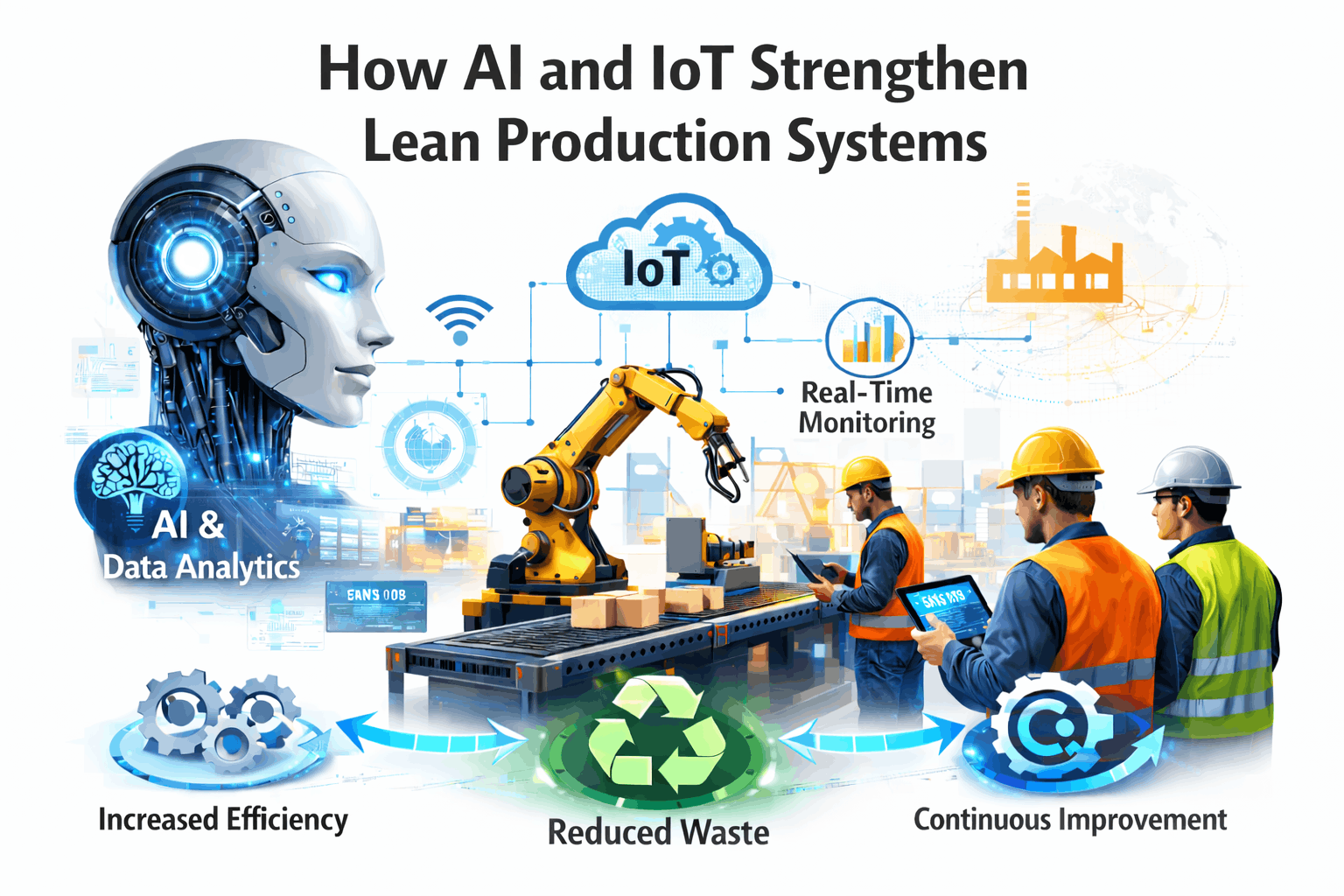
How AI and IoT Strengthen Lean Production Systems
Artificial Intelligence (AI) and the Internet of Things (IoT) enhance lean production by transforming traditional manufacturing systems into intelligent, connected environments. IoT devices gather real-time data from machines, materials, and workflows, while AI analyses this information to improve accuracy, efficiency, and responsiveness.
By combining data visibility with advanced analytics, organisations can reduce waste, optimise resource utilisation, and maintain consistent production flow. This integration supports core lean principles such as continuous improvement, value stream optimisation, and operational discipline.
AI and IoT also improve cross-functional coordination by connecting production, maintenance, and supply chain systems. The result is a more agile and resilient lean production model capable of adapting to changing market demands.
In addition, digital integration enhances decision-making at every level of the organisation. Managers gain deeper insight into performance trends, enabling strategic planning that aligns operational activities with long-term business objectives.
As data becomes more accessible and actionable, lean production evolves from reactive problem-solving to proactive optimisation, strengthening competitiveness and operational excellence.
Enabling Real-Time Monitoring with IoT Sensors
IoT sensors provide continuous visibility into machine performance, material movement, and production progress. Real-time dashboards allow managers to track key performance indicators such as uptime, throughput, and energy consumption.
This immediate insight helps detect bottlenecks, reduce delays, and maintain smooth workflow across operations. Teams can respond quickly to performance deviations, preventing small issues from escalating into larger disruptions.
Enhanced monitoring strengthens lean systems by ensuring transparency, accountability, and faster decision-making throughout the production environment.
Live tracking of production metrics also supports better collaboration between departments. When teams share the same real-time information, communication improves and alignment becomes easier to maintain.
Over time, consistent monitoring creates a reliable performance baseline, allowing organisations to measure improvements accurately and refine processes systematically.
Using AI for Predictive Analytics in Production
AI-powered analytics evaluate historical and real-time production data to forecast trends, identify patterns, and anticipate potential disruptions. Predictive insights allow organisations to adjust schedules, allocate resources effectively, and prevent unexpected downtime.
Instead of reacting to problems after they occur, businesses can proactively manage operations based on intelligent forecasts. This improves production stability and supports lean objectives of minimising waste and maximising efficiency.
Predictive analytics also enhances demand forecasting and inventory planning, ensuring that materials and resources are aligned with actual production needs.
Machine learning models continuously improve as more data is collected, increasing the accuracy of predictions and strengthening operational reliability over time.
By integrating predictive intelligence into daily workflows, organisations can reduce variability, optimise cycle times, and create a more stable and efficient production system.
Reducing Waste through Smart Automation
Smart automation systems eliminate repetitive manual tasks, reduce errors, and improve process consistency. AI-driven controls optimise machine settings, production speeds, and material usage to minimise excess and defects.
Connected systems monitor energy consumption and equipment conditions, helping organisations reduce operational losses and avoid unnecessary resource usage. Automated quality checks further prevent defective products from progressing through the value stream.
By integrating automation with intelligent analytics, lean production systems become more efficient, cost-effective, and capable of delivering higher value with fewer resources.
Automation also supports standardised workflows, ensuring that best practices are consistently applied across shifts and production lines. This reduces variation and strengthens overall process stability.
As waste is systematically reduced, organisations experience improved profitability, faster delivery times, and enhanced customer satisfaction, reinforcing the long-term benefits of AI-driven lean systems.
Optimising Processes with Intelligent Data Insights
AI-powered analytics transform raw production data into actionable insights that improve workflow efficiency and reduce operational variability. By analysing cycle times, machine utilisation, and throughput rates, organisations can identify bottlenecks and optimise resource allocation.
Real-time dashboards provide clear visibility into process performance, enabling faster decision-making and continuous refinement of lean workflows. Over time, intelligent insights support stable, predictable, and highly efficient production systems.
Advanced analytics also help detect hidden inefficiencies that may not be visible through manual observation. Pattern recognition tools uncover recurring delays, micro-stoppages, or resource imbalances that impact productivity.
By embedding AI insights into daily operations, businesses create a culture of data-driven optimisation where continuous improvement becomes systematic and measurable.
Preventing Downtime with Predictive Maintenance
IoT sensors continuously monitor equipment health, capturing vibration, temperature, and performance data. AI models analyse this information to predict potential failures before breakdowns occur.
This proactive maintenance strategy reduces unplanned downtime, extends equipment lifespan, and ensures consistent production flow — strengthening lean objectives and operational reliability.
Predictive alerts allow maintenance teams to schedule interventions during planned downtimes, minimising disruption to production schedules.
Over time, collected machine data improves forecasting accuracy, helping organisations refine maintenance strategies and allocate resources more efficiently.
Improving Quality with Data-Driven Control Systems
Smart quality control systems use AI algorithms and sensor data to detect deviations in real time. Automated alerts allow immediate corrective action, preventing defects from progressing through the value stream.
Continuous monitoring of quality KPIs ensures consistent standards, reduces rework, and enhances customer satisfaction while supporting lean manufacturing excellence.
Historical quality data can be analysed to identify root causes of recurring defects, enabling preventive improvements rather than reactive corrections.
Integrated reporting tools also simplify compliance tracking, audits, and documentation, ensuring transparency and operational accountability.
Creating Connected and Intelligent Production Environments
Integrated IoT networks connect machines, systems, and teams into a unified digital ecosystem. This connectivity enables seamless communication between production, maintenance, and planning functions.
A connected production environment improves coordination, enhances transparency, and enables faster adaptation to demand changes while maintaining lean efficiency.
Data flows automatically across platforms such as ERP and MES systems, ensuring real-time synchronisation between operations and business management.
This digital integration supports smarter collaboration, faster problem resolution, and improved alignment across the entire production value chain.
Optimising Inventory with AI-Based Forecasting
AI-driven demand forecasting analyses historical trends and real-time sales data to optimise stock levels. This prevents overproduction and reduces excess inventory costs.
Smart inventory systems ensure materials are available exactly when needed, supporting just-in-time practices and improving cash flow management.
Predictive analytics also adjust reorder points dynamically based on demand fluctuations, supplier performance, and seasonal trends.
Optimised inventory management reduces storage costs, improves working capital efficiency, and enhances overall supply chain responsiveness.
Enhancing Energy Efficiency through IoT Monitoring
IoT-enabled energy monitoring systems track power consumption across equipment and production lines. Analytics identify inefficiencies and recommend optimisation strategies.
Improved energy efficiency reduces operational costs, supports sustainability initiatives, and aligns with lean principles of waste reduction.
Energy performance benchmarking across shifts or departments highlights opportunities for continuous improvement.
Predictive energy modelling also helps organisations anticipate peak usage periods and optimise scheduling to minimise utility expenses.
Integrating Smart Supply Chains with Lean Systems
Digital supply chain integration connects suppliers, inventory, and logistics partners in real time. This improves demand planning, reduces delays, and enhances coordination.
A smart supply chain ensures materials flow smoothly into production, supporting lean objectives of reduced lead times and improved responsiveness.
Shared data platforms allow suppliers to access forecasts and shipment updates, strengthening collaboration and reducing uncertainty.
Advanced analytics also evaluate supplier performance trends, helping businesses refine procurement strategies and mitigate risks.
Strengthening Lean Efficiency with Automation
Automation eliminates repetitive tasks, increases precision, and standardises workflows. AI-driven scheduling and robotic systems improve throughput without increasing labour costs.
By combining automation with lean methodologies, organisations achieve consistent performance, reduced variability, and scalable efficiency.
Robotic process automation can streamline administrative processes such as order processing and reporting, enhancing overall operational productivity.
Automation also generates valuable operational data that supports continuous process optimisation and performance tracking.
Empowering Teams with Digital Lean Tools
Digital dashboards, collaboration platforms, and mobile applications provide employees with real-time performance insights. This empowers teams to make informed decisions and address issues proactively.
Access to shared data fosters accountability, encourages innovation, and strengthens continuous improvement initiatives across the organisation.
Digital training tools accelerate onboarding and skills development, ensuring employees can adapt quickly to evolving technologies.
Empowered teams contribute actively to optimisation efforts, creating a culture of engagement and operational excellence.
Building Scalable Smart Manufacturing Systems
Cloud-based platforms and digital workflows enable organisations to scale operations efficiently without proportional increases in resources.
Scalable smart systems maintain quality, efficiency, and agility as production volumes grow, ensuring sustainable long-term expansion.
Performance analytics highlight capacity constraints early, allowing proactive planning for growth.
Scalable infrastructure ensures that technological investments continue delivering value as business complexity increases.
Supporting Lean Decision-Making with AI Insights
AI-driven analytics provide predictive insights that guide strategic and operational decisions. Managers can simulate scenarios, optimise schedules, and allocate resources effectively.
Data-backed decision-making reduces uncertainty, enhances responsiveness, and strengthens lean performance across all functions.
Real-time KPI monitoring ensures that strategic objectives remain aligned with operational activities.
AI-powered recommendations help leaders prioritise improvements that deliver the highest operational impact.
Enhancing Operational Visibility with IoT Connectivity
IoT connectivity enables real-time tracking of machines, materials, and workflows across facilities. Centralised dashboards offer a comprehensive view of performance metrics.
Greater visibility improves transparency, speeds up issue resolution, and supports consistent execution of lean strategies.
Remote monitoring capabilities allow managers to oversee multiple sites and ensure consistent standards.
Historical performance tracking also supports benchmarking and long-term operational planning.
Driving Continuous Improvement with AI and IoT
AI and IoT continuously collect and analyse operational data, identifying opportunities for optimisation and waste reduction.
Automated reporting and performance tracking accelerate improvement cycles, embedding continuous enhancement into everyday operations.
Trend analysis highlights incremental gains that compound into significant long-term efficiency improvements.
Digital documentation ensures that lessons learned are captured and shared across teams.
Implementing Intelligent Quality Management Systems
Smart quality systems integrate AI analytics with automated inspections to ensure consistent compliance and traceability.
By centralising quality data, organisations reduce defects, streamline audits, and maintain high customer satisfaction standards.
Integrated root cause analysis tools enable faster resolution of recurring issues.
Quality insights feed directly into production planning, ensuring continuous alignment between standards and execution.
Accelerating Lean Digital Transformation
Digital transformation initiatives align lean methodologies with advanced technologies such as AI, IoT, and cloud computing.
This alignment enhances agility, reduces operational waste, and positions organisations to innovate and compete effectively in dynamic markets.
Cross-functional collaboration improves as digital tools break down information silos.
Sustained digital adoption ensures continuous operational evolution and long-term competitiveness.
Gaining Competitive Advantage through AI-Driven Lean Production
By integrating AI and IoT into lean systems, organisations achieve higher productivity, improved quality, and faster response times.
This intelligence-driven approach strengthens resilience, lowers costs, and creates a sustainable competitive advantage in modern manufacturing environments.
Continuous innovation supported by digital insights ensures adaptability in rapidly changing markets.
Ultimately, AI-driven lean production positions businesses for long-term growth, operational excellence, and industry leadership.