What Are the 4 Phases of the Strategic Management Process?
The strategic management process is a structured business approach used by organisations to define goals, create strategies, implement plans, and evaluate performance. It helps businesses align their resources, people, and operations with long-term objectives while adapting to changing market conditions.
The 4 phases of the strategic management process include Environmental Scanning, Strategy Formulation, Strategy Implementation, and Strategy Evaluation. Together, these phases provide a complete framework for organisational planning and sustainable growth.
Strategic management enables organisations to make informed decisions by analysing both internal strengths and external market opportunities. It creates a clear direction for achieving competitive advantage and long-term success.
Businesses across industries use strategic management to improve efficiency, reduce uncertainty, strengthen leadership, and respond effectively to market challenges.
It also improves organisational focus by ensuring that all departments work towards common business objectives rather than isolated targets.
Furthermore, the strategic management process encourages continuous learning and adaptability, allowing organisations to remain competitive in rapidly evolving markets.
Ultimately, strategic management acts as a roadmap that guides organisations towards sustainable performance, operational excellence, and future growth.
Companies that consistently follow strategic management principles are often better prepared to handle market disruptions, changing customer expectations, and technological advancements.
By maintaining a long-term strategic vision, organisations can improve business stability while creating new opportunities for innovation and expansion.
Why the Strategic Management Process Matters for Business Success
The strategic management process is essential because it provides organisations with a clear structure for planning and achieving long-term objectives. Without a strategic framework, businesses often struggle with unclear priorities, inconsistent decision-making, and poor resource allocation.
Strategic management helps organisations identify market opportunities, anticipate risks, and respond proactively to industry changes. This improves competitiveness and long-term stability.
It also strengthens alignment between leadership, employees, and operational activities. When strategic goals are clearly communicated, teams understand their responsibilities and contribute more effectively towards organisational success.
Another major advantage is improved decision-making. Strategic management provides data-driven insights that support better financial planning, operational efficiency, and market positioning.
It enables organisations to monitor performance continuously, ensuring that business activities remain aligned with changing customer demands and market conditions.
Strong strategic management also enhances innovation by encouraging organisations to explore new ideas, technologies, and growth opportunities.
Ultimately, the strategic management process creates a disciplined and forward-thinking business culture focused on long-term performance and sustainable success.
Businesses that invest in strategic planning often experience better employee engagement because teams understand the organisation’s direction and long-term goals more clearly.
Effective strategic management also improves customer satisfaction by helping organisations deliver consistent products, services, and overall customer experiences.
Understanding the Strategic Management Process and Its Business Impact
The strategic management process is designed to help organisations analyse their current position, establish objectives, develop strategies, and measure results effectively.
It combines business analysis, planning, execution, and performance monitoring into a continuous cycle of improvement and adaptation.
By following a structured management process, organisations can identify strengths, weaknesses, opportunities, and threats more accurately. This improves strategic decision-making and operational planning.
Strategic management also supports organisational agility by enabling businesses to adapt quickly to economic changes, customer expectations, and competitive pressures.
Its impact extends beyond leadership teams because it influences operational efficiency, employee engagement, customer satisfaction, and overall business performance.
It also creates accountability by ensuring that strategic goals are measurable and regularly reviewed.
Over time, effective strategic management strengthens business resilience and helps organisations maintain a competitive advantage in challenging markets.
Organisations that continuously refine their strategies are more likely to achieve sustainable growth and maintain long-term market relevance.
Strategic management also improves collaboration across departments by aligning operational activities with company-wide objectives and performance expectations.
Overview of the 4 Phases of Strategic Management
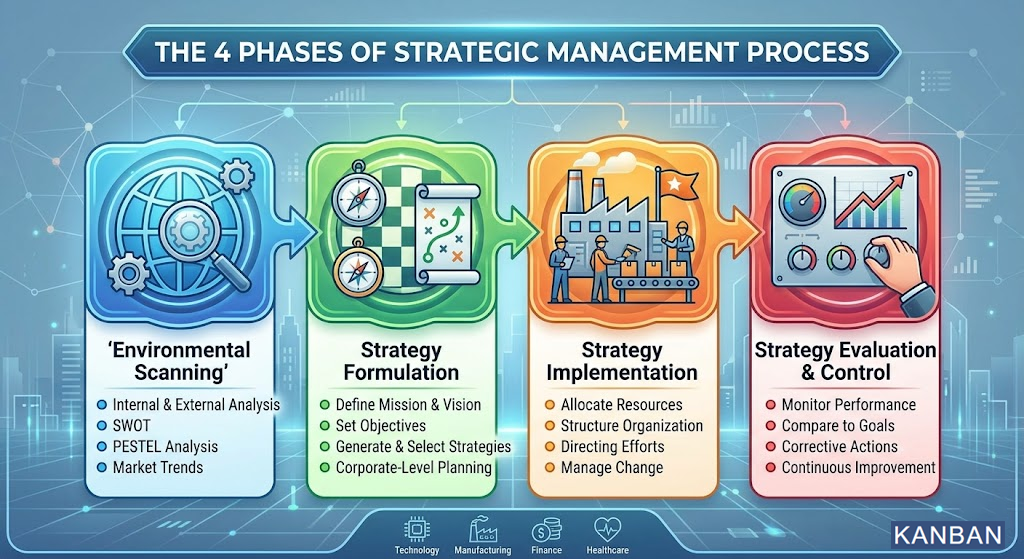
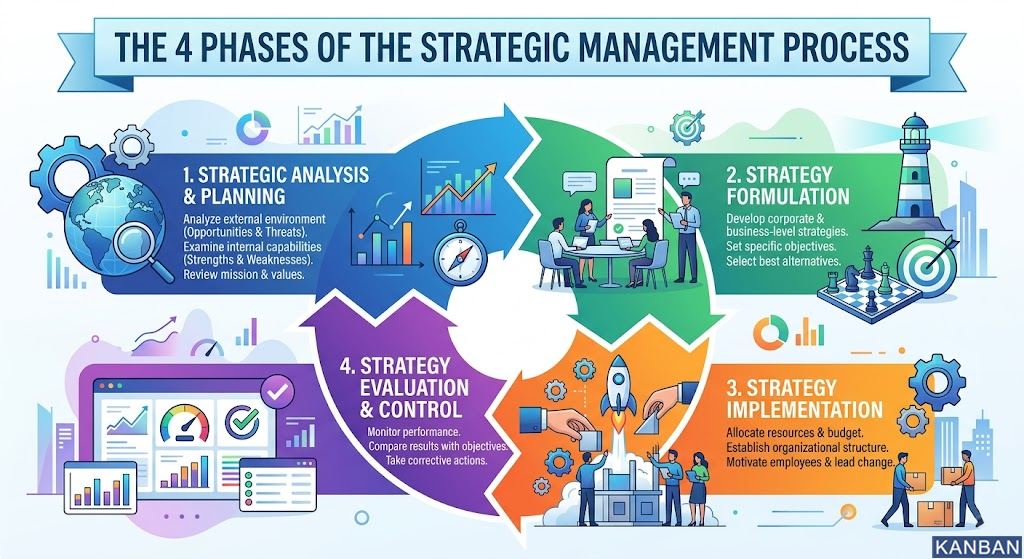
The 4 phases of strategic management form a complete framework for planning, executing, and improving business performance.
Phase 1 – Environmental Scanning: Involves analysing internal and external business environments to identify opportunities, risks, strengths, and weaknesses.
Phase 2 – Strategy Formulation: Focuses on creating strategic objectives, business plans, and competitive approaches based on organisational analysis.
Phase 3 – Strategy Implementation: Involves executing strategic plans through resource allocation, leadership direction, and operational management.
Phase 4 – Strategy Evaluation: Measures business performance, reviews strategic effectiveness, and identifies areas for improvement.
These four phases work together to ensure that organisations maintain alignment between planning, execution, and business goals.
They also support continuous improvement by encouraging organisations to evaluate results regularly and adapt strategies when necessary.
Successful organisations treat strategic management as an ongoing cycle rather than a one-time planning activity.
Each phase contributes to stronger organisational decision-making and helps businesses remain flexible in competitive and rapidly changing markets.
When properly integrated, these strategic phases improve operational efficiency, business performance, and long-term organisational sustainability.
Phase 1 – Environmental Scanning and Business Analysis
Environmental scanning is the first phase of the strategic management process and focuses on analysing both internal and external business environments. Organisations assess market trends, customer expectations, competitor activities, economic conditions, and operational performance to identify opportunities and potential risks.
This phase helps businesses understand their current position while supporting informed strategic decision-making. By evaluating organisational strengths and weaknesses alongside external opportunities and threats, companies can create a strong foundation for future planning and long-term success.
Environmental scanning also enables organisations to identify emerging market trends before competitors, allowing businesses to prepare strategic responses more effectively. This proactive approach supports better risk management and improves long-term organisational stability.
Businesses that regularly conduct environmental analysis are often more capable of adapting to customer behaviour changes, economic uncertainty, and evolving industry regulations. It also strengthens strategic forecasting and improves overall business resilience.
In addition, environmental scanning encourages continuous organisational learning by helping leadership teams monitor performance patterns, technological developments, and competitive market movements more consistently.
Environmental scanning also improves business adaptability by helping organisations respond proactively to changing market conditions, technological developments, and industry challenges.
Phase 2 – Strategy Formulation and Business Planning
Strategy formulation involves developing clear business objectives, strategic priorities, and long-term plans based on insights gathered during environmental analysis. Organisations define their vision, mission, competitive approach, and growth strategies to achieve sustainable business success.
Strategy formulation also supports stronger financial planning by helping organisations prioritise investments, operational improvements, and growth initiatives more effectively. This improves resource utilisation and long-term business sustainability.
Clear strategic planning allows businesses to establish measurable objectives and performance targets that guide decision-making across all departments and management levels.
Furthermore, organisations with well-defined strategic plans are generally better positioned to respond to market uncertainty, customer expectations, and competitive pressures while maintaining operational stability.
This phase enables leadership teams to allocate resources effectively while creating practical plans that align with organisational goals. Strategic planning also helps businesses improve market positioning, operational efficiency, and overall competitiveness.
Well-structured strategy formulation ensures that organisations maintain a clear direction while preparing for future business opportunities and market changes.
Phase 3 – Strategy Implementation and Organisational Execution
Strategy implementation focuses on converting strategic plans into practical business actions. This phase involves assigning responsibilities, managing resources, improving communication, and aligning operational activities with strategic objectives.
Successful implementation requires strong leadership, employee engagement, and effective coordination across departments. Organisations must ensure that teams clearly understand business goals and contribute towards achieving them efficiently.
Effective strategy execution improves productivity, operational performance, and organisational consistency while supporting long-term business growth and stability.
Phase 4 – Strategy Evaluation and Performance Monitoring
Strategy evaluation is the final phase of the strategic management process and focuses on measuring organisational performance against strategic objectives. Businesses review key performance indicators, financial outcomes, operational efficiency, and overall business progress.
Successful strategy implementation also requires effective performance management systems that track progress and ensure accountability throughout the organisation. Regular communication helps teams remain aligned with business priorities and operational objectives.
Organisations that focus on strong implementation practices often experience improved employee productivity, better operational coordination, and higher levels of customer satisfaction.
Additionally, effective execution helps businesses convert strategic ideas into measurable outcomes, ensuring that long-term goals are supported by consistent day-to-day operational activities.
This phase helps organisations identify areas requiring improvement while ensuring that strategic plans remain aligned with changing market conditions and customer expectations.
Continuous performance monitoring supports informed decision-making, encourages organisational learning, and enables businesses to adapt strategies for long-term success and sustainable growth.
How the Strategic Management Process Works in Organisations
The strategic management process works as a continuous cycle that helps organisations plan, execute, monitor, and improve business performance. It begins with analysing the business environment, followed by developing strategic objectives and implementing practical action plans.
Another important benefit of strategic management is improved organisational focus. Clear strategic objectives help employees understand business priorities and contribute more effectively towards long-term success.
Strategic management also strengthens operational consistency by ensuring that business decisions are aligned with organisational goals, performance expectations, and market demands.
Furthermore, businesses with effective strategic management processes are often more resilient during economic uncertainty because they can respond quickly to external challenges and changing industry conditions.
Organisations then evaluate performance regularly to ensure that business activities remain aligned with strategic goals. This structured approach improves decision-making, strengthens accountability, and supports long-term organisational success.
By integrating planning with operational execution, strategic management helps businesses remain competitive, adaptable, and focused on sustainable growth.
Key Benefits of Using a Strategic Management Process
The strategic management process provides organisations with a clear framework for achieving long-term objectives and improving overall business performance. It supports better decision-making by helping businesses identify opportunities, manage risks, and allocate resources effectively.
Strategic management also supports sustainable expansion by helping organisations balance short-term operational demands with long-term business objectives. This creates greater stability and future growth opportunities.
Businesses that invest in long-term strategic planning are often more successful in building stronger customer relationships, improving brand reputation, and increasing market share.
Additionally, continuous strategic development encourages organisations to innovate, improve efficiency, and maintain competitiveness within rapidly changing business environments.
Strategic management also improves communication, employee alignment, operational efficiency, and organisational accountability. Teams gain a clearer understanding of business priorities and contribute more effectively towards shared objectives.
Additionally, organisations that adopt strategic management practices are often better prepared to respond to market changes, customer demands, and competitive pressures.
Strategic Management and Long-Term Business Growth
Strategic management plays an important role in supporting long-term business growth by helping organisations establish clear goals and sustainable development plans. It enables businesses to identify expansion opportunities, improve operational efficiency, and strengthen competitive positioning.
Strategic planning tools also improve communication across organisations by presenting business data and performance insights in a clear and structured manner. This supports faster and more accurate decision-making.
Many organisations combine multiple strategic tools to gain a broader understanding of business performance, customer expectations, financial outcomes, and operational risks.
Furthermore, the use of digital strategic planning systems allows businesses to monitor performance in real time while improving reporting accuracy and organisational transparency.
By maintaining a long-term strategic focus, organisations can adapt to market changes more effectively while improving financial performance and customer satisfaction.
Strong strategic management also encourages innovation, continuous improvement, and organisational resilience, all of which contribute to sustainable growth and long-term business stability.
Strategic Planning Tools Used in Modern Organisations
Modern organisations use various strategic planning tools to improve analysis, decision-making, and business performance management. Common tools include SWOT analysis, PESTLE analysis, Balanced Scorecards, KPI dashboards, and business performance frameworks.
KPIs also help organisations establish measurable benchmarks that support strategic planning and continuous performance improvement. Regular monitoring ensures that operational activities remain aligned with business objectives.
Businesses that use clearly defined KPIs are often better equipped to identify performance trends, improve efficiency, and make informed operational decisions.
Additionally, KPI reporting improves organisational transparency by providing leadership teams with accurate insights into business progress, operational challenges, and growth opportunities.
These tools help organisations evaluate internal capabilities, monitor market conditions, and measure progress against strategic objectives. They also support data-driven decision-making and improve organisational planning accuracy.
Using strategic planning tools enables businesses to maintain better operational control while supporting continuous improvement and long-term strategic success.
Key Performance Indicators in Strategic Management
Key Performance Indicators (KPIs) are measurable values used to track organisational performance and evaluate strategic success. Businesses use KPIs to monitor financial performance, operational efficiency, customer satisfaction, employee productivity, and overall business growth.
Effective KPI management helps organisations identify strengths, address performance gaps, and make informed strategic decisions. It also improves accountability by ensuring that progress towards business objectives is monitored consistently.
Strong leadership also encourages employee engagement by creating a positive organisational culture focused on collaboration, accountability, and shared business success.
Leaders play an essential role in managing organisational change and ensuring that strategic initiatives are implemented effectively across all business functions.
Furthermore, effective leadership strengthens business resilience by helping organisations remain focused, adaptable, and prepared for future operational and market challenges.
Well-defined KPIs support continuous improvement and help organisations maintain alignment between strategic plans and operational activities.
Role of Leadership in Strategic Management Success
Leadership plays a critical role in the success of the strategic management process. Strong leadership helps organisations establish clear business goals, communicate strategic priorities, and guide teams towards achieving organisational objectives.
Organisations should also ensure that employees receive appropriate training and support during implementation to improve engagement and operational effectiveness.
Regular communication and progress reviews help leadership teams identify challenges early and maintain alignment between strategic objectives and business activities.
Furthermore, successful implementation requires continuous monitoring, adaptability, and commitment to long-term organisational improvement and sustainable business performance.
Effective leaders support decision-making, encourage collaboration, and create a culture focused on accountability and continuous improvement. They also help organisations respond confidently to market changes and business challenges.
By providing direction and maintaining organisational focus, leadership strengthens strategic execution and supports long-term business performance.
Step-by-Step Guide to Implementing a Strategic Management Process
Implementing a strategic management process begins with analysing the business environment and identifying organisational goals. Businesses then develop strategic plans, allocate resources, and establish clear responsibilities for execution.
The next step involves monitoring performance regularly through KPIs, business reviews, and operational assessments. Organisations should continuously evaluate results and adjust strategies where necessary to maintain alignment with changing market conditions.
A structured implementation process improves organisational efficiency, strengthens accountability, and supports sustainable long-term business success.
Digital Tools and Software for Strategic Planning and Tracking
Digital tools and strategic planning software help organisations manage business objectives, monitor performance, and improve operational visibility. Many businesses use dashboards, Balanced Scorecard software, KPI tracking systems, and project management platforms to support strategic execution.
Digital strategic management tools also improve collaboration by allowing teams to share business information, monitor objectives, and track progress through centralised platforms.
Many organisations use cloud-based software solutions to improve accessibility, reporting accuracy, and performance visibility across multiple departments and business locations.
Additionally, modern strategic planning software supports faster decision-making by providing automated reporting, data analysis, and real-time business performance insights.
These digital solutions provide real-time insights that improve decision-making, performance monitoring, and organisational communication. They also help businesses track progress more accurately while supporting data-driven strategic planning.
By using modern digital tools, organisations can improve efficiency, strengthen performance management, and maintain better alignment between strategic goals and operational activities.
The 4 phases of the strategic management process help organisations improve business performance by creating a structured and systematic approach to planning, execution, monitoring, and continuous improvement.
Common Mistakes in Strategic Management Implementation
Many organisations face challenges during strategic management implementation because of unclear objectives, poor communication, or insufficient planning. Without a clear strategic direction, teams may struggle to align operational activities with organisational goals.
Another common mistake is failing to involve employees in the strategic process. When staff members do not understand business priorities or their responsibilities, implementation often becomes inconsistent and ineffective.
Organisations may also experience difficulties when leadership teams fail to monitor progress regularly or adapt strategies in response to changing market conditions. This can lead to poor decision-making and reduced organisational performance.
Insufficient resource allocation is another major issue that affects strategic execution. Businesses must ensure that financial resources, technology, and skilled personnel are available to support long-term objectives effectively.
Companies that avoid these common mistakes are generally more successful in maintaining operational efficiency, strategic alignment, and sustainable business growth.
Regular performance reviews, employee engagement, and continuous communication can significantly improve the success of strategic management implementation across organisations.
How Strategic Management Supports Organisational Culture
Strategic management plays an important role in shaping and strengthening organisational culture by aligning employees with shared business goals and values. A clear strategic direction helps teams understand the organisation’s purpose and long-term objectives.
Strong strategic management encourages accountability, collaboration, and continuous improvement throughout the workplace. Employees are more likely to remain engaged when they understand how their contributions support overall business success.
Leadership teams also use strategic management to promote innovation, adaptability, and positive workplace behaviours that support organisational performance.
An effective organisational culture improves communication, employee motivation, and operational consistency across departments and management levels.
Businesses with strong strategic cultures are often more resilient during periods of change because employees remain focused on shared priorities and long-term goals.
Strategic management also supports employee development by encouraging learning, performance improvement, and greater involvement in organisational decision-making.
Identifying Performance Gaps Through Strategic Evaluation
Strategic evaluation helps organisations identify performance gaps by comparing actual business results against planned objectives and performance targets. This process allows businesses to assess operational effectiveness and strategic progress more accurately.
Performance gap analysis highlights areas where organisations may be underperforming in relation to financial goals, customer satisfaction, operational efficiency, or employee productivity.
By identifying these gaps early, businesses can implement corrective actions that improve performance and strengthen overall strategic execution.
Regular evaluation also supports continuous improvement by helping organisations refine processes, adjust strategies, and respond to changing business conditions more effectively.
Performance analysis provides leadership teams with valuable insights that support informed decision-making and long-term organisational development.
Businesses that consistently monitor performance gaps are often better prepared to maintain competitiveness, improve efficiency, and achieve sustainable growth.
Strategic Management and Effective Decision-Making
Strategic management improves organisational decision-making by providing structured analysis, clear objectives, and reliable performance information. Businesses can make more informed choices when decisions are supported by accurate data and long-term planning.
Effective decision-making helps organisations allocate resources efficiently, manage operational risks, and identify growth opportunities within competitive markets.
Strategic management also supports faster responses to market changes because leadership teams have access to performance insights and strategic priorities.
Organisations that adopt structured decision-making processes are often more successful in maintaining operational stability and achieving business objectives.
Data-driven strategic decisions improve financial performance, strengthen customer relationships, and support long-term organisational growth.
Furthermore, effective strategic management reduces uncertainty by helping organisations evaluate potential outcomes before implementing major business decisions.
Role of Communication in the Strategic Management Process
Communication is a critical element of the strategic management process because it ensures that organisational goals, priorities, and expectations are clearly understood across all business levels.
Effective communication helps leadership teams share strategic objectives with employees while improving collaboration and operational coordination.
When communication is clear and consistent, employees are more likely to remain engaged and aligned with organisational strategies and performance expectations.
Strong communication also supports change management by helping organisations explain strategic decisions and reduce uncertainty during business transitions.
Businesses that prioritise communication often experience stronger teamwork, improved productivity, and better strategic implementation outcomes.
Additionally, open communication encourages feedback and continuous improvement, allowing organisations to identify operational challenges and strategic opportunities more effectively.
Continuous Improvement and Strategic Management
Continuous improvement is an essential part of strategic management because it encourages organisations to review performance regularly and identify opportunities for operational enhancement.
Businesses that focus on continuous improvement are often better equipped to increase efficiency, reduce waste, and improve customer satisfaction over time.
Strategic management supports this process by establishing measurable goals, monitoring performance indicators, and encouraging ongoing organisational learning.
Continuous improvement also strengthens adaptability by helping businesses respond more effectively to changing customer expectations, industry developments, and competitive pressures.
Organisations that adopt a culture of continuous improvement are generally more innovative, resilient, and prepared for long-term business growth.
Regular evaluation and process refinement help businesses maintain high performance standards while supporting sustainable operational success.
Future Trends in Strategic Management and Business Planning
The future of strategic management is increasingly influenced by digital transformation, data analytics, automation, and artificial intelligence. Organisations are adopting advanced technologies to improve planning accuracy and business decision-making.
Modern businesses are also focusing more on agility and flexibility to respond quickly to changing market conditions and customer expectations.
Cloud-based strategic planning tools and real-time performance dashboards are becoming more common as organisations seek greater visibility and operational efficiency.
Sustainability and environmental responsibility are also becoming important strategic priorities for organisations across multiple industries.
Future strategic management practices are expected to place greater emphasis on innovation, employee engagement, and customer-focused business strategies.
Businesses that adapt to emerging trends and technological advancements are more likely to maintain competitiveness and achieve long-term organisational success.
Conclusion: Why the 4 Phases of Strategic Management Are Important
The 4 phases of strategic management provide organisations with a structured framework for analysing business conditions, developing strategies, implementing plans, and monitoring performance effectively.
These phases help businesses improve decision-making, strengthen operational efficiency, and maintain alignment between organisational goals and daily activities.
Strategic management also supports adaptability by enabling organisations to respond proactively to market changes, customer expectations, and competitive challenges.
Businesses that consistently apply strategic management principles are often better positioned to achieve sustainable growth, financial stability, and long-term success.
By integrating planning, execution, evaluation, and continuous improvement, organisations can create stronger business foundations and improve overall organisational performance.
Ultimately, the strategic management process acts as a roadmap that guides organisations towards innovation, resilience, operational excellence, and future business growth.