What Are the 4 Levels of Business Strategy?
The 4 Levels of Business Strategy describe a structured framework that organisations use to plan, implement, and manage strategic direction across every layer of the business. These levels ensure that long-term goals are translated into actionable plans that guide departments, teams, and day-to-day operations.
The four levels include corporate-level strategy, business-level strategy, functional-level strategy, and operational-level strategy. Each level serves a distinct purpose, but they all work together to ensure consistency, alignment, and strategic clarity across the organisation.
This framework is widely used in modern management because it bridges the gap between high-level vision and practical execution. It ensures that leadership decisions are reflected in departmental planning and frontline activities.
Organisations that apply the 4 levels of strategy effectively are better equipped to improve performance, maintain competitive advantage, and respond to changing market conditions with agility and confidence.
The framework also provides a structured approach to breaking down complex organisational goals into manageable components. It allows leaders to communicate expectations more effectively across different departments. Employees gain a clearer understanding of how their work contributes to overall success. It reduces confusion and improves coordination across teams. Ultimately, it creates a more disciplined and goal-oriented organisation.
Why the 4 Levels of Business Strategy Matter in Modern Organisations
Modern businesses operate in highly competitive, fast-changing environments where clear strategic direction is essential for survival and growth. The 4 Levels of Business Strategy provide a structured approach that helps organisations maintain focus while scaling effectively.
Without a layered strategy framework, businesses often experience misalignment between leadership vision and operational execution. This leads to inefficiencies, duplicated effort, and unclear performance expectations across teams.
The 4 levels matter because they ensure that every part of the organisation contributes to the same strategic objectives. From executive leadership to frontline employees, everyone works within a unified strategic direction.
They also improve decision-making by ensuring that choices made at departmental level support broader corporate goals. This reduces wasted resources and increases organisational efficiency.
This structured approach also improves organisational stability during periods of change. It ensures that all departments remain aligned even when market conditions shift. Leaders can respond more quickly to challenges without disrupting operations. It strengthens long-term planning and reduces strategic uncertainty. As a result, businesses become more resilient and adaptable.
Understanding the 4 Levels of Business Strategy and Their Core Functions
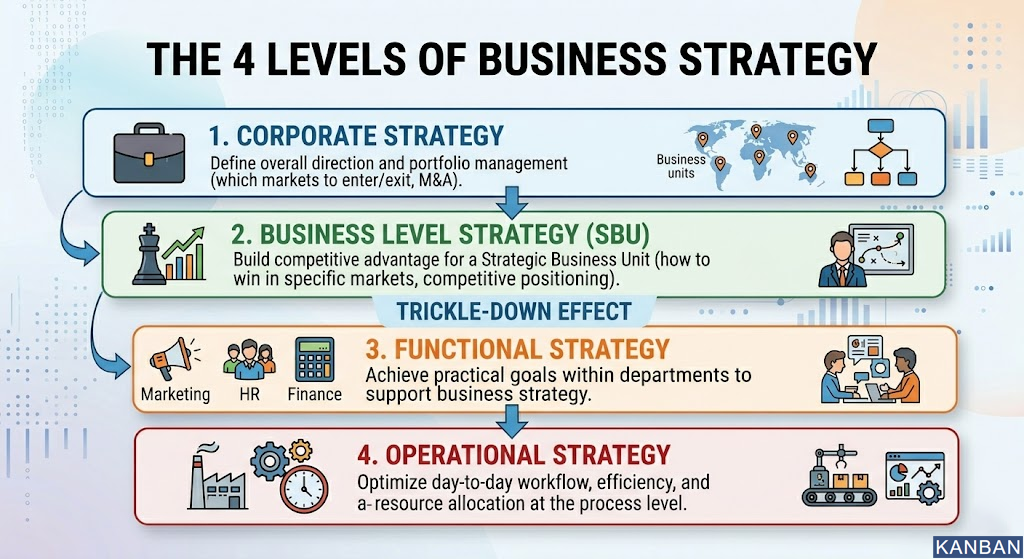
The 4 Levels of Business Strategy represent a hierarchy of planning that connects long-term vision with day-to-day execution. Each level plays a unique role in ensuring that strategy is both actionable and measurable.
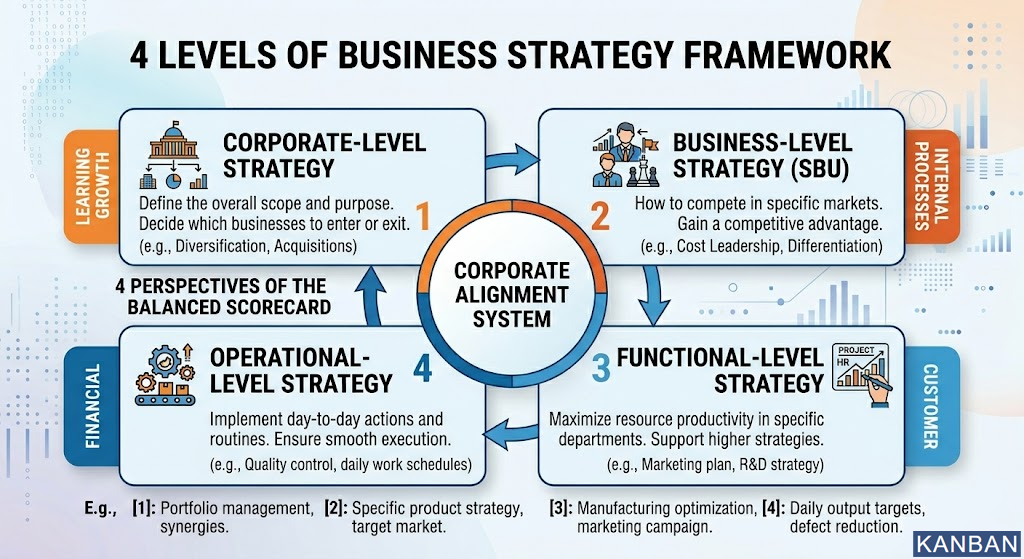
At the highest level, corporate strategy defines the overall direction of the organisation. Below this, business-level strategy focuses on how the organisation competes in specific markets. Functional-level strategy ensures departments operate efficiently, while operational strategy manages daily execution.
Together, these levels create a structured system that improves coordination between leadership, management, and operational teams.
This layered approach is particularly valuable in large organisations where multiple departments and business units must work together towards shared goals.
It also enables better strategic control, allowing leaders to monitor performance at different levels and make informed adjustments when needed.
The framework supports clarity in organisational design and reduces duplication of effort across departments. It ensures that each level has clearly defined responsibilities and measurable outcomes. Communication becomes more structured and less fragmented. Decision-making becomes faster due to clearer reporting lines. Overall, it strengthens organisational discipline and efficiency.
Level 1: Corporate-Level Strategy Explained
Corporate-level strategy is the highest level of business strategy and focuses on the overall scope and direction of the organisation. It is typically developed by senior executives and board members.
This level defines which markets the organisation will operate in, what industries it will compete in, and how resources will be allocated across different business units.
Corporate strategy also involves major decisions such as mergers, acquisitions, diversification, and long-term investment planning. These decisions shape the overall structure and future growth of the organisation.
A strong corporate-level strategy ensures that all business units operate under a unified vision and contribute to long-term organisational success.
It also plays a key role in risk management by balancing investment across different markets and reducing over-reliance on a single revenue stream.
This level of strategy sets the foundation for organisational sustainability and long-term competitiveness. It guides leadership in making high-impact financial and structural decisions. It ensures resources are allocated where they deliver maximum value. It helps organisations expand strategically rather than reactively. Ultimately, it defines the long-term identity of the business.
Level 2: Business-Level Strategy and Competitive Advantage
Business-level strategy focuses on how an organisation competes within specific markets or industries. It is concerned with gaining a competitive advantage over rivals.
This level involves decisions around pricing, product differentiation, customer targeting, branding, and market positioning. It determines how a business attracts and retains customers.
Companies often choose between strategies such as cost leadership, differentiation, or niche market focus depending on their strengths and market conditions.
A well-developed business-level strategy helps organisations stand out in competitive markets while maintaining profitability and customer loyalty.
It also ensures that resources are allocated effectively to areas that generate the highest return on investment.
This strategy directly influences customer perception and market reputation. It helps organisations build long-term brand value and trust. Strong positioning improves resilience against competitors. It supports innovation by encouraging differentiation in products and services. It ultimately drives revenue growth and market expansion.
Level 3: Functional-Level Strategy and Departmental Alignment
Functional-level strategy focuses on individual departments such as marketing, finance, human resources, operations, and IT. It ensures that each function supports the wider business strategy.
This level translates business goals into departmental objectives, ensuring that every team understands its role in achieving organisational success.
For example, the marketing department may focus on brand awareness and customer acquisition, while operations focuses on efficiency and service delivery.
Functional strategies improve coordination between departments and help eliminate inefficiencies caused by misaligned objectives.
They also enhance performance management by introducing clear KPIs and measurable targets for each department.
This level ensures that specialist teams operate efficiently within their own domains while supporting overall business objectives. It improves collaboration between departments through shared goals. It reduces silos that often slow down organisational performance. It enhances accountability through structured reporting systems. It strengthens overall operational effectiveness.
Level 4: Operational-Level Strategy and Day-to-Day Business Operations
Operational-level strategy focuses on the day-to-day activities that keep the organisation running efficiently. It is the most detailed level of strategy and is closely linked to execution.
This level includes workflows, production processes, scheduling, task management, and performance monitoring at an operational level.
Operational strategy ensures that employees understand their daily responsibilities and how their work contributes to broader organisational goals.
It also helps improve productivity by standardising processes and reducing operational inefficiencies.
Strong operational strategy is essential for maintaining consistency, quality control, and service reliability across the organisation.
This level directly impacts customer satisfaction through efficient service delivery. It ensures that operational systems run smoothly without disruption. It supports consistency in output and performance standards. It allows managers to monitor real-time productivity. It forms the backbone of organisational execution.
How the 4 Levels of Business Strategy Work Together
The 4 Levels of Business Strategy are interconnected and must work in harmony to achieve organisational success. Each level supports and reinforces the others.
Corporate strategy sets the direction, business strategy defines competition, functional strategy enables departmental execution, and operational strategy ensures daily delivery.
When aligned properly, these levels create a seamless flow from vision to execution, ensuring that strategic goals are achieved efficiently.
This integration helps organisations avoid fragmentation, where departments work independently without contributing to shared objectives.
It also improves coordination, reduces inefficiencies, and strengthens overall business performance.
When all levels are aligned, organisations experience smoother communication and faster execution of strategies. Decision-making becomes more consistent across departments. Teams are better able to collaborate towards shared outcomes. Strategic priorities are easier to track and measure. This creates a unified and high-performing organisation.
The Importance of Strategic Alignment Across All Business Levels
Strategic alignment ensures that all four levels of business strategy operate in harmony towards shared organisational objectives. It connects corporate vision with departmental execution and daily operational tasks. Without alignment, organisations risk inconsistency, duplication of effort, and unclear priorities. Proper alignment strengthens coordination between leadership, management, and frontline teams. It ensures that every decision contributes directly to long-term business success.
Alignment also improves organisational efficiency by removing conflicting objectives between departments. It allows managers to prioritise resources based on strategic importance rather than isolated departmental goals. Employees gain clarity on expectations and performance standards. Communication becomes more structured and transparent across the organisation. This leads to a more unified and productive business environment.
Strong strategic alignment supports better governance and accountability at every level. It ensures that KPIs are consistently linked to overall business outcomes. Leaders can monitor performance more effectively across departments. It reduces operational risks caused by miscommunication or misdirection. Ultimately, it strengthens organisational stability and long-term growth potential.
Strategic alignment also enhances cross-functional collaboration by ensuring departments work towards shared outcomes rather than isolated targets. It helps eliminate duplication of effort and wasted resources. Leaders can create more cohesive strategies that integrate all areas of the organisation. It improves responsiveness to market changes through unified action. It also strengthens organisational culture by promoting shared purpose. Decision-making becomes more efficient and structured. Overall, alignment drives sustainable competitive advantage.
Using the 4 Levels of Business Strategy for Strategic Planning and Organisational Success
The 4 Levels of Business Strategy provide a structured foundation for effective strategic planning. They help organisations translate long-term vision into practical and measurable actions. Each level ensures that planning is aligned from corporate objectives down to operational execution. This structured approach reduces ambiguity and improves focus across the organisation. It ensures that all departments contribute meaningfully to strategic success.
Strategic planning becomes more effective because goals are clearly defined and cascaded throughout the organisation. Leaders can allocate resources more efficiently based on priority areas. Departments gain clarity on performance expectations and deliverables. It improves coordination between business units and functional teams. This leads to more consistent and predictable outcomes.
The framework also supports adaptability in changing market conditions. Organisations can adjust strategies at different levels without disrupting overall direction. It encourages continuous review and refinement of goals. Planning becomes a dynamic and responsive process rather than a static document. This increases long-term organisational resilience and competitiveness.
The structured planning approach also improves strategic transparency across all leadership levels. It ensures that decision-making is based on clear priorities and measurable outcomes. Teams can better anticipate organisational needs and prepare accordingly. It reduces uncertainty in long-term forecasting and budgeting. It strengthens alignment between strategy and execution. It also enhances organisational agility in fast-changing markets. Ultimately, it builds a stronger foundation for scalable growth.
Measuring Business Success Through Strategic Goals and KPIs
Measuring success within the 4 Levels of Business Strategy relies heavily on clearly defined KPIs and performance metrics. Each level of strategy requires specific indicators to track progress effectively. Corporate KPIs measure overall profitability and growth. Business-level KPIs assess competitive performance. Functional and operational KPIs focus on efficiency and execution quality.
This structured measurement system ensures transparency across the organisation. Leaders can quickly identify whether strategic goals are being achieved. It allows for data-driven decision-making rather than assumptions. Departments can track their own performance against clear benchmarks. This improves accountability and ownership of results.
Regular performance measurement also supports continuous improvement. Organisations can identify trends, gaps, and opportunities for optimisation. It helps refine strategy based on real performance data. This ensures that strategic planning remains relevant and effective. Ultimately, it strengthens organisational performance and long-term success.
A robust KPI system also enables predictive insights that support proactive management. Businesses can identify risks before they escalate into major issues. It allows leadership teams to adjust strategies in real time. Performance dashboards improve visibility across all departments. It enhances communication between management and operational teams. It also ensures alignment with long-term objectives. Ultimately, it transforms performance management into a strategic advantage.
How the 4 Levels of Business Strategy Support Employee Performance and Accountability
The 4 Levels of Business Strategy play a vital role in improving employee performance by creating clarity in roles and expectations. Employees understand how their tasks contribute to broader organisational goals. This increases motivation and engagement across teams. It also reduces confusion regarding responsibilities. Clear strategic direction improves workplace efficiency and morale.
Accountability is strengthened because performance expectations are clearly defined at every level. Managers can track employee contributions using structured KPIs. Employees receive regular feedback based on measurable outcomes. This encourages continuous improvement and professional development. It also creates a culture of responsibility and ownership.
The framework supports workforce alignment with organisational priorities. Training and development become more targeted and effective. Employees are better equipped to meet performance expectations. This leads to improved productivity and job satisfaction. Ultimately, it strengthens overall organisational capability.
Employee performance also improves through clearer communication between leadership and staff. Workers understand how their contributions impact business success. Motivation increases when employees see measurable results of their work. It encourages collaboration and teamwork across departments. It also reduces performance gaps caused by misunderstanding. Recognition systems become more effective when aligned with strategy. Overall, it builds a high-performance workplace culture.
Improving Decision-Making Through Multi-Level Business Strategy
Multi-level business strategy improves decision-making by providing structured insights from across the organisation. Leaders can evaluate information from corporate, business, functional, and operational levels. This creates a more complete understanding of organisational performance. Decisions become more informed and balanced. It reduces reliance on isolated or incomplete data.
The framework enables faster and more accurate responses to business challenges. Managers can identify risks and opportunities early. Decisions can be made based on real-time performance data. This improves agility and responsiveness in competitive markets. It also reduces operational uncertainty.
Improved decision-making leads to stronger strategic execution. Organisations can align decisions with long-term goals more effectively. It enhances coordination between departments and leadership teams. This results in more consistent and reliable outcomes. Ultimately, it strengthens organisational success and stability.
Decision-making also benefits from improved visibility across departments and systems. Leaders gain access to real-time insights that support faster action. It reduces dependency on outdated or incomplete reports. It improves confidence in strategic planning. Teams can collaborate more effectively on complex decisions. It strengthens organisational resilience in uncertain environments. Overall, it ensures smarter and more strategic leadership.
The Role of Visual Management and Reporting in Business Strategy
Visual management plays an essential role in simplifying complex strategic information. It uses dashboards, charts, and scorecards to present performance data clearly. This helps organisations understand progress at a glance. It reduces the need for lengthy reports. Visual tools improve accessibility and communication.
It also enhances transparency across all levels of business strategy. Employees and managers can view real-time performance updates. This encourages accountability and engagement. It ensures that everyone is aligned with strategic objectives. It also improves collaboration between departments.
Visual reporting supports faster decision-making and operational efficiency. Leaders can quickly identify issues and take corrective action. It improves monitoring of KPIs and strategic goals. This leads to more proactive management. Ultimately, it strengthens organisational performance and clarity.
Visual systems also make complex data easier to interpret for all stakeholders. They reduce communication barriers between technical and non-technical teams. Managers can identify trends and patterns more efficiently. It supports better strategic forecasting and planning. It enhances real-time performance tracking across departments. It also improves organisational responsiveness. Overall, it creates a more data-driven culture.
Identifying Performance Gaps Using Strategic Management Techniques
Performance gaps occur when actual results fall below expected strategic outcomes. The 4 Levels of Business Strategy help organisations identify these gaps more effectively. Each level provides insights into different aspects of performance. This allows businesses to pinpoint inefficiencies accurately. It improves problem-solving and corrective action planning.
Identifying gaps early helps prevent long-term operational issues. Managers can respond before problems escalate. It supports continuous monitoring of KPIs and performance trends. This ensures better control over business outcomes. It also improves operational stability.
Addressing performance gaps leads to improved efficiency and productivity. Organisations can refine processes and improve resource allocation. It strengthens strategic alignment across departments. This results in better overall business performance. Ultimately, it supports sustainable growth and improvement.
Performance gap analysis also helps organisations prioritise improvement initiatives effectively. Leaders can focus resources on high-impact areas. It improves workforce efficiency and operational consistency. It supports better financial control and cost optimisation. It enhances decision-making accuracy at all levels. It also reduces recurring operational issues. Overall, it drives continuous organisational improvement.
A Step-by-Step Guide to Implementing the 4 Levels of Business Strategy
Implementing the 4 Levels of Business Strategy begins with defining clear corporate objectives. These objectives must then be cascaded across business, functional, and operational levels. Each level should have clearly defined goals and KPIs. This ensures consistency across the organisation. It creates a structured implementation process.
Effective communication is essential during implementation. Employees must understand their roles within the strategy. Training and development programmes support this understanding. Leadership involvement ensures alignment and accountability. This improves overall adoption of the framework.
Regular monitoring and feedback are critical for success. Organisations must review progress and adjust strategies where necessary. This ensures continuous improvement and effectiveness. It helps maintain alignment across all levels. Ultimately, it ensures successful long-term implementation.
Successful implementation also depends on strong leadership commitment and organisational culture. Managers must actively support strategic adoption at every level. Technology plays a key role in tracking progress and performance. Clear documentation ensures consistency across departments. Regular audits help maintain alignment with objectives. Employee engagement ensures smoother execution of strategies. Overall, implementation requires coordination, discipline, and continuous evaluation.
How the 4 Levels of Business Strategy Support Sustainable Business Growth
The 4 Levels of Business Strategy support sustainable growth by aligning long-term goals with daily operations. This ensures that all activities contribute to overall business expansion. It improves efficiency and resource utilisation. It also strengthens organisational focus. This creates a stable foundation for growth.
Growth becomes more manageable because each level of strategy is clearly defined. Businesses can scale without losing control or direction. It improves adaptability in changing markets. It also enhances innovation and competitiveness. This leads to stronger market positioning.
Sustainable growth is achieved through continuous monitoring and improvement. Organisations can respond to market changes effectively. It ensures long-term profitability and stability. It also supports workforce and operational development. Ultimately, it enables consistent business success.
Growth is further strengthened through improved strategic foresight and planning accuracy. Businesses can identify expansion opportunities more effectively. It enhances investment decision-making and risk management. It supports diversification into new markets and services. It also strengthens financial sustainability over time. Teams become more aligned with long-term objectives. Ultimately, it ensures balanced and controlled business expansion.
Using Business Strategy Levels to Manage Organisational Change Effectively
The 4 Levels of Business Strategy provide a structured approach to managing organisational change. They ensure that changes are implemented consistently across all departments. This reduces disruption and confusion. It also improves communication during transitions. It supports smoother change implementation.
Change management becomes more effective when aligned with strategic levels. Leaders can monitor the impact of change on performance. Employees are better informed about organisational direction. This increases acceptance and reduces resistance. It improves overall organisational adaptability.
Structured strategy levels ensure that change supports long-term goals. It prevents misalignment during transformation processes. It strengthens organisational resilience. It also improves operational continuity. Ultimately, it ensures successful change execution.
Change management is further enhanced through structured communication and employee engagement strategies. Organisations can reduce uncertainty during transitions. Leadership teams can guide employees more effectively through change. It supports smoother adoption of new systems and processes. It reduces productivity loss during transformation periods. It also improves organisational morale during change initiatives. Overall, it ensures sustainable transformation success.
Digital Tools and Technologies That Support Business Strategy Planning
Digital tools play a crucial role in supporting modern business strategy planning. Technologies such as ERP, CRM, and business intelligence systems enhance visibility. They provide real-time access to performance data. This improves decision-making across all levels. It also increases efficiency and accuracy.
Automation tools simplify KPI tracking and reporting. They reduce manual effort and improve consistency. Cloud-based platforms enable remote access to strategic data. This supports collaboration across departments. It enhances organisational flexibility.
Advanced analytics and AI tools improve forecasting and strategic insights. They help organisations identify trends and risks early. This supports proactive decision-making. It also strengthens long-term planning. Ultimately, it enhances strategic effectiveness and digital transformation.
Digital transformation also enables organisations to operate with greater agility and scalability. It improves integration between systems and departments. Data-driven insights support more accurate forecasting. It reduces operational inefficiencies through automation. It enhances customer experience and service delivery. It also strengthens cybersecurity and data governance. Overall, digital tools are essential for modern strategic success.
The Four Levels of Business Strategy help organisations improve strategic performance by creating a structured, transparent, and results-driven business environment where corporate leaders, business managers, functional departments, and operational teams can clearly understand organisational objectives, monitor performance at every level, align daily activities with long-term strategic goals, strengthen accountability, improve communication, and support continuous improvement across the entire organisation.
Key KPIs to Track When Applying the 4 Levels of Business Strategy
Key Performance Indicators (KPIs) are essential for measuring success across the 4 Levels of Business Strategy. They provide a structured way to evaluate performance at corporate, business, functional, and operational levels. At the corporate level, KPIs typically focus on revenue growth, profitability, and market share. Business-level KPIs assess competitive positioning and customer acquisition. Functional KPIs measure departmental efficiency, while operational KPIs focus on daily productivity and execution quality.
KPIs help organisations maintain visibility across all strategic levels by turning objectives into measurable outcomes. They ensure that performance is not based on assumptions but on accurate, data-driven insights. This improves accountability across teams and departments. Leaders can quickly identify whether strategic goals are being achieved. It also helps organisations prioritise improvements where needed.
A well-structured KPI system supports continuous monitoring and performance optimisation. It enables organisations to track progress in real time and respond quickly to issues. Dashboards and reporting tools make KPI tracking more accessible and transparent. This improves communication between leadership and operational teams. Ultimately, KPIs strengthen decision-making and strategic execution.
Effective KPI management also improves alignment between strategy and daily operations. Employees understand how their performance impacts wider organisational goals. This increases motivation and engagement across teams. It also reduces inefficiencies caused by unclear expectations. Strong KPI frameworks ensure long-term organisational success. They form the foundation of performance-driven strategy execution.
When KPIs are properly integrated across all four levels, organisations achieve greater consistency and control. They can measure both short-term performance and long-term strategic success. This ensures balanced growth and operational stability. It also supports continuous improvement across departments. Overall, KPIs transform strategy into measurable action.
How the 4 Levels of Business Strategy Support Lean Management and Continuous Improvement
The 4 Levels of Business Strategy align strongly with lean management principles by promoting efficiency, waste reduction, and continuous improvement. Lean management focuses on eliminating non-value-adding activities, and strategic alignment ensures these improvements occur at every organisational level. Corporate strategy defines efficiency goals, while operational strategy focuses on execution improvements. This creates a structured approach to ongoing optimisation.
The framework supports continuous improvement by embedding performance monitoring into every level of strategy. Organisations can identify inefficiencies quickly and implement corrective actions. Functional teams work to improve processes, while operational teams focus on daily optimisation. This ensures that improvement is not a one-time effort but an ongoing process. It strengthens organisational agility and responsiveness.
Lean principles are more effective when supported by clear strategic direction. The 4 Levels of Business Strategy ensure that improvement initiatives are aligned with broader business objectives. This prevents wasted effort on low-impact changes. It also improves collaboration between departments. Employees understand how their improvements contribute to organisational success.
Continuous improvement is further enhanced through data-driven decision-making. KPIs and performance metrics help identify areas of inefficiency. This enables organisations to prioritise improvements based on impact. It also supports faster implementation of changes. Over time, this leads to higher productivity and reduced operational costs.
By combining lean management with structured strategy levels, organisations achieve sustainable operational excellence. Processes become more efficient, consistent, and scalable. It improves quality, reduces waste, and enhances customer satisfaction. This integration strengthens long-term competitiveness. Ultimately, it creates a culture of continuous improvement.
The Role of Leadership in Successfully Managing Business Strategy
Leadership plays a critical role in ensuring the successful implementation of the 4 Levels of Business Strategy. Leaders are responsible for defining vision, setting direction, and ensuring alignment across all levels. Strong leadership ensures that strategic goals are clearly communicated throughout the organisation. This creates clarity and purpose for all employees.
Effective leaders also ensure accountability by linking performance to strategic objectives. They monitor progress using KPIs and performance dashboards. This allows them to identify gaps and take corrective action quickly. Leadership involvement ensures that strategy does not remain theoretical but becomes actionable. It strengthens execution across the organisation.
Communication is another essential leadership function in strategic management. Leaders must ensure that expectations are clearly understood at every level. This includes translating corporate strategy into operational tasks. It also involves engaging employees in the strategic process. Clear communication improves alignment and reduces misunderstandings.
Leadership also drives organisational culture and behaviour. A strong strategic culture encourages accountability, collaboration, and continuous improvement. Leaders set the tone for how strategy is implemented across teams. This influences employee motivation and performance. It ensures that strategy is embedded into everyday operations.
Ultimately, strong leadership is essential for maintaining strategic consistency and direction. Without leadership commitment, even well-designed strategies can fail. Leaders ensure alignment, execution, and long-term success. They bridge the gap between planning and performance. This makes leadership a key driver of organisational effectiveness.
Common Challenges When Implementing Multi-Level Business Strategies
Implementing the 4 Levels of Business Strategy can present several challenges for organisations. One common issue is misalignment between strategic levels, where corporate goals do not translate effectively into operational actions. This creates confusion and reduces efficiency. It can also lead to inconsistent performance across departments.
Another challenge is poor communication between leadership and operational teams. When strategic objectives are not clearly communicated, employees may struggle to understand their roles. This leads to reduced engagement and productivity. It also increases the risk of misinterpretation of goals. Clear communication systems are essential to overcome this challenge.
Resource constraints can also impact strategy implementation. Organisations may lack the tools, technology, or personnel needed to execute strategic plans effectively. This limits performance and slows down progress. Proper resource allocation is necessary for success. It ensures that each level of strategy is adequately supported.
Resistance to change is another significant challenge. Employees may be hesitant to adopt new processes or systems. This can slow down implementation and reduce effectiveness. Strong leadership and training are required to address this issue. It helps build confidence and acceptance across teams.
Overcoming these challenges requires strong planning, communication, and leadership commitment. Organisations must continuously monitor progress and adjust strategies when needed. This ensures alignment and effectiveness across all levels. It also supports long-term strategic success. Ultimately, proactive management reduces implementation risks.
Integrating the 4 Levels of Business Strategy with Existing Systems and Processes
Integrating the 4 Levels of Business Strategy with existing systems is essential for effective implementation. Organisations must align strategy with current workflows, processes, and technologies. This ensures consistency across operations and reduces disruption. It also improves efficiency and coordination between departments.
Integration with ERP, CRM, and business intelligence systems enhances strategic visibility. These tools provide real-time data that supports decision-making at all levels. They also help track KPIs and monitor performance effectively. This improves transparency across the organisation. It strengthens strategic control and oversight.
Process alignment is another important aspect of integration. Business processes must support strategic objectives at each level. This ensures that operations are not working against strategic goals. It also improves productivity and reduces inefficiencies. Aligned processes create a smoother workflow across departments.
Training and change management are essential for successful integration. Employees must understand how systems support strategic goals. This improves adoption and reduces resistance. It also ensures that teams use tools effectively. Proper training enhances overall system performance.
Effective integration creates a unified organisational structure where strategy and operations work seamlessly together. It improves communication, coordination, and performance management. It also strengthens decision-making and operational efficiency. Ultimately, it ensures that strategy is fully embedded into business systems.
Future Trends in Strategic Planning and Business Management
Future trends in business strategy are increasingly shaped by digital transformation and data-driven decision-making. Organisations are moving towards real-time analytics and AI-powered insights. This allows faster and more accurate strategic planning. It also improves responsiveness to market changes.
Sustainability is becoming a major focus in modern business strategy. Companies are integrating environmental, social, and governance (ESG) goals into their strategic frameworks. This reflects growing stakeholder expectations. It also improves long-term brand reputation and value. Sustainable strategy is now a competitive advantage.
Remote and hybrid working models are also influencing strategic planning. Businesses must adapt operational and functional strategies to support distributed teams. Digital collaboration tools are essential for maintaining productivity. This ensures continuity across all levels of strategy. It also improves workforce flexibility.
Automation and artificial intelligence are transforming operational strategy. Routine tasks are increasingly being automated to improve efficiency. This allows employees to focus on higher-value activities. It also reduces operational costs and errors. AI-driven insights enhance decision-making accuracy.
Overall, future business strategy will be more agile, digital, and data-driven. Organisations that embrace these trends will gain a competitive advantage. They will be better equipped to respond to change and uncertainty. This will improve long-term resilience and performance. Strategic innovation will define future business success.
Conclusion: Understanding the 4 Levels of Business Strategy for Long-Term Success
The 4 Levels of Business Strategy provide a comprehensive framework for aligning organisational vision with execution. They ensure that corporate goals are effectively translated into business, functional, and operational actions. This creates clarity, consistency, and coordination across all levels of the organisation. It also improves overall performance and efficiency.
By integrating these levels, organisations can improve decision-making, strengthen accountability, and enhance strategic alignment. This ensures that every department contributes to long-term success. It also supports continuous improvement and adaptability. The framework is essential for modern business management.
Businesses that apply this structured approach are better positioned to achieve sustainable growth. They can respond more effectively to market changes and competitive pressures. It also improves operational stability and customer satisfaction. This leads to stronger business performance over time.
The 4 Levels of Business Strategy also support innovation and long-term planning. They encourage organisations to think strategically while executing efficiently. This balance is essential for success in dynamic markets. It strengthens organisational resilience and competitiveness. It ensures consistent progress towards strategic goals.
Ultimately, understanding and applying this framework enables organisations to operate more effectively at every level. It transforms strategy into action and vision into results. This makes it a vital tool for modern business success. It supports both short-term performance and long-term sustainability. It remains a cornerstone of effective strategic management.