What are Digital and Physical SCOIC Boards?
Introduction to SCOIC Boards in Shop Floor Management
In modern manufacturing and operational environments, Digital and Physical SCOIC Boards (Safety, Cost, Output, Innovation, Customer) are essential tools for effective shop floor management. These boards provide a structured and visual system to monitor daily performance, ensuring alignment with operational goals.
Physical boards typically use whiteboards, charts, and manual updates, while digital boards leverage software, dashboards, and real-time data integration. Both approaches aim to improve visibility, accountability, and continuous improvement across operations.
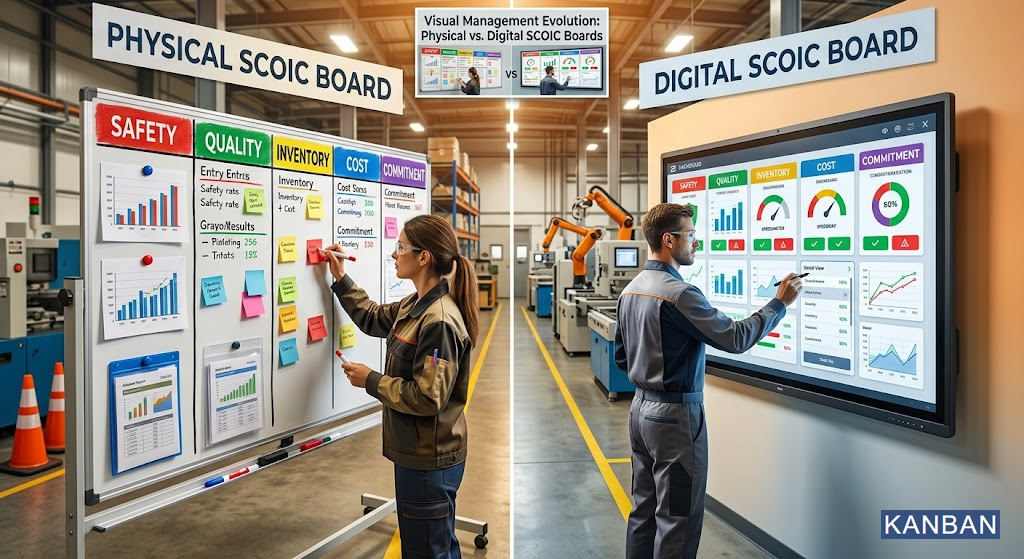
Visual Management for Shop Floor Excellence
The strength of SCOIC boards lies in their visual representation of key operational metrics. Physical boards offer simplicity and direct team interaction, while digital boards provide dynamic, automated, and real-time insights.
This visibility ensures teams remain aligned and focused on critical performance areas.
Real-Time vs Manual Updates
Digital SCOIC boards enable real-time tracking of KPIs, allowing instant visibility into performance and quick decision-making. In contrast, physical boards rely on manual updates, which can sometimes lead to delays but encourage team engagement during updates.
Choosing between the two depends on operational needs, scale, and technological readiness.
Core SCOIC Elements on Boards
Both digital and physical boards are built around five key pillars—Safety, Cost, Output, Innovation, and Customer. These elements are displayed visually to help teams monitor performance and take timely action.
Regardless of format, these pillars ensure a balanced approach to daily management.
Improving Accountability and Team Communication
SCOIC boards enhance accountability by clearly displaying responsibilities and performance metrics. Physical boards encourage face-to-face discussions, while digital boards enable remote visibility and cross-functional collaboration.
This transparency improves communication, ownership, and team alignment.
Why SCOIC Boards Matter in Shop Floor Management
Aligning Shop Floor Activities with Business Goals
SCOIC boards ensure that daily shop floor activities are aligned with organizational objectives.
They simplify complex operational data into easy-to-understand visuals.
This helps teams stay focused on safety, cost efficiency, productivity, innovation, and customer satisfaction.
It also ensures consistency across operations.
Ultimately, it improves performance and decision-making.
Aligned operations lead to sustainable business growth.
Enhancing Operational Visibility
Both digital and physical boards provide clear visibility into daily performance.
Teams can quickly identify inefficiencies and risks.
This supports faster decision-making and problem resolution.
Digital boards offer real-time updates, while physical boards encourage team discussions.
Greater visibility improves coordination and efficiency.
Clear insights empower teams to act proactively.
Driving Data-Driven Decisions
Digital SCOIC boards enable data-driven decision-making through automated data collection and analytics.
Managers can identify trends, patterns, and performance gaps quickly.
Physical boards support structured discussions and team-based decision-making.
Both approaches contribute to improved operational performance.
Combining both methods often delivers the best results.
Ensuring Consistency and Process Control
SCOIC boards promote standardized processes and consistent performance tracking.
Digital systems ensure accuracy and reduce manual errors.
Physical boards reinforce discipline and routine updates.
This balance helps maintain quality and safety standards.
Standardization improves scalability and operational control.
Digital vs Physical SCOIC Boards: Key Differences
Accessibility and Flexibility
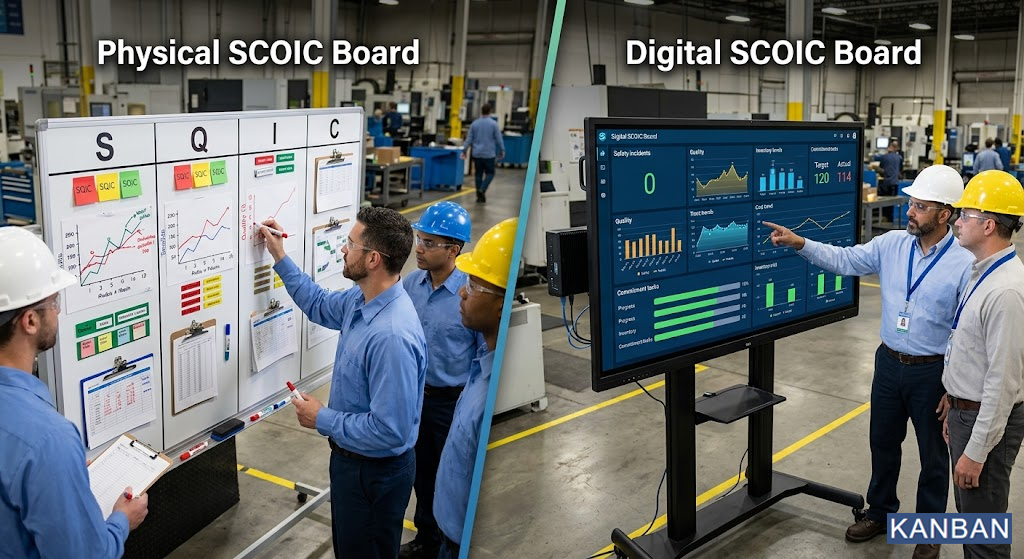
Digital boards can be accessed remotely from multiple devices, making them ideal for large or distributed teams.
Physical boards are limited to on-site visibility but provide immediate access for shop floor teams.
Flexibility is higher with digital solutions.
However, physical boards offer simplicity and ease of use.
Data Accuracy and Update Speed
Digital SCOIC boards provide real-time, automated updates, ensuring high data accuracy.
Physical boards depend on manual updates, which may introduce delays or errors.
However, manual updates encourage team involvement.
Each approach has its own strengths.
Cost and Implementation
Physical boards are cost-effective and easy to implement.
Digital boards require investment in software, hardware, and training.
However, digital systems provide long-term efficiency gains.
The choice depends on budget and operational needs.
Engagement and Collaboration
Physical boards encourage daily team interaction and discussion.
Digital boards enable collaboration across departments and locations.
Combining both can maximize engagement and efficiency.
Step-by-Step Guide: Implementing Digital and Physical SCOIC Boards
Implementing SCOIC boards on the shop floor requires a structured approach that considers both digital and physical systems. The process starts with defining key performance metrics across Safety, Cost, Output, Innovation, and Customer.
Organisations must decide whether to use physical boards, digital dashboards, or a hybrid approach based on operational complexity and resources.
Physical boards should be placed in visible shop floor locations, while digital boards should be integrated with existing systems for real-time data tracking.
Training teams is essential to ensure proper usage, updates, and interpretation of data.
Regular review meetings should be conducted to analyze performance, identify gaps, and take corrective actions.
Over time, combining digital efficiency with physical engagement creates a powerful system for continuous improvement and operational excellence.
Safety Tracking on Physical SCOIC Boards
Tracking safety on physical SCOIC boards is a fundamental practice in shop floor management.
These boards visually display safety metrics such as incidents, near misses, and safety observations.
Teams can quickly review safety performance during daily meetings.
This promotes awareness and proactive risk management.
Physical boards encourage team participation and accountability.
Manual updates ensure team involvement and ownership of safety practices.
They also create opportunities for discussion and immediate action.
Visual safety tracking helps identify recurring issues and hazards.
Over time, this improves workplace safety culture.
Physical boards are simple, cost-effective, and highly visible.
They reinforce discipline and consistency in safety management.
This step strengthens operational safety and compliance.
Cost Monitoring Using Digital SCOIC Boards
Digital SCOIC boards enable efficient monitoring of operational costs through real-time data integration.
They provide automated tracking of expenses, waste, and resource utilization.
This allows organisations to compare actual costs against targets instantly.
Real-time insights help identify cost overruns quickly.
Digital systems reduce manual errors and improve accuracy.
Managers can access cost data from anywhere, improving flexibility.
Analytics tools provide deeper insights into cost trends.
This supports better budgeting and forecasting.
Digital boards improve financial transparency and control.
They enable faster decision-making and corrective actions.
Over time, digital cost monitoring improves efficiency and profitability.
This approach strengthens financial discipline across operations.
Output and Productivity Tracking: Digital vs Physical
Tracking output is essential for measuring productivity on the shop floor.
Physical SCOIC boards display production data manually, encouraging team involvement.
Digital boards provide real-time production tracking and automated updates.
This enables faster identification of performance gaps.
Both methods help compare actual output with planned targets.
Digital systems allow trend analysis and predictive insights.
Physical boards promote team discussions and problem-solving.
Combining both approaches improves productivity management.
Teams can identify bottlenecks and inefficiencies more effectively.
Regular tracking ensures continuous improvement in output.
Optimizing productivity leads to better operational performance.
This strengthens accountability and performance tracking.
Driving Innovation Through SCOIC Boards
SCOIC boards play a vital role in encouraging innovation and continuous improvement.
Physical boards allow teams to post ideas and track improvement initiatives.
Digital boards provide structured platforms for capturing and managing ideas.
This helps organisations implement improvements efficiently.
Innovation increases productivity and competitiveness.
It also fosters a culture of creativity and engagement.
Digital systems can track innovation metrics and outcomes.
Physical boards encourage team collaboration and brainstorming.
Regular updates ensure continuous flow of improvements.
Encouraging innovation improves adaptability to change.
This supports long-term growth and operational excellence.
Over time, innovation becomes embedded in daily operations.
Improving Customer Focus with SCOIC Boards
Customer metrics are essential for ensuring product and service quality.
Physical SCOIC boards display customer feedback, complaints, and quality metrics.
Digital boards provide real-time updates on customer satisfaction scores.
This helps teams respond quickly to customer issues.
Improving customer focus builds trust and loyalty.
It also enhances brand reputation.
Digital tools enable deeper analysis of customer trends.
Physical boards improve team awareness and engagement.
Monitoring customer metrics ensures consistent service quality.
Organisations can use insights to improve processes and offerings.
Continuous focus on customers drives long-term success.
This ensures alignment with customer expectations.
Tools and Techniques for Managing SCOIC Boards
Effective SCOIC board management requires the right tools and techniques.
Physical boards use visual tools such as charts, markers, and templates.
Digital boards rely on dashboards, software platforms, and analytics tools.
These tools help track safety, cost, output, innovation, and customer metrics.
They provide structured approaches to performance management.
Using the right tools improves efficiency and accuracy.
Training teams ensures proper usage of both board types.
Consistent application delivers long-term benefits.
Digital tools enhance real-time monitoring capabilities.
Analytics support deeper insights and better decisions.
Combining tools strengthens SCOIC implementation.
This improves overall operational performance.
KPIs Displayed on Digital and Physical SCOIC Boards
KPIs are essential for measuring shop floor performance using SCOIC boards.
Both digital and physical boards display metrics across safety, cost, output, innovation, and customer areas.
Common KPIs include incident rates, cost efficiency, production output, improvement initiatives, and customer satisfaction scores.
Digital boards provide real-time KPI updates and analytics.
Physical boards offer clear and simple visual tracking.
These metrics help identify performance gaps.
Regular monitoring ensures alignment with business goals.
KPIs improve transparency and accountability.
They allow teams to track trends over time.
Clear KPIs help teams focus on priorities.
They support benchmarking and performance comparison.
Effective KPI management drives continuous improvement.
Standardizing Shop Floor Processes with SCOIC Boards
Standardization ensures consistency in shop floor operations using SCOIC boards.
It involves defining clear processes and maintaining them across teams.
Physical boards reinforce routine and discipline.
Digital boards ensure consistency through automated workflows.
Standard processes reduce variability and improve efficiency.
They make training and onboarding easier.
Clear standards improve execution and understanding.
Standardization supports long-term improvements.
It provides a baseline for optimization.
Organisations can continuously refine processes.
This ensures operational stability and scalability.
Standardization strengthens overall efficiency.
Role of Digital Transformation in SCOIC Boards
Digital transformation enhances SCOIC boards by integrating modern technologies into shop floor management.
Digital boards provide real-time data visibility and automated updates.
This improves accuracy and decision-making speed.
Automation reduces manual effort and errors.
Cloud-based systems improve accessibility and collaboration.
Digital SCOIC boards support scalability and flexibility.
They enhance reporting and tracking capabilities.
Organisations can use analytics for deeper insights.
Digital transformation strengthens operational efficiency.
It enables faster response to changes.
Technology improves transparency and connectivity.
Over time, digital systems drive innovation and growth.
Integrating Digital SCOIC Boards with Business Systems
Integration ensures seamless data flow between SCOIC boards and existing systems.
Digital boards can connect with ERP, MES, and other enterprise tools.
This eliminates data silos and improves coordination.
Real-time data sharing enhances decision-making.
Integration improves tracking across all SCOIC metrics.
It aligns shop floor operations with business strategy.
This improves overall performance.
Integration supports scalability and growth.
It ensures consistency across departments.
Organisations gain a holistic view of operations.
Collaboration improves across teams.
This drives continuous improvement and efficiency.
Steps to Implement Digital and Physical SCOIC Boards
Implementing SCOIC boards requires a structured and disciplined approach.
Organisations must define clear KPIs across all five pillars.
Teams should be trained on using both digital and physical boards.
Leadership support is essential for successful adoption.
Physical boards should be placed in visible shop floor areas.
Digital boards should be integrated with data systems.
Regular reviews ensure continuous improvement.
Employee involvement increases engagement.
Clear communication ensures alignment.
Organisations should focus on long-term sustainability.
Digital tools improve tracking and reporting.
Feedback loops help refine processes.
Structured implementation builds operational discipline.
Challenges in Using Digital vs Physical SCOIC Boards
Organisations may face challenges when implementing SCOIC boards.
Resistance to change is a common issue.
Employees may prefer traditional methods over digital tools.
Digital boards require training and investment.
Physical boards may lack real-time data accuracy.
Maintaining consistency can be difficult.
Data reliability is also a concern.
Clear communication helps overcome these challenges.
Leadership support is critical.
Training improves adoption and effectiveness.
Combining both approaches can reduce limitations.
Strong change management ensures success.
Overcoming challenges improves performance.
Leadership Role in Managing SCOIC Boards
Leadership plays a key role in managing SCOIC boards effectively.
Leaders define expectations and ensure alignment with goals.
They promote accountability and transparency.
Regular reviews help identify improvement areas.
Leaders provide tools, training, and support.
They encourage collaboration and innovation.
This drives sustainable performance.
Leadership involvement reinforces discipline.
It motivates teams to perform better.
Strong leadership builds engagement and trust.
Consistent support ensures successful implementation.
Over time, leadership drives continuous improvement.
Continuous Improvement Using SCOIC Boards
Continuous improvement is a key objective of SCOIC boards.
Teams regularly evaluate performance across all five pillars.
This helps identify improvement opportunities.
Teams are encouraged to suggest and implement ideas.
Regular feedback ensures progress.
Continuous improvement enhances efficiency.
It supports adaptability to change.
This builds a culture of operational excellence.
Small improvements lead to long-term gains.
Structured methods support improvements.
Monitoring ensures sustainable results.
Continuous improvement strengthens competitiveness.
Workforce Engagement via Digital and Physical Boards
SCOIC boards improve workforce engagement by involving employees in daily performance tracking.
Physical boards encourage direct participation and discussions.
Digital boards enable wider collaboration and visibility.
Employees gain clarity on roles and responsibilities.
This increases accountability and motivation.
Transparent data improves communication.
Collaboration becomes more effective.
Recognition boosts morale.
Employees are encouraged to share ideas.
This drives innovation and better results.
Engaged teams are more productive.
Strong engagement improves retention and performance.
Benefits of Digital vs Physical SCOIC Boards
Both digital and physical SCOIC boards offer significant benefits.
They improve visibility and control over operations.
Digital boards provide real-time insights and analytics.
Physical boards enhance team engagement and communication.
Organisations can quickly identify and resolve issues.
This reduces inefficiencies and risks.
Decision-making becomes faster and more accurate.
Both approaches support continuous improvement.
They improve productivity and performance.
Organisations become more competitive.
They also improve customer satisfaction.
Combining both methods delivers maximum value.
Future Trends in SCOIC Board Management
The future of SCOIC boards is driven by digital innovation and smart technologies.
Organisations are adopting real-time dashboards and automation.
Predictive analytics will enhance performance tracking.
Digital boards will become more intelligent and interactive.
Integration with advanced systems will improve efficiency.
Organisations will become more agile and responsive.
Artificial intelligence will enhance decision-making.
Machine learning will help predict issues.
Data-driven insights will support proactive actions.
Future boards will be more user-friendly.
Technology will strengthen daily management practices.
Over time, SCOIC boards will drive higher efficiency and innovation.