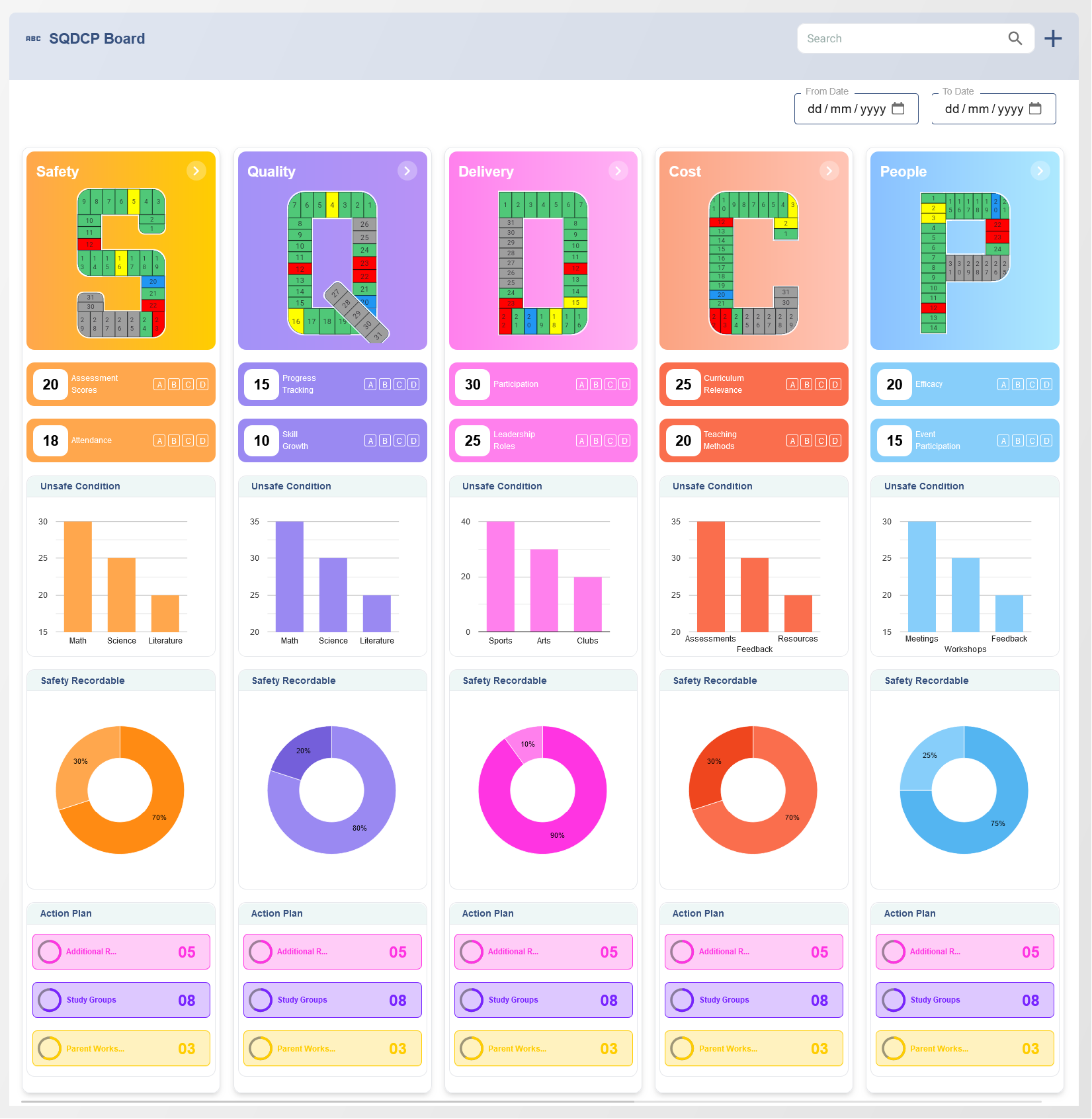
In modern industries, maintaining operational excellence requires a structured approach to monitoring key performance indicators (KPIs) related to Safety, Quality, Cost, Delivery, and People (SQCDP). Traditionally, businesses relied on manual SQCDP boards to track performance, but with digital transformation, organizations are now leveraging digital SQCDP boards for real-time data tracking, enhanced visibility, and better decision-making.
1. Understanding SQCDP
SQCDP is a performance management framework used across various industries to monitor and improve key business metrics. Each component of SQCDP represents a critical area of operational performance:
- Safety: Tracking incidents, near misses, and safety compliance to ensure a secure working environment.
- Quality: Measuring defect rates, process compliance, and customer feedback to maintain product and service excellence.
- Cost: Monitoring financial efficiency, waste reduction, and overall cost management.
- Delivery: Ensuring on-time production, inventory management, and supply chain efficiency.
- People: Evaluating workforce engagement, training, and productivity levels.
By systematically reviewing these elements, businesses can maintain a continuous improvement mindset and address operational challenges proactively.
2. Transitioning from Manual to Digital SQCDP Boards
Traditional SQCDP boards are typically whiteboards or paper-based tracking systems updated manually by teams. While effective in engaging employees, these manual systems have several limitations, such as:
- Delays in data collection and reporting.
- Difficulty in maintaining historical data for trend analysis.
- Lack of real-time insights and automated updates.
- Risk of human errors in data recording.
Digital SQCDP boards address these challenges by providing a centralized platform that integrates real-time data collection, visualization, and automated reporting. These digital solutions enhance decision-making and streamline performance tracking.
3. Key Features of Digital SQCDP Boards
Digital SQCDP boards come with several advanced features that improve operational efficiency and drive performance improvements.
Real-Time Data Updates
Digital boards automatically collect and update data, ensuring that teams have access to the latest performance metrics. This eliminates the need for manual updates and reduces errors.
Customizable Dashboards
Organizations can configure digital SQCDP boards to align with their unique processes and KPIs. Customizable dashboards allow teams to focus on the most relevant metrics.
Visual Indicators and Alerts
Color-coded status indicators help teams quickly assess performance. Alerts and notifications highlight deviations from targets, allowing for immediate corrective actions.
Historical Data and Trend Analysis
Unlike manual boards, digital SQCDP solutions store historical data, enabling trend analysis and predictive insights. Businesses can identify recurring issues and make data-driven decisions.
Integration with Other Systems
Digital SQCDP boards can be integrated with enterprise resource planning (ERP) and manufacturing execution systems (MES), ensuring seamless data flow across departments.
4. Benefits of Implementing Digital SQCDP Boards
Adopting a digital SQCDP system brings significant advantages to organizations aiming for operational excellence.
Enhanced Transparency and Communication
By providing a single source of truth, digital SQCDP boards improve communication across teams. Managers and employees can easily access performance data, fostering a culture of accountability.
Improved Decision-Making
Real-time data and visual dashboards enable faster, data-driven decision-making. Teams can promptly identify and resolve issues before they escalate.
Increased Efficiency and Productivity
Automation reduces administrative workload, allowing employees to focus on value-added activities. This leads to increased productivity and operational efficiency.
Better Compliance and Standardization
Digital systems ensure compliance with safety, quality, and regulatory standards by maintaining accurate and auditable records.
Scalability and Remote Accessibility
Unlike physical boards, digital SQCDP solutions can be accessed remotely, making them ideal for distributed teams and multi-location operations.
5. Steps to Implement a Digital SQCDP Board
Organizations can follow these steps to successfully implement a digital SQCDP board:
Step 1: Define Key Metrics and Objectives
Identify the most critical SQCDP metrics that align with business goals. Ensure that the selected KPIs are measurable and relevant to operational success.
Step 2: Choose the Right Digital Solution
Select a digital platform that supports real-time data updates, customization, and integration with existing systems.
Step 3: Configure the Dashboard
Customize the digital board to match workflow requirements, ensuring that it visually represents each SQCDP category effectively.
Step 4: Train Employees
Provide training to employees on how to use the digital SQCDP board, interpret data, and take corrective actions when necessary.
Step 5: Monitor and Optimize
Continuously evaluate board performance, gather feedback from users, and refine the system for continuous improvement.
6. Future of Digital SQCDP Boards
The evolution of digital SQCDP boards is driven by advancements in data analytics, automation, and artificial intelligence. Future developments may include:
- Predictive Analytics: AI-driven insights to forecast potential issues and recommend solutions.
- IoT Integration: Real-time data collection from sensors and connected devices for enhanced monitoring.
- Mobile Access: Improved mobile compatibility for on-the-go performance tracking.
- Enhanced User Experience: Intuitive interfaces for seamless interaction with performance data.
As digital transformation continues, organizations adopting digital SQCDP boards will gain a competitive advantage by improving visibility, efficiency, and responsiveness in their operations.
Digital SQCDP Boards
What is a Digital SQCDP Board?
A Digital SQCDP Board is an interactive dashboard used to monitor and manage key performance metrics related to Safety, Quality, Cost, Delivery, and People. It replaces traditional whiteboards with a digital interface for real-time tracking and reporting.
How does an SQCDP board improve operational efficiency?
By providing a structured approach to tracking daily performance metrics, an SQCDP board helps teams identify inefficiencies, bottlenecks, and areas for improvement. It ensures accountability and facilitates quick decision-making.
What does SQCDP stand for?
SQCDP stands for Safety, Quality, Cost, Delivery, and People. These five key performance indicators help organizations monitor overall operational performance and drive continuous improvement.
How does a digital SQCDP board enhance real-time monitoring?
Unlike manual tracking methods, a digital SQCDP board updates data in real-time, ensuring that teams always have the latest performance insights. This enables quick responses to issues and enhances operational transparency.
What are the key features of a digital SQCDP board?
Key features include real-time data visualization, customizable dashboards, automated reporting, trend analysis, and integration with other business management systems for seamless data sharing.
How does a digital SQCDP board support continuous improvement?
By providing clear insights into performance trends, a digital SQCDP board helps teams identify recurring problems, measure improvement efforts, and implement corrective actions efficiently.
Can SQCDP boards be customized for different industries?
Yes, SQCDP boards can be tailored to fit the specific needs of various industries, including manufacturing, healthcare, logistics, and retail. Customization ensures that relevant KPIs are tracked based on industry standards.
How do digital SQCDP boards help in decision-making?
With real-time data and historical trends available at a glance, managers can make data-driven decisions to address inefficiencies, allocate resources effectively, and improve overall productivity.
Can digital SQCDP boards integrate with other management systems?
Yes, digital SQCDP boards can integrate with enterprise resource planning (ERP), manufacturing execution systems (MES), and other business tools to streamline data collection and reporting.
How is data updated on a digital SQCDP board?
Data can be updated manually by team members, automatically through integrated systems, or via IoT-enabled devices that feed real-time information into the board.
What types of metrics can be tracked on an SQCDP board?
Metrics include safety incidents, defect rates, production costs, on-time deliveries, employee engagement, and other KPIs that impact overall performance.
How does an SQCDP board help in tracking performance trends?
By displaying historical data and real-time insights, an SQCDP board allows managers to spot recurring issues, evaluate the effectiveness of improvement efforts, and adjust strategies accordingly.
Is training required to use a digital SQCDP board?
Basic training is recommended to ensure that team members can effectively update and analyze data. However, most digital SQCDP boards are designed to be user-friendly and require minimal technical knowledge.
How does an SQCDP board contribute to lean manufacturing?
By providing real-time insights into key performance areas, an SQCDP board supports lean manufacturing principles by identifying waste, improving efficiency, and enhancing workflow optimization.
How do I get started with a digital SQCDP board?
To get started, define the KPIs relevant to your organization, set up a digital SQCDP board, integrate it with existing systems if necessary, and ensure team members are trained on how to use it effectively.