Boost Productivity with Lean Industry 4.0
Maximising Efficiency Through Smart Manufacturing Integration
Lean manufacturing focuses on reducing waste, improving efficiency, and delivering maximum customer value. Lean Industry 4.0 builds on these principles by integrating advanced technologies such as Industrial IoT (IIoT), artificial intelligence, automation, cloud platforms, and real-time analytics into modern production environments.
By digitally connecting machines, systems, and teams, Lean Industry 4.0 enhances visibility across the entire operation. Real-time performance data allows managers to monitor production instantly, identify inefficiencies, and make faster, data-driven decisions that directly improve productivity.
Smart sensors and connected devices continuously track equipment performance, downtime, material flow, and quality metrics. When issues arise, instant alerts enable rapid corrective action, preventing delays and maintaining consistent workflow across the production line.
Productivity improves further through intelligent process optimisation. Monitoring cycle times, throughput, and bottlenecks ensures smoother operations while maintaining the flexibility needed to adapt to changing customer demands.
Digital work instructions, automated controls, and standardised workflows reduce errors and variation. These technologies reinforce lean best practices while ensuring consistent execution and improved operational efficiency.
By combining lean principles with smart digital innovation, Lean Industry 4.0 empowers organisations to increase output, reduce waste, minimise downtime, and build agile, high-performance manufacturing systems ready for the future.
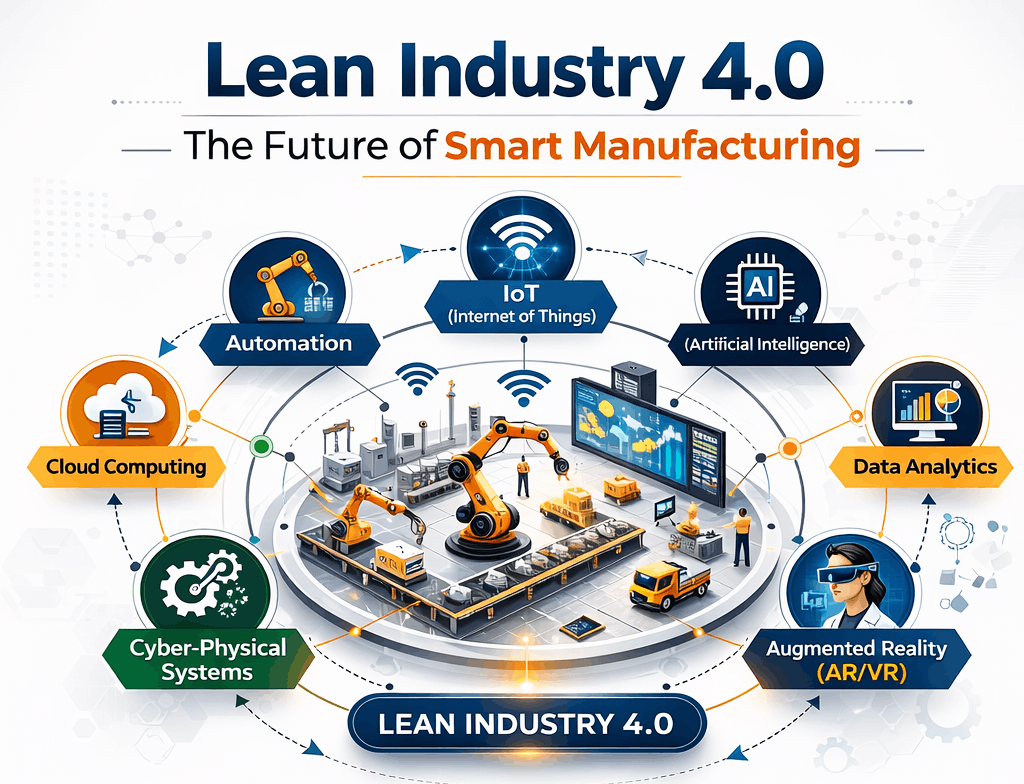
Enhancing Productivity with Real-Time Smart Factory Visibility
Lean Industry 4.0 strengthens operational performance by delivering real-time digital visibility across machines, workflows, and production lines. Connected sensors, IIoT devices, and intelligent dashboards provide instant insights into throughput, cycle times, downtime, and quality metrics—creating full transparency across the factory floor.
With live performance data available at every stage of production, inefficiencies are identified and resolved quickly. Teams can act immediately to stabilise processes, reduce variability, and maintain continuous, high-output operations without unnecessary waste.
Automated alerts and smart performance tracking prioritise critical improvements. Faster, data-driven decision-making ensures resources are optimised, productivity increases, and operational targets remain on track.
Continuous digital monitoring aligns production output with customer demand and strategic business objectives. Real-time intelligence enhances accountability, improves workflow discipline, and drives measurable productivity gains.
Standardising Digital Processes for Consistent High Performance
Lean Industry 4.0 promotes process standardisation through unified digital metrics applied across shifts, lines, and facilities. Consistent measurement systems ensure improvement initiatives are aligned, scalable, and performance-driven.
Automated data capture replaces manual reporting, reducing errors and increasing reliability. Accurate real-time information supports stronger continuous improvement efforts and more effective performance benchmarking.
Digital workflows, centralised procedures, and intelligent controls reduce operational variation while reinforcing lean best practices. Standardised execution ensures consistent output and predictable results.
Shared access to live production dashboards improves collaboration between operations, maintenance, quality, and supply chain teams. A single connected platform enhances communication and speeds up cross-functional problem-solving.
Accelerating Growth with Predictive and Data-Driven Intelligence
Lean Industry 4.0 continuously collects and analyses production data to uncover hidden inefficiencies and emerging constraints. Early detection enables proactive intervention before productivity is impacted.
Predictive analytics anticipate equipment failures and maintenance needs, reducing downtime and improving overall equipment effectiveness (OEE). Proactive strategies protect workflow continuity and maximise production capacity.
Interactive dashboards track key performance indicators in real time, allowing organisations to measure improvements and adjust strategies quickly. Results become transparent, measurable, and sustainable.
By combining lean methodologies with advanced digital technologies, Lean Industry 4.0 drives higher output, lower costs, and smarter operational control—empowering manufacturers to boost productivity and remain competitive in the era of smart manufacturing.
Understanding Lean Industry 4.0 Fundamentals
Blending Lean Methodology with Advanced Digital Innovation
Lean Industry 4.0 combines the core principles of lean manufacturing—waste elimination, continuous improvement, and value stream optimisation—with advanced digital technologies such as Industrial IoT (IIoT), artificial intelligence, automation, and cloud-based analytics.
This integration creates a connected production ecosystem where machines, systems, and teams operate with shared real-time visibility. Data flows seamlessly across departments, strengthening coordination and aligning operational performance with strategic business goals.
By embedding digital intelligence directly into processes, organisations move beyond reactive problem-solving toward proactive, data-driven performance management.
The foundation of Lean Industry 4.0 lies in synchronising people, processes, and technology. When digital systems support lean thinking, improvements become measurable, repeatable, and scalable across the entire enterprise.
This strategic alignment ensures that digital investments directly support waste reduction, operational stability, and long-term productivity growth.
Boosting Productivity with Digital Transformation
Driving Measurable Performance Gains Through Smart Connectivity
Digital transformation within Lean Industry 4.0 environments enables continuous monitoring of production lines, equipment efficiency, and key performance indicators in real time.
Live dashboards and automated alerts allow managers and operators to respond instantly to disruptions, minimising downtime and maintaining stable workflow.
Predictive analytics further enhance productivity by identifying potential constraints before they impact output, ensuring smoother operations and improved resource utilisation.
Connected systems also enhance scheduling accuracy and production planning. Real-time demand signals and performance feedback loops enable faster adjustments to maintain optimal output levels.
As a result, manufacturers can increase throughput, shorten lead times, and achieve consistent operational excellence across shifts and facilities.
Optimising Processes Using Lean Principles
Eliminating Waste Through Structured, Data-Driven Improvement
Lean Industry 4.0 strengthens traditional lean practices by applying advanced data analysis to identify inefficiencies, bottlenecks, and process variation.
Continuous monitoring of cycle times, material flow, and equipment performance enables targeted improvement initiatives that reduce waste and stabilise production systems.
Standardised digital workflows reinforce best practices across shifts and facilities, ensuring consistent execution and sustainable efficiency improvements.
Real-time root cause analysis tools help teams quickly pinpoint the source of recurring issues. This accelerates corrective action and prevents repeated performance losses.
By combining structured lean methodologies with digital precision, organisations create optimised value streams that consistently deliver higher productivity and improved quality.
Improving Efficiency with Smart Automation
Enhancing Operational Stability with Intelligent Systems
Lean Industry 4.0 leverages robotics, collaborative automation, and AI-driven control systems to streamline repetitive and non-value-added activities.
Intelligent automation dynamically adjusts workflows based on real-time production data, maintaining quality standards while minimising variability.
Digital work instructions, automated scheduling, and integrated control platforms ensure smoother coordination across teams—boosting overall efficiency and scalable performance.
Automation also supports safer working environments by reducing manual intervention in high-risk tasks. This improves workforce wellbeing while increasing operational reliability.
With smart automation embedded into lean systems, manufacturers achieve faster cycle times, reduced operational costs, and a more resilient, high-performing production framework.
Enhancing Performance with Real-Time Data
Lean Industry 4.0 enables continuous monitoring of machines, production lines, and operational metrics through connected sensors and intelligent dashboards. Real-time data provides instant visibility into throughput, cycle times, downtime, and efficiency levels.
Immediate performance feedback allows teams to respond quickly to deviations, stabilising workflows before disruptions escalate. This rapid responsiveness strengthens operational control and minimises productivity losses.
Live data streams also support better coordination between departments, ensuring production remains aligned with customer demand and delivery commitments.
Historical data layered with live performance metrics provides deeper operational insight, enabling trend analysis and long-term performance optimisation strategies.
With complete digital visibility, decision-makers gain the clarity needed to continuously refine processes and drive sustainable productivity improvements.
Reducing Operational Waste through Smart Insights
Advanced analytics within Lean Industry 4.0 environments identify inefficiencies such as overproduction, idle time, excess inventory, and quality defects. Real-time insights allow immediate corrective action.
Trend analysis tools uncover recurring waste patterns, enabling structured improvement initiatives that target root causes rather than surface symptoms.
By combining lean principles with digital intelligence, manufacturers create measurable and sustainable waste reduction strategies that improve cost efficiency and overall productivity.
Automated reporting ensures that waste metrics remain transparent and consistently tracked across all production levels.
Over time, this disciplined approach fosters a culture of accountability and continuous elimination of non-value-added activities.
Increasing Output with Predictive Analytics
Predictive analytics leverages historical and live production data to forecast performance trends, capacity constraints, and potential bottlenecks.
AI-driven models support smarter production planning by anticipating demand shifts and optimising scheduling decisions in advance.
Scenario simulation tools allow manufacturers to evaluate multiple production strategies, ensuring optimal throughput while minimising risk and uncertainty.
Predictive insights also support workforce planning, aligning staffing levels with expected production requirements.
This forward-looking capability enables organisations to maximise output while maintaining operational stability.
Minimising Downtime with Intelligent Maintenance
Intelligent maintenance systems use IoT sensors and AI algorithms to continuously monitor equipment health and detect early warning signs of failure.
Maintenance is scheduled based on real-time condition data rather than fixed intervals, reducing unnecessary servicing and preventing unexpected breakdowns.
This proactive approach increases equipment availability, improves overall equipment effectiveness (OEE), and protects consistent production output.
Maintenance teams gain actionable diagnostic insights that shorten repair times and improve troubleshooting accuracy.
As predictive models evolve, equipment reliability steadily improves, strengthening long-term operational resilience.
Enhancing Product Quality through Digital Monitoring
Digital monitoring systems analyse production parameters in real time to detect anomalies and quality deviations instantly.
Automated inspections and smart alerts allow operators to take corrective action before defects propagate through the production line.
Data-driven quality management strengthens compliance, reduces rework, and ensures higher customer satisfaction through consistent product standards.
Predictive quality analytics identify patterns that could lead to defects, enabling preventive adjustments before issues escalate.
Continuous digital oversight reinforces a culture of quality excellence and measurable process control.
Optimising Resource Utilisation
Lean Industry 4.0 improves visibility across labour, materials, energy, and machine capacity to ensure optimal allocation of resources.
Real-time tracking identifies underutilised assets and highlights opportunities to balance workloads more effectively across production lines.
Strategic resource optimisation reduces operating costs while increasing throughput and maintaining lean efficiency standards.
Energy monitoring tools support sustainable manufacturing by identifying opportunities to reduce consumption and environmental impact.
Data-backed allocation decisions ensure every resource contributes maximum value to overall production performance.
Building Agile and Resilient Manufacturing Systems
Connected digital systems enable manufacturers to adapt quickly to fluctuating demand, supply chain changes, and market disruptions.
Integrated production planning tools synchronise operations across departments, supporting faster decision-making and smoother workflow adjustments.
Agile manufacturing systems maintain stability under pressure, ensuring consistent productivity and long-term resilience.
Scenario planning capabilities allow organisations to test contingency strategies and prepare for unexpected operational challenges.
This adaptability ensures sustainable performance even in rapidly changing industrial environments.
Tracking Productivity KPIs in Real Time
Interactive dashboards provide live visibility into critical KPIs such as OEE, throughput, defect rates, and cycle time.
Continuous KPI monitoring enables rapid response to performance gaps and reinforces accountability across operational teams.
Comparative analytics across shifts and facilities promote benchmarking and structured performance improvement initiatives.
Customisable KPI reporting ensures metrics remain aligned with evolving operational priorities.
Real-time measurement transforms performance tracking from periodic review into continuous operational discipline.
Driving Continuous Innovation and Improvement
Lean Industry 4.0 platforms continuously collect and analyse operational data to uncover hidden improvement opportunities.
Smart analytics accelerate testing and validation of new process enhancements, reducing implementation risk and speeding up innovation cycles.
Ongoing digital feedback loops ensure improvement strategies remain dynamic, measurable, and aligned with evolving production objectives.
Collaborative digital platforms allow teams to share insights and replicate successful improvements across facilities.
This structured innovation approach transforms continuous improvement into a scalable competitive advantage.
Aligning Lean Industry 4.0 with Business Growth
Lean Industry 4.0 connects shop-floor performance metrics directly to broader strategic goals such as profitability, customer satisfaction, and market expansion.
Executive dashboards integrate operational KPIs with financial indicators, enabling informed, data-driven leadership decisions.
By aligning digital manufacturing excellence with corporate strategy, organisations ensure productivity improvements translate into sustainable competitive advantage.
Clear performance visibility strengthens strategic planning and investment prioritisation across the enterprise.
This alignment ensures operational efficiency consistently supports long-term growth, innovation, and market leadership.