Why the Best OEE Software 2026 Matters
Improving Equipment Utilisation and Productivity
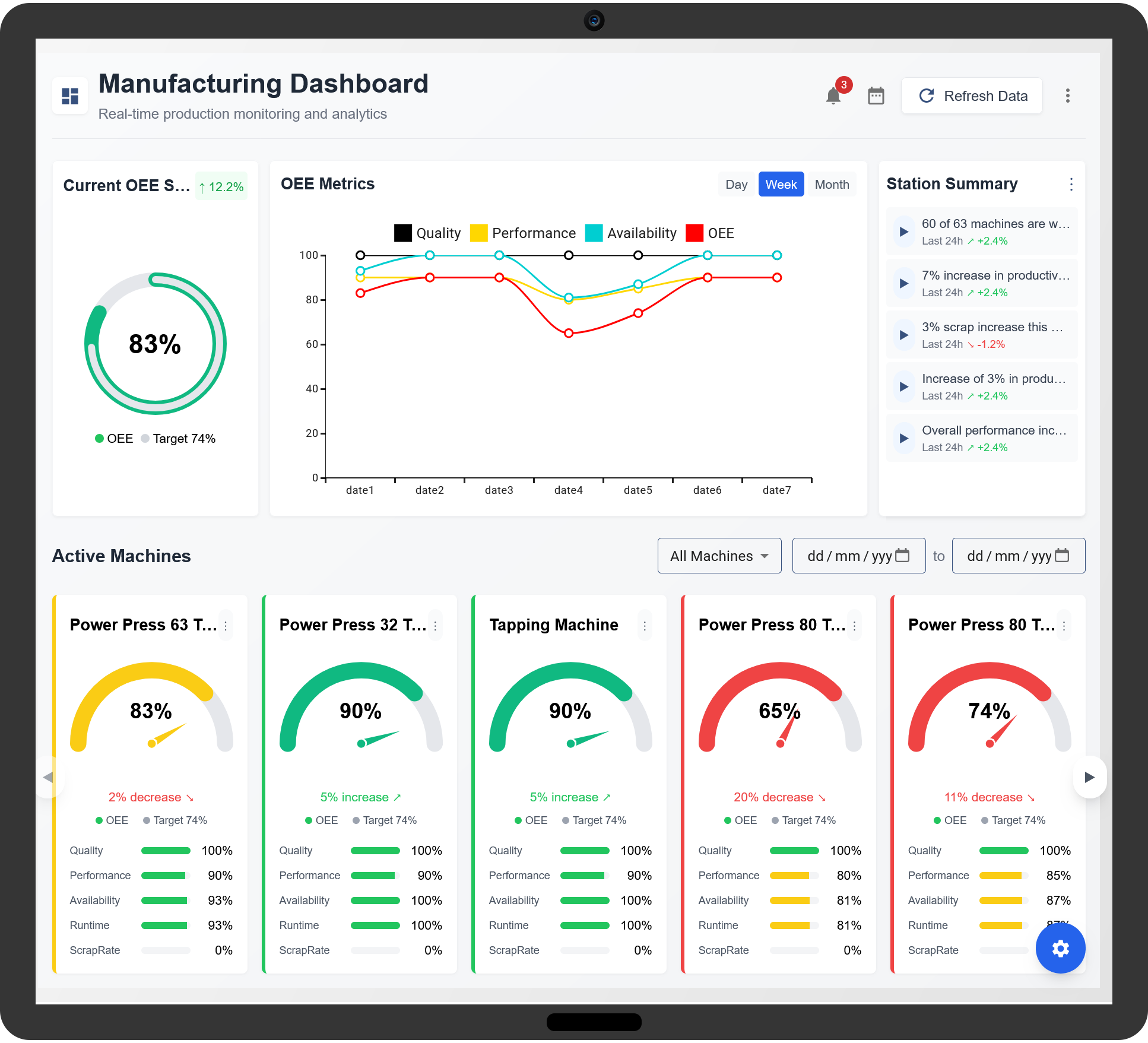
The Best OEE Software 2026 provides complete visibility into machine availability, performance losses, and quality issues. By identifying inefficiencies in real time, manufacturers can improve throughput, reduce waste, and increase equipment utilisation.
Supporting Continuous Improvement Initiatives
OEE software supports lean manufacturing and continuous improvement by highlighting recurring losses and root causes. Teams can prioritise improvement actions based on data rather than assumptions.
Enhancing Visibility for Management and Operators
From shop-floor operators to plant managers, OEE dashboards ensure everyone understands current performance and areas for improvement.
Building a Clear OEE Improvement Strategy
Linking OEE to Business Objectives
Before deploying the Best OEE Software 2026, organisations must define how OEE improvements support business goals such as cost reduction, delivery reliability, and customer satisfaction.
Setting Realistic OEE Targets
Clear targets for availability, performance, and quality help teams focus improvement efforts and track progress consistently.
Effective OEE strategies avoid unrealistic benchmarks. Instead, organisations should establish baseline performance levels and define incremental improvement targets. This approach encourages steady progress and prevents disengagement caused by unattainable goals.
Leadership Commitment to OEE Excellence
Why Leadership Support Is Critical
Leadership involvement ensures that OEE software is treated as a strategic tool rather than just a reporting system. When leaders actively review OEE data, participate in performance discussions, and support improvement actions, OEE becomes embedded in daily and strategic decision-making. Visible leadership commitment signals the importance of operational excellence, encourages cross-functional collaboration, and ensures that improvement initiatives receive the necessary resources and priority.
Without visible leadership engagement, OEE initiatives risk becoming reporting exercises rather than true drivers of improvement. Strong leadership involvement reinforces accountability, helps prioritise critical improvement actions, and sustains momentum over time. By consistently linking OEE performance to business goals, leaders create a culture of ownership, continuous improvement, and long-term operational success.
Aligning Production, Maintenance & Quality Teams
Breaking Down Functional Silos
The Best OEE Software 2026 creates a shared performance view for production, maintenance, and quality teams by consolidating availability, performance, and quality data into a single, transparent platform. This shared visibility breaks down functional silos, aligns teams around common goals, and improves accountability across departments. When everyone works from the same data, collaboration becomes more effective and decision-making more consistent.
When downtime, speed losses, or quality issues occur, cross-functional teams can collaborate quickly using real-time OEE insights to identify root causes and prioritise corrective actions. Clear visibility into losses supports faster problem-solving, reduces finger-pointing, and encourages a proactive improvement culture. This coordinated approach improves equipment reliability, product quality, and overall operational efficiency.
Defining the Right OEE Metrics
Focusing on Actionable KPIs
Effective OEE software tracks downtime reasons, speed losses, and quality defects in a structured and consistent manner, providing teams with clear visibility into where performance losses occur. By breaking OEE into actionable components, teams can quickly identify the most significant constraints, prioritise improvement efforts, and focus on actions that deliver measurable performance gains. Clear, well-defined metrics support faster analysis and more effective daily management.
Actionable KPIs ensure that performance data leads to improvement actions rather than passive reporting. When KPIs are clearly linked to ownership and corrective actions, teams are empowered to respond promptly to deviations and track the impact of their improvements over time. This approach transforms OEE data into a practical decision- making tool that drives continuous improvement and sustained operational excellence.
Training Teams to Use OEE Software Effectively
Empowering Operators and Supervisors
Practical training ensures accurate data entry, correct loss classification, and confident use of OEE dashboards by operators and supervisors. Hands-on sessions help teams understand how their inputs affect performance metrics and why data accuracy is critical for reliable analysis. When users are comfortable navigating the system, updating information, and interpreting trends, OEE software becomes an effective daily management and problem-solving tool.
Well-trained teams are more likely to trust the system and actively use OEE insights to drive meaningful improvements. Confidence in the software encourages consistent usage, stronger ownership of results, and proactive identification of improvement opportunities. This capability-building approach supports a culture of continuous improvement and maximises the long-term value of OEE initiatives.
Integrating OEE Software with Manufacturing Systems
Connecting Machines and MES
Integration with PLCs, MES, ERP, and maintenance systems ensures real-time, accurate OEE data without manual effort by automatically capturing machine status, production counts, downtime events, and quality information. This direct data flow eliminates manual data entry, reduces delays, and improves consistency across systems. Real-time integration enables teams to monitor equipment performance continuously and respond quickly to emerging issues on the shop floor.
Seamless integration reduces data errors and provides a complete view of manufacturing performance by combining operational, maintenance, and production data in one platform. This holistic visibility supports better root cause analysis, aligns departments around shared performance goals, and enables informed decision-making. A fully integrated OEE system scales with manufacturing operations and strengthens long-term operational efficiency and reliability.
Building a Data-Driven Manufacturing Culture
Making Performance Visible
OEE dashboards promote transparency by making real-time performance data visible to operators, supervisors, and management across the manufacturing floor. Clear visibility into availability, performance, and quality metrics helps teams understand current conditions, identify losses, and recognise improvement opportunities. This transparency encourages shared ownership of results and supports data-driven discussions during daily reviews and shift handovers.
When performance is visible, teams become more engaged and proactive in addressing issues rather than reacting after problems escalate. Access to accurate, timely OEE insights motivates employees to take responsibility for improvements, collaborate across functions, and continuously optimise processes. Over time, this visibility-driven approach builds a strong data-driven manufacturing culture focused on accountability, learning, and sustained operational excellence.
Establishing Regular OEE Review Cycles
Turning Data into Action
Daily, weekly, and monthly OEE reviews help sustain improvements and prevent recurring losses by providing a structured framework for monitoring performance, identifying bottlenecks, and tracking corrective actions. Daily reviews allow teams to address immediate issues on the shop floor, weekly meetings provide a broader operational perspective, and monthly reviews support strategic planning and long-term improvement initiatives.
Structured review cycles ensure accountability and continuous progress by assigning ownership for action items, monitoring follow-ups, and evaluating the effectiveness of improvement efforts. This disciplined approach keeps teams focused on key performance objectives, reinforces the importance of OEE metrics, and drives a culture of proactive problem-solving and sustained operational excellence.
Communicating OEE Goals Across the Plant
Aligning Everyone with Improvement Targets
Clear communication ensures every employee understands how OEE targets relate to operational success by linking availability, performance, and quality metrics to day-to-day responsibilities. When employees know the impact of their actions on overall equipment effectiveness, they can prioritise efforts that directly contribute to plant performance and operational excellence.
Shared goals encourage teamwork and consistent focus on improvement by fostering collaboration between operators, maintenance, and quality teams. When OEE objectives are communicated clearly and reinforced through visual dashboards, meetings, and leadership messaging, employees are more engaged, aligned, and motivated to drive measurable results, creating a culture of continuous improvement across the plant.
Using Real-Time OEE Dashboards
Responding Faster to Issues
Real-time dashboards enable quick reaction to breakdowns, quality issues, and performance losses by providing immediate visibility into machine status, production output, and quality metrics. Operators and supervisors can monitor performance continuously, identify anomalies as they occur, and take corrective actions without delay, ensuring smoother operations and higher productivity.
Faster responses reduce downtime and prevent small issues from becoming major disruptions, improving overall equipment effectiveness and maintaining production schedules. By leveraging real-time insights, teams can prioritise interventions, allocate resources efficiently, and foster a proactive culture that minimises operational risks and maximises output.
Best Practices for OEE Software Implementation
Keeping OEE Simple and Consistent
Successful implementations focus on standard definitions for downtime, speed losses, and quality defects, ensuring that all teams interpret OEE metrics consistently. Clear ownership of data entry, metric tracking, and corrective actions establishes accountability and drives meaningful improvements. Continuous refinement of processes and dashboards ensures that the OEE software remains relevant and aligned with evolving operational priorities.
Simplicity ensures long-term adoption and consistent data quality by making the system intuitive and easy to use for operators, supervisors, and managers. When OEE metrics are straightforward, teams are more likely to engage regularly, update data accurately, and use insights to drive continuous improvement, ultimately supporting sustainable operational excellence.
Ensuring Accurate OEE Data Collection
Trusting the Numbers
Accurate data collection ensures OEE insights can be trusted for decision-making by capturing real-time machine status, production counts, downtime reasons, and quality defects consistently and correctly. Standardised processes for recording and validating data help minimise errors and ensure that performance metrics reflect true operational conditions, enabling managers to make informed and timely decisions.
Reliable data builds confidence and supports strategic actions by providing a solid foundation for identifying trends, prioritising improvement initiatives, and measuring the impact of corrective actions. When teams trust the accuracy of OEE data, they are more likely to engage with the system actively, maintain high-quality inputs, and use insights to drive continuous improvement and long-term operational excellence.
Tracking OEE Software Adoption
Encouraging Consistent Usage
High adoption ensures reliable performance data and sustainable improvement by making the OEE system an integral part of daily operations. When operators, supervisors, and managers consistently enter accurate data and actively engage with dashboards, the organisation gains a clear, up-to-date view of performance across all equipment and processes.
Consistent usage strengthens accountability across teams by clearly showing who is responsible for updating metrics, addressing losses, and implementing corrective actions. Tracking adoption also helps identify training needs or gaps in engagement, ensuring continuous improvement initiatives remain effective and that the OEE software delivers maximum value to the organisation over time.
Measuring ROI with the Best OEE Software 2026
Delivering Measurable Manufacturing Results
The Best OEE Software 2026 delivers ROI through reduced downtime, higher productivity, improved quality, and better decision-making by providing accurate, real-time insights into machine performance, production efficiency, and quality metrics. Organisations can quickly identify bottlenecks, prioritise improvement actions, and allocate resources effectively, resulting in measurable cost savings and operational gains.
Over time, these benefits support sustainable growth and operational excellence by fostering a culture of continuous improvement, increasing equipment reliability, and optimising overall manufacturing efficiency. The cumulative impact of better decision-making, consistent performance tracking, and enhanced team engagement translates into stronger competitiveness and long-term business success.