What Is Balanced Scorecard (BSC) Software and How It Helps Canadian Businesses
Understanding BSC Software
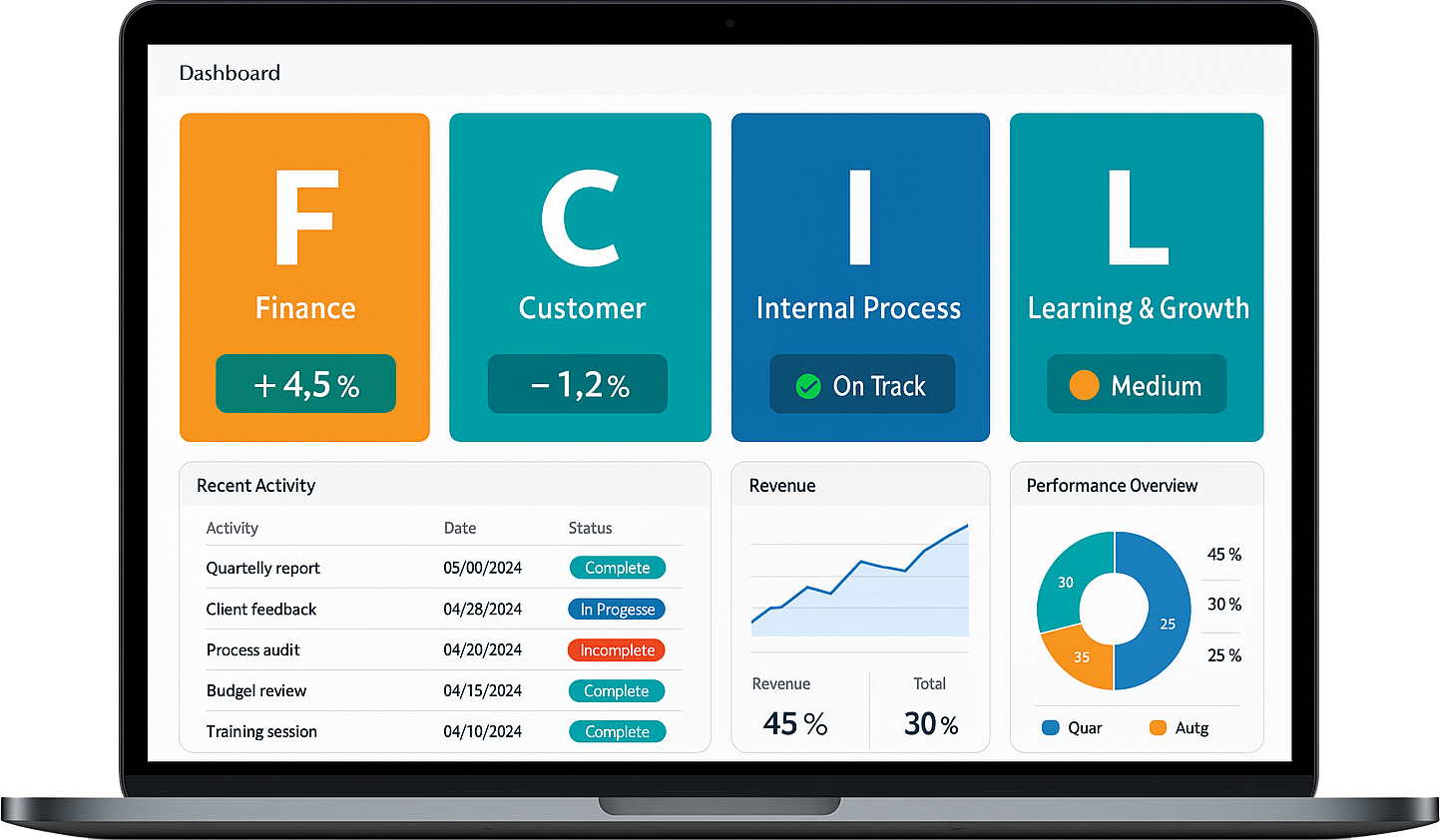
Balanced Scorecard (BSC) software is a strategic management tool designed to help Canadian businesses align operations with long-term objectives. The system provides a digital framework to monitor key performance indicators (KPIs) across four main perspectives: financial, customer, internal processes, and learning and growth. By offering a centralised view of performance, the software allows managers to assess progress, identify gaps, and take timely actions that ensure organisational goals are achieved effectively.
Benefits for Canadian Businesses
Canadian companies face competitive markets that demand efficiency and accuracy. BSC software supports data-driven decision-making, helping managers measure results, track performance, and maintain accountability. By linking KPIs to strategic objectives, the software ensures that every department contributes to overall company goals, improving operational consistency and long-term growth.
Integration and Accessibility
The software integrates seamlessly with other enterprise systems, such as finance, HR, and operations, ensuring real-time data is available for decision-making. Accessibility from multiple locations allows teams and executives across Canadian offices to collaborate efficiently and stay informed of organisational performance.
Supporting Continuous Improvement
BSC Software provides historical tracking, benchmarking, and performance trends that enable Canadian businesses to monitor progress over time. By encouraging a culture of continuous improvement, companies can optimise processes, adapt strategies, and ensure sustained success in dynamic business environments.
Why Canadian Companies Are Adopting BSC Software for Strategic Management
Addressing Organisational Complexity
Canadian companies often face complex operational and strategic challenges. Balanced Scorecard software helps simplify performance management by consolidating KPIs from multiple departments into one platform. This centralised approach allows leaders to monitor organisational performance comprehensively and make informed decisions efficiently.
Aligning Strategy with Operations
BSC software ensures that team and departmental objectives align with organisational strategy. By clearly linking KPIs to strategic goals, Canadian companies improve accountability and ensure that daily operations consistently support long-term objectives.
Enhancing Performance Measurement
Traditional reporting methods may not provide a complete picture of organisational performance. BSC software delivers real-time insights across financial, customer, internal process, and learning perspectives. Managers can quickly detect underperformance, implement corrective actions, and drive measurable improvements.
Promoting Continuous Improvement
The software tracks performance trends, historical data, and benchmarking metrics, enabling Canadian companies to optimise operations and enhance productivity. Continuous monitoring and adjustment foster a culture of learning and improvement, ensuring the company remains competitive and aligned with its strategic goals.
Key Features to Look for in the Best BSC Software
Customisable KPIs and Metrics
The best BSC software allows Canadian companies to define KPIs for each perspective, set measurable targets, and track progress accurately. Customisation ensures metrics are relevant to the company’s strategy and operational needs, supporting precise performance measurement.
Interactive Dashboards
Dashboards provide visual representation of KPIs, enabling managers to monitor performance, detect trends, and spot issues quickly. Real-time updates ensure the most accurate and actionable insights are always available.
Automated Reporting and Alerts
Automated reports reduce manual effort, while alerts notify managers when KPIs deviate from targets. This helps maintain accountability and ensures proactive corrective actions are taken to stay on track with strategic goals.
Seamless Integration with Enterprise Systems
Integration with finance, HR, and operational systems ensures that data flows into the scorecard automatically. This provides a comprehensive, real-time view of organisational performance and improves strategic management efficiency.
Linking Strategy to Measurable KPIs Using BSC Software
Translating Strategy into Action
BSC Software allows Canadian companies to transform high-level strategy into measurable KPIs. Each KPI is tied to a specific organisational objective, making it actionable and measurable. This provides clarity on how daily operations support strategic goals effectively.
Tracking Performance Across Perspectives
The software monitors KPIs across financial, customer, internal process, and learning perspectives. By capturing all aspects of organisational performance, managers can ensure comprehensive alignment with strategic objectives and make data-driven decisions.
Improving Accountability
KPI assignment to departments or individuals ensures accountability. Managers can track progress in real time, detect gaps promptly, and provide support where needed, keeping all areas aligned with the company’s strategic direction.
Supporting Strategic Adjustments
Continuous KPI monitoring allows Canadian companies to adapt their strategies to evolving market or operational conditions. BSC software ensures that strategy remains relevant and execution-focused, leading to improved overall performance.
Tracking Performance Across Financial, Customer, Internal, and Learning Perspectives
Holistic Monitoring
BSC software enables Canadian managers to monitor performance across financial, customer, internal process, and learning perspectives. This balanced approach ensures that all dimensions of performance are evaluated, improving strategic decision-making and operational alignment.
Identifying Gaps and Opportunities
By analysing performance metrics, managers can identify underperforming areas and implement initiatives to enhance efficiency, customer satisfaction, and workforce growth. This ensures continuous improvement across the organisation.
Real-Time Insights
Interactive dashboards provide real-time performance data, allowing managers to act promptly. Immediate access to current information ensures issues are addressed before they impact results.
Supporting Continuous Improvement
Historical data and benchmarking enable Canadian companies to measure progress over time. This continuous monitoring fosters learning, ensures alignment with strategic objectives, and drives sustained organisational success.
Enhancing Decision-Making with Real-Time BSC Dashboards
Visualising Key Metrics
BSC dashboards display KPIs visually, using charts, graphs, and summaries. Managers can quickly assess performance, prioritise actions, and make informed decisions that support strategic objectives efficiently.
Real-Time Data Access
Live dashboards reflect current performance, allowing managers to respond immediately to operational or strategic challenges. Accurate, up-to-date information improves decision-making and reduces reliance on outdated reports.
Customisable Views for Teams
Dashboards can be tailored for executives, department heads, or teams, displaying relevant KPIs for each role. This simplifies monitoring and ensures all team members have actionable insights.
Strategic Planning Support
By linking dashboards to long-term strategic goals, BSC software enables Canadian companies to track progress, forecast results, and implement adjustments that improve overall performance and ensure strategic success.
Aligning Team and Individual Goals with Organisational Objectives
Translating Strategy into Daily Actions
BSC software helps Canadian companies connect organisational strategy with team and individual objectives. Employees understand how their work contributes to overall goals, improving accountability, focus, and engagement across the company.
Monitoring Progress Effectively
Managers can track progress against KPIs, identifying areas where support or corrective actions are required. This ensures teams and individuals remain aligned with strategic objectives and contribute effectively to organisational success.
Encouraging Collaboration
Alignment of objectives fosters collaboration, as teams work together toward shared outcomes. This culture of collective accountability improves communication, cooperation, and overall organisational performance.
Continuous Feedback and Adjustment
Real-time analytics provide continuous feedback to employees, helping them adjust their efforts to stay aligned with organisational goals. This ongoing process ensures consistent execution of strategy and measurable results.
Supporting Continuous Improvement Through BSC Insights
Leveraging Organisational Data
Balanced Scorecard (BSC) insights provide a structured approach to understanding performance across multiple perspectives, including financial, customer, internal processes, and learning and growth. Organisations can use these insights to identify areas that require improvement and implement targeted interventions. By monitoring BSC metrics regularly, managers can ensure that continuous improvement initiatives align with strategic objectives and deliver measurable benefits. The visibility provided by BSC insights supports a culture of proactive improvement, enabling teams to address challenges before they escalate. Structured insights also help identify operational inefficiencies and resource gaps, providing a clear roadmap for improvement. Through systematic tracking, organisations can assess the effectiveness of their initiatives and refine processes over time.
Driving Team Engagement
Sharing BSC insights with teams enhances engagement and accountability. When employees understand how their contributions impact organisational objectives, they are motivated to take ownership of improvements. Transparent access to relevant data encourages collaboration and supports a sense of responsibility for achieving measurable results. Teams can actively participate in identifying improvement opportunities and implementing solutions that align with the organisation’s goals. BSC insights provide clear evidence of performance trends, helping teams focus their efforts on high-impact areas. This approach ensures that continuous improvement is embedded across all levels of the organisation and becomes part of everyday operations. Employees can track progress against targets and contribute to refining processes in real time.
Aligning Improvements with Strategy
Improvements guided by BSC insights are aligned with broader strategic goals, ensuring that initiatives support long-term organisational success. Leaders can make informed, data-driven decisions, adjusting priorities and resources based on evidence. This alignment guarantees that improvements are not isolated actions but part of a coordinated strategy. Using BSC insights, organisations can balance operational efficiency, customer satisfaction, and employee development to achieve sustainable performance gains. Continuous monitoring ensures that the organisation remains agile and responsive to changing business conditions while consistently improving processes, outcomes, and overall competitiveness.
Standardising Performance Reporting Across Departments and Locations
Ensuring Consistent Metrics
Standardising performance reporting ensures all departments and locations measure and present data in a consistent manner. This approach removes discrepancies caused by varying reporting formats, making comparisons reliable and actionable. Managers can benchmark performance across teams and sites, identifying strengths, weaknesses, and areas requiring support. Consistency in reporting improves transparency and provides a clear understanding of overall organisational performance, enabling data-driven decisions that reflect true business performance.
Streamlining Reporting Processes
Uniform reporting templates simplify data collection, reduce administrative effort, and minimise errors. Teams can quickly input data into a standardised format, freeing up time for analysis rather than manual reconciliation. Streamlined reporting enhances efficiency across the organisation, allowing leadership to focus on strategic decisions rather than spending time consolidating inconsistent data from different sources. Reliable data also supports compliance and auditing requirements.
Facilitating Benchmarking and Insights
Standardised reporting enables meaningful benchmarking across departments and locations. Leaders can identify top-performing teams, replicate best practices, and provide targeted guidance where performance is lagging. This approach promotes continuous improvement and fosters a culture of accountability. Teams understand expectations clearly and can work towards shared organisational objectives. Overall, standardised performance reporting enhances decision-making, improves alignment, and drives measurable results consistently throughout the business.
Supporting Strategic Goals
Aligning reporting standards with organisational strategy ensures that all collected metrics contribute to strategic priorities. Managers gain clarity on progress towards goals, enabling timely interventions and informed planning. Standardised reporting strengthens accountability, reduces miscommunication, and provides a unified view of business performance. By integrating data from all departments and locations into one cohesive system, organisations can maintain focus on strategic objectives, improve operational efficiency, and enhance long-term performance.
Tracking Strategic Initiatives and Measuring Business Outcomes Effectively
Linking Initiatives to Results
Tracking strategic initiatives requires connecting them directly to measurable business outcomes. By linking projects to specific KPIs, organisations can determine whether initiatives deliver tangible benefits. This connection ensures resources are focused on initiatives that support organisational objectives. Leaders can monitor performance, assess progress, and determine if adjustments are needed to achieve desired outcomes. Effective tracking transforms strategy from a high-level plan into actionable steps with measurable results, improving organisational accountability.
Real-Time Monitoring and Visibility
Using real-time monitoring tools allows management to track progress continuously. Delays, bottlenecks, and risks can be identified early, ensuring proactive intervention. Teams receive clear visibility of their responsibilities, and management gains insight into how initiatives impact overall business performance. Real-time tracking supports timely decision-making, enabling swift course corrections that keep strategic initiatives aligned with objectives.
Evidence-Based Decision Making
Data-driven tracking provides insights that inform strategic decisions. Analysis of trends, performance metrics, and initiative outcomes helps leaders prioritise actions, allocate resources effectively, and measure success. Evidence-based decisions reduce risk and enhance efficiency, ensuring initiatives contribute maximum value to the organisation. Tracking allows organisations to assess ROI, learn from successes and failures, and optimise future strategic projects.
Enhancing Accountability and Collaboration
Tracking initiatives creates clear accountability by assigning ownership of outcomes to teams or individuals. Collaborative efforts improve as each department understands its role in achieving objectives. Transparent reporting encourages shared responsibility, aligns efforts across teams, and ensures initiatives contribute to measurable business outcomes. By systematically tracking initiatives, organisations can drive sustainable performance improvements and strengthen long-term business growth.
Reducing Manual Reporting and Administrative Work with BSC Software
Automation of Reporting
BSC software automates the collection, processing, and presentation of performance data, significantly reducing manual effort. Staff no longer need to compile spreadsheets or reconcile multiple reports, freeing time for strategic analysis. Automated reporting ensures that information is accurate, consistent, and delivered in real time, enhancing decision-making. By reducing repetitive administrative tasks, teams can focus on activities that directly support organisational goals.
Minimising Errors and Inconsistencies
Manual reporting is prone to mistakes and discrepancies that can affect decision-making. BSC software standardises data input and calculation methods, ensuring accuracy and consistency across all departments. Reliable reporting improves confidence in performance metrics and allows managers to take corrective action swiftly. The risk of miscommunication or misinterpretation is significantly reduced, supporting operational efficiency and effective strategic management.
Improving Team Collaboration
With automated reporting, multiple teams can access the same up-to-date information simultaneously. This transparency fosters collaboration, coordination, and shared accountability. Teams can focus on analysing performance trends, identifying opportunities for improvement, and implementing process enhancements. Automated reporting promotes alignment across departments, ensuring that all efforts contribute to achieving strategic objectives efficiently.
Enhancing Strategic Focus
By eliminating administrative burden, BSC software enables management and staff to concentrate on strategic priorities. Performance monitoring becomes continuous rather than periodic, allowing timely interventions and informed planning. This focus ensures that organisational resources are applied where they have the greatest impact, driving measurable improvements, operational efficiency, and long-term success.
Integrating BSC Software with Existing Enterprise Systems
Seamless Data Flow
Integrating BSC software with enterprise systems ensures that performance data is shared seamlessly across departments and platforms. This integration reduces the need for manual data entry, minimises errors, and maintains a single source of truth. Managers can access consistent, accurate information in real time, improving monitoring and decision-making processes. Integrated systems support strategic initiatives by providing a holistic view of performance across the organisation.
Enhanced Reporting Capabilities
Integration enables consolidated reporting that combines financial, operational, and HR data. Organisations gain insights into how various initiatives affect business outcomes and can identify areas for optimisation. Comprehensive reporting supports evidence-based decisions, helping leaders make informed choices that improve efficiency and support strategic objectives. Cross-department visibility ensures alignment and collaboration throughout the organisation.
Efficiency and Time Savings
Integrated BSC software reduces the administrative burden associated with collecting and reconciling data from multiple sources. Staff can dedicate more time to analysing results and implementing improvements, rather than repetitive data entry. Automation of workflows streamlines reporting, reduces errors, and ensures timely delivery of insights, enhancing productivity and operational effectiveness.
Supporting Scalability and Growth
Integration allows BSC systems to scale as organisations expand. New departments or locations can be added without increasing manual reporting efforts. Standardised, integrated data ensures consistency, supports strategic planning, and allows leaders to monitor performance across a growing business. Scalable solutions provide flexibility to maintain high levels of performance while supporting long-term growth.
Empowering Teams to Take Ownership of Strategic Goals
Clarity of Objectives
Empowering teams starts with providing clear strategic objectives. Employees need to understand how their work contributes to organisational goals. Clarity ensures that teams know their responsibilities and can focus on activities that generate measurable outcomes. Well-defined objectives align individual and team efforts with the overall business strategy, creating a sense of purpose and direction.
Access to Relevant Metrics
Teams empowered with performance metrics can monitor progress and adjust actions accordingly. Visibility into KPIs encourages ownership, as employees can see the direct impact of their efforts. Access to accurate data fosters informed decision-making and motivates teams to take proactive steps to achieve goals. This transparency promotes accountability and drives measurable improvements across the organisation.
Encouraging Collaboration
Empowered teams work collaboratively to achieve strategic objectives. Sharing information, coordinating actions, and supporting colleagues enhances efficiency and ensures consistent results. Collaborative engagement allows for knowledge exchange, continuous learning, and better problem-solving. Teams become more adaptable and responsive, supporting organisational agility.
Driving Continuous Improvement
Ownership of strategic goals motivates teams to identify improvement opportunities and implement solutions. Employees are encouraged to contribute ideas, refine processes, and enhance performance. By actively participating in continuous improvement, teams help maintain high performance standards and ensure that strategic initiatives achieve desired outcomes. Engagement drives sustainable organisational growth and long-term success.
Using BSC Analytics to Drive Long-Term Business Growth
Data-Driven Insights
BSC analytics provide insights into organisational performance across key perspectives. By analysing trends and metrics, leaders can identify growth opportunities, optimise resources, and ensure initiatives align with strategic priorities. Data-driven insights allow for more effective planning and execution, supporting long-term business growth. Analytics highlight areas that require attention, enabling proactive improvements and maximising returns.
Improving Operational Efficiency
Analysing performance data helps organisations identify process inefficiencies and areas for optimisation. Improvements can be prioritised based on impact, supporting better allocation of resources. BSC analytics allow for continuous monitoring of operations, ensuring that performance gains are sustained and operational excellence is maintained. Organisations can implement targeted interventions to enhance productivity and reduce waste.
Supporting Investment Decisions
Analytical insights inform investment and resource allocation decisions. By understanding which initiatives contribute most to business growth, management can prioritise projects that deliver measurable value. This evidence-based approach ensures resources are used effectively, maximising ROI and supporting sustainable development. BSC analytics provide clarity on the long-term impact of strategic initiatives.
Tracking Sustainable Growth
Continuous monitoring through BSC analytics allows organisations to track progress over time, ensuring that growth strategies remain effective. Insights guide decision-making, support continuous improvement, and provide visibility into long-term business performance. Organisations can adjust initiatives as required, maintain alignment with strategic objectives, and achieve measurable growth outcomes that are sustainable and resilient in a changing business environment.
Measuring ROI and Strategic Impact with Balanced Scorecard Software
Quantifying Benefits
BSC software allows organisations to measure the tangible benefits of strategic initiatives across financial, operational, and customer perspectives. By linking projects to measurable KPIs, businesses can evaluate whether objectives are being achieved. Quantifying ROI provides evidence of performance improvements and informs future decision-making, ensuring that investments deliver maximum value and align with strategic priorities.
Aligning Actions with Strategy
Balanced Scorecard software links actions to organisational goals, ensuring initiatives are strategically aligned. Teams understand how their work contributes to broader objectives, fostering accountability and engagement. Alignment helps ensure that resources are applied effectively, initiatives are prioritised, and outcomes support the organisation’s long-term strategy.
Enabling Data-Driven Decisions
Real-time data from BSC software supports informed decision-making. Leaders can track performance trends, evaluate the effectiveness of initiatives, and make adjustments proactively. Evidence-based insights reduce the risk of wasted resources, optimise project outcomes, and provide clarity on the impact of strategic actions. This approach ensures sustainable improvements across all organisational areas.
Demonstrating Long-Term Value
By monitoring ROI and strategic impact over time, organisations can demonstrate measurable results from BSC initiatives. This supports continuous improvement, reinforces accountability, and drives high performance. Tracking long-term outcomes ensures that strategic actions contribute to lasting value, enabling sustainable growth and organisational success. Leaders can make informed choices, optimise processes, and maintain alignment with strategic objectives while delivering measurable benefits.