What is Balanced Scorecard (BSC) Software in Biotech Manufacturing?
Introduction to Balanced Scorecard in Biotech
In biotech manufacturing, Balanced Scorecard (BSC) software is a strategic performance management tool used to track, measure, and align business activities with organisational goals. It goes beyond traditional financial metrics by incorporating multiple dimensions of performance, helping biotech companies maintain high standards in quality, compliance, and innovation. The BSC framework enables organisations to translate their vision and strategy into actionable objectives across key operational areas.
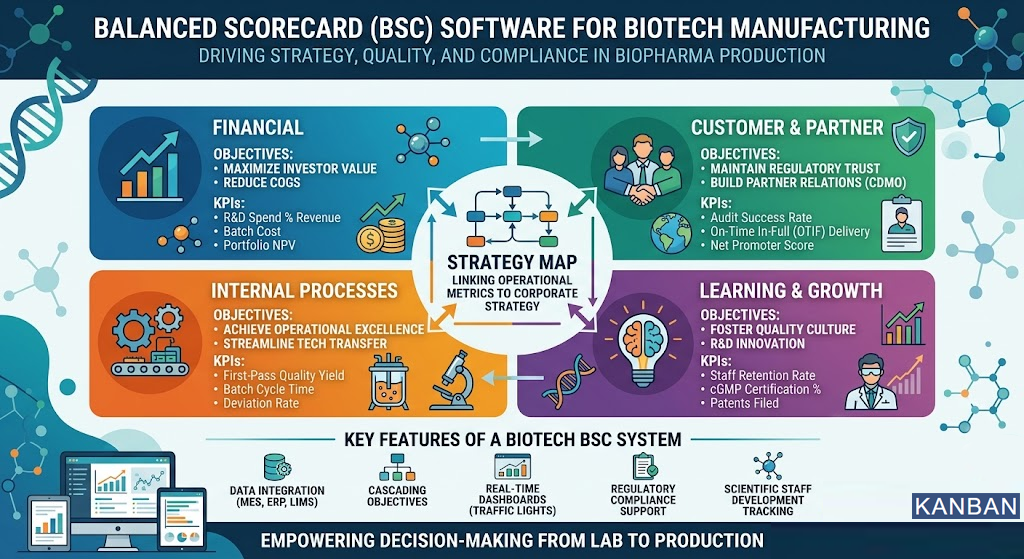
Financial Perspective: Driving Cost Efficiency and Profitability
The financial perspective focuses on measuring revenue growth, cost control, and overall profitability. In biotech manufacturing, this includes monitoring production costs, return on investment (ROI), and resource utilisation. BSC software helps organisations optimise financial performance while maintaining compliance with strict regulatory requirements.
Customer Perspective: Enhancing Quality and Satisfaction
The customer perspective evaluates how well a company meets the expectations of clients, patients, and stakeholders. In biotech, this often involves ensuring product quality, reliability, and timely delivery. BSC software helps track customer satisfaction, complaint rates, and product consistency, enabling organisations to build trust and maintain strong relationships.
Internal Process Perspective: Optimising Operations and Compliance
The internal process perspective focuses on improving manufacturing efficiency and ensuring adherence to regulatory standards such as GMP (Good Manufacturing Practices). BSC software enables biotech companies to monitor production cycles, quality control processes, and compliance metrics, helping reduce errors and improve operational reliability.
Learning & Growth Perspective: Fostering Innovation and Workforce Development
The learning and growth perspective emphasises employee skills, training, and organisational culture. In a highly innovative industry like biotech, continuous learning and development are essential. BSC software supports tracking employee performance, training effectiveness, and innovation initiatives, ensuring the workforce is equipped to drive future growth.
Why Balanced Scorecard Software Matters in Biotech Manufacturing
By integrating financial and non-financial metrics, BSC software provides a holistic view of organisational performance. It helps biotech manufacturers improve decision-making, maintain regulatory compliance, enhance product quality, and align daily operations with long-term strategic goals. Ultimately, it serves as a powerful tool for driving efficiency, innovation, and sustainable growth in a highly regulated environment.
Why Balanced Scorecard (BSC) Software Matters in Biotech Manufacturing
Aligning Strategy with Execution
In biotech manufacturing, Balanced Scorecard (BSC) software plays a crucial role in aligning organisational strategy with day-to-day operations. It helps translate complex business objectives into clearly defined and measurable goals that teams can execute effectively.
This alignment ensures that departments such as research, production, quality assurance, and compliance are all working toward the same strategic vision, reducing fragmentation and improving coordination.
By breaking down high-level strategies into actionable performance indicators, BSC software provides clarity to employees about their roles and contributions to overall success.
It also enables continuous monitoring of progress, allowing organisations to adjust strategies quickly in response to changing regulatory or market conditions.
Ultimately, this structured approach improves focus, enhances collaboration, and ensures consistent execution of strategic goals across the organisation.
Improving Visibility Across Operations
Balanced Scorecard software enhances visibility across biotech operations by providing real-time insights into key performance metrics such as production efficiency, quality standards, and compliance indicators.
This transparency allows managers to identify inefficiencies and bottlenecks early, preventing them from escalating into larger operational challenges.
With interactive dashboards and automated reporting, complex data is presented in a simplified and accessible format for decision-makers.
Improved visibility also supports better communication between departments, as teams have access to consistent and up-to-date performance information.
As a result, organisations can make quicker decisions, optimise processes, and maintain high levels of operational efficiency.
Enhancing Decision-Making
BSC software empowers organisations to make informed decisions by providing accurate and timely data across multiple performance dimensions.
Leaders can analyse trends, identify performance gaps, and implement corrective actions based on reliable insights rather than assumptions.
The integration of financial and operational metrics ensures that decisions are balanced and aligned with both short-term and long-term goals.
Advanced analytics capabilities also allow for scenario planning, helping organisations evaluate different strategies before implementation.
This data-driven approach leads to more effective decision-making, reduced risks, and improved organisational performance.
Supporting Regulatory Compliance
Regulatory compliance is critical in biotech manufacturing, and BSC software helps organisations track and manage compliance-related metrics effectively.
It ensures adherence to industry standards such as GMP and FDA regulations by monitoring key compliance indicators in real time.
Automated alerts and reporting features help organisations identify deviations and address them promptly before they become serious issues.
Additionally, BSC software improves documentation and traceability, which are essential for audits and regulatory inspections.
Overall, it provides a structured approach to maintaining compliance while supporting efficient and reliable operations.
The Four Perspectives of Balanced Scorecard in Biotech
Understanding the Balanced Approach
The Balanced Scorecard framework is based on four key perspectives: financial, customer, internal processes, and learning & growth, which together provide a comprehensive view of organisational performance.
This balanced approach ensures that organisations do not focus solely on financial outcomes but also consider operational efficiency, customer satisfaction, and employee development.
By incorporating multiple perspectives, biotech companies can identify areas of improvement that may not be visible through financial analysis alone.
It also promotes long-term thinking by emphasising sustainability, innovation, and continuous improvement.
As a result, organisations can achieve more stable growth and maintain a competitive advantage in the industry.
Creating a Holistic Performance System
BSC software enables organisations to create a holistic performance management system that integrates data from various departments into a single platform.
This integration provides a comprehensive view of how different functions interact and impact overall business performance.
For example, improvements in employee training can enhance process efficiency, which in turn improves product quality and customer satisfaction.
Such insights help organisations make more informed decisions and prioritise initiatives effectively.
Ultimately, this holistic approach ensures that all aspects of the organisation contribute to achieving strategic objectives.
Financial Perspective: Measuring Profitability and Cost Efficiency
The financial perspective in Balanced Scorecard (BSC) software focuses on evaluating the economic performance of biotech manufacturing operations by tracking profitability, cost efficiency, and overall financial health. It ensures that strategic initiatives contribute to sustainable revenue growth while maintaining strict cost control.
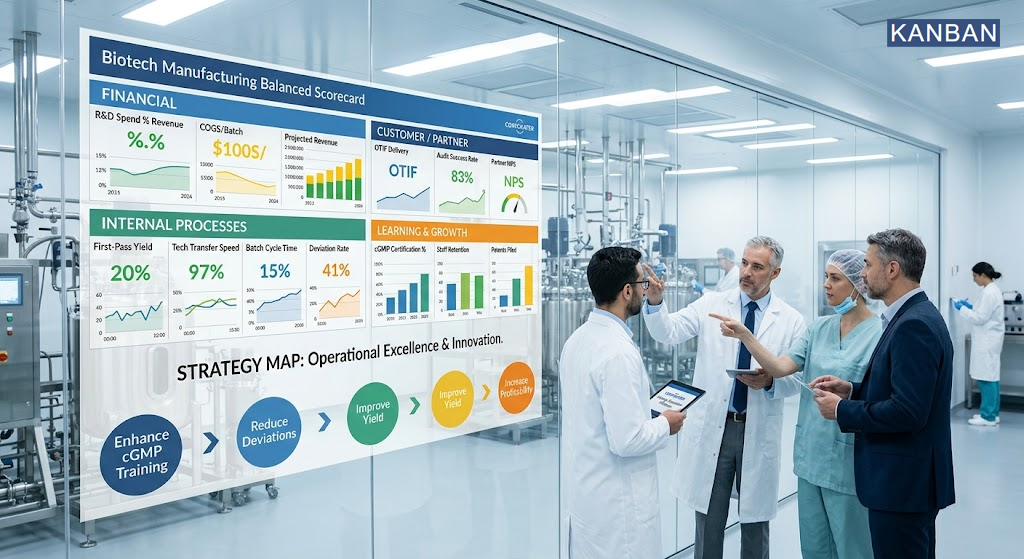
In biotech manufacturing, financial metrics often include production costs per batch, return on investment (ROI), operating margins, and capital expenditure efficiency. These indicators help organisations understand how effectively they are utilising resources in a highly regulated and capital-intensive environment.
BSC software enables real-time tracking of these financial metrics, allowing organisations to quickly identify cost overruns, inefficiencies, or unexpected financial risks. This visibility is critical for maintaining profitability while meeting regulatory and quality standards.
Additionally, the financial perspective supports better budgeting and forecasting by providing accurate historical and real-time data. This helps organisations plan investments in research, infrastructure, and technology more effectively.
Ultimately, by continuously monitoring financial performance, biotech companies can ensure long-term sustainability, improve profitability, and make informed strategic decisions that align with business goals.
Customer Perspective: Ensuring Quality and Client Satisfaction
The customer perspective in BSC software focuses on how biotech manufacturing organisations deliver value to their customers, including pharmaceutical companies, healthcare providers, and patients. It emphasises product quality, reliability, and overall customer satisfaction.
In this industry, customer expectations are extremely high due to the critical nature of biotech products, making quality consistency and timely delivery essential performance indicators. Metrics such as customer satisfaction scores, complaint rates, and on-time delivery performance are commonly tracked.
BSC software helps organisations monitor these metrics in real time, enabling them to quickly identify issues that may affect customer trust or product reliability. This proactive approach helps maintain strong relationships with clients and stakeholders.
Furthermore, the customer perspective encourages organisations to continuously improve their products and services based on feedback and performance data. This ensures that they remain competitive in a rapidly evolving market.
By focusing on customer needs and expectations, biotech manufacturers can enhance their reputation, build long-term partnerships, and ensure consistent demand for their products.
Internal Process Perspective: Optimizing Manufacturing and Compliance
The internal process perspective in Balanced Scorecard software focuses on improving the efficiency, reliability, and compliance of manufacturing operations within biotech organisations. It ensures that processes are designed to deliver high-quality products consistently.
Key metrics in this perspective include production cycle time, batch success rates, process deviations, and adherence to Good Manufacturing Practices (GMP). These indicators help organisations evaluate the effectiveness of their internal workflows.
BSC software enables continuous monitoring of these processes, allowing organisations to identify bottlenecks, reduce waste, and improve overall operational efficiency. This is particularly important in biotech manufacturing, where precision and consistency are critical.
In addition, the software supports compliance management by tracking regulatory requirements and ensuring that all processes meet industry standards. This reduces the risk of non-compliance and associated penalties.
By optimising internal processes, biotech companies can improve productivity, maintain product quality, and ensure smooth and reliable operations.
Learning & Growth Perspective: Driving Innovation and Workforce Development
The learning and growth perspective in BSC software focuses on developing the capabilities of employees, systems, and organisational culture to support long-term success in biotech manufacturing. It emphasises innovation, knowledge sharing, and continuous improvement.
In a rapidly evolving industry like biotechnology, staying competitive requires ongoing investment in employee training, research and development, and technological advancements. Metrics such as employee skill levels, training effectiveness, and innovation outputs are commonly tracked.
BSC software helps organisations monitor these metrics and identify gaps in skills or knowledge that may impact performance. This allows companies to implement targeted training programs and improve workforce capabilities.
Additionally, fostering a culture of innovation encourages employees to contribute new ideas and improvements, which can lead to better processes, products, and competitive advantages.
By focusing on learning and growth, biotech manufacturers can build a skilled workforce, drive innovation, and ensure sustainable success in a highly competitive and regulated industry.
Key Performance Indicators (KPIs) for Biotech Manufacturing BSC
Defining Relevant Metrics
Defining relevant KPIs is essential for effective performance management in biotech manufacturing, as these metrics provide a clear measure of success.
BSC software helps organisations identify KPIs that align with strategic objectives and regulatory requirements.
These metrics ensure that performance is evaluated consistently across different departments and processes.
Well-defined KPIs also provide a foundation for continuous improvement by highlighting areas that require attention.
Ultimately, accurate and meaningful KPIs enable organisations to track progress and achieve their goals effectively.
Examples of Financial and Operational KPIs
Financial and operational KPIs in biotech manufacturing include metrics such as production cost per batch, yield rates, and cycle times.
These indicators help organisations evaluate efficiency, profitability, and resource utilisation.
Tracking these KPIs allows companies to identify inefficiencies and implement cost-saving measures.
It also supports better planning and allocation of resources.
As a result, organisations can improve both financial performance and operational efficiency.
Using BSC Software to Ensure Regulatory Compliance (FDA, GMP)
Balanced Scorecard (BSC) software plays a vital role in helping biotech manufacturing organisations maintain strict regulatory compliance with standards such as FDA and Good Manufacturing Practices (GMP). These regulations require continuous monitoring, documentation, and control of processes to ensure product safety and quality.
By integrating compliance metrics into the performance management framework, BSC software allows organisations to track key indicators such as audit results, deviation rates, and corrective action effectiveness. This ensures that compliance is not treated as a separate activity but as an integral part of daily operations.
Real-time monitoring capabilities enable organisations to quickly identify any deviations from regulatory requirements and take immediate corrective action. This proactive approach reduces the risk of non-compliance and potential penalties.
Additionally, BSC software enhances documentation and traceability by maintaining detailed records of processes, inspections, and quality checks. This is particularly important during regulatory audits, where accurate and accessible documentation is essential.
Ultimately, by embedding compliance into performance management, biotech companies can ensure consistent adherence to regulatory standards while maintaining operational efficiency and product quality.
Role of BSC Software in Digital Transformation of Biotech Operations
Balanced Scorecard (BSC) software is a key enabler of digital transformation in biotech manufacturing, as it provides a structured framework for integrating technology with strategic performance management. It helps organisations transition from traditional manual processes to data-driven operations.
Through digital dashboards and automated reporting, BSC software allows organisations to monitor performance in real time, reducing reliance on manual data collection and improving accuracy. This enhances efficiency across all operational levels.
The integration of BSC with digital systems such as Manufacturing Execution Systems (MES) and Enterprise Resource Planning (ERP) platforms enables seamless data flow and improved coordination between departments.
Digital transformation also improves agility, allowing organisations to respond quickly to changes in market demand, regulatory requirements, or production challenges. BSC software supports this adaptability by providing timely insights.
As a result, biotech companies can achieve greater operational efficiency, improve decision-making, and stay competitive in an increasingly technology-driven industry.
Integrating Real-Time Data and Analytics in BSC Systems
Integrating real-time data and analytics into Balanced Scorecard (BSC) systems significantly enhances the effectiveness of performance management in biotech manufacturing. It allows organisations to make decisions based on up-to-date and accurate information.
BSC software can collect data from various sources, including production systems, quality management tools, and compliance platforms, creating a unified view of organisational performance. This eliminates data silos and improves transparency.
Advanced analytics capabilities enable organisations to identify trends, detect anomalies, and predict potential issues before they impact operations. This proactive approach improves efficiency and reduces risks.
Real-time dashboards provide instant visibility into key performance indicators, allowing managers to monitor progress and take corrective actions without delay. This improves responsiveness and operational control.
By leveraging real-time data and analytics, biotech companies can enhance decision-making, optimise processes, and achieve continuous improvement in a highly competitive and regulated environment.
Steps to Implement Balanced Scorecard Software in Biotech Companies
Defining Strategic Objectives
The first step in implementing BSC software is defining clear and measurable strategic objectives that align with the organisation’s vision.
These objectives should reflect both short-term priorities and long-term goals.
They provide a roadmap for performance management and decision-making.
Clear objectives ensure that all teams understand what needs to be achieved.
This clarity is essential for successful implementation.
Selecting Appropriate KPIs
Once objectives are defined, organisations must select KPIs that accurately measure performance.
These KPIs should be relevant, measurable, and aligned with business goals.
Choosing the right metrics ensures effective tracking and evaluation.
It also helps organisations focus on what truly matters.
This step is critical for achieving meaningful results.
Common Challenges in Implementing BSC in Biotech Manufacturing
Implementing Balanced Scorecard (BSC) software in biotech manufacturing can be complex due to the highly regulated nature of the industry and the need to align multiple departments with a unified strategy. Organisations often face difficulties in translating strategic goals into measurable and actionable performance indicators.
One of the primary challenges is selecting the right key performance indicators (KPIs) that accurately reflect both operational efficiency and regulatory compliance. Poorly chosen metrics can lead to misleading insights and ineffective decision-making.
Another significant challenge is data integration, as biotech companies typically operate with multiple systems for production, quality management, and compliance. Integrating these systems into a single BSC platform requires time, resources, and technical expertise.
Resistance to change among employees and management can also hinder successful implementation. Teams may be reluctant to adopt new tools or processes, especially if they are not fully aware of the benefits.
To overcome these challenges, organisations must invest in proper planning, training, and change management strategies, ensuring that all stakeholders understand the value of BSC and actively support its implementation.
Role of Leadership in Successful BSC Adoption
Leadership plays a critical role in the successful adoption of Balanced Scorecard (BSC) software in biotech manufacturing, as it sets the direction and establishes the importance of performance management across the organisation. Strong leadership ensures that strategic objectives are clearly defined and communicated.
Leaders are responsible for aligning teams with organisational goals and ensuring that all departments understand how their performance contributes to overall success. This alignment is essential for achieving meaningful results from BSC implementation.
Effective leaders also promote a culture of accountability by encouraging teams to take ownership of their performance metrics and continuously strive for improvement. This fosters a results-driven work environment.
In addition, leadership must support the adoption of BSC by providing necessary resources, including training, technology, and ongoing support. Without this commitment, implementation efforts may fail.
Ultimately, strong leadership ensures that BSC becomes an integral part of organisational culture, driving continuous improvement and long-term success.
Using BSC for Continuous Improvement and Strategic Alignment
Balanced Scorecard (BSC) software serves as a powerful tool for driving continuous improvement in biotech manufacturing by providing a structured framework for monitoring and enhancing performance across multiple dimensions.
By regularly analysing performance data, organisations can identify inefficiencies, gaps, and opportunities for improvement in their processes. This enables them to implement corrective actions and optimise operations.
BSC also ensures that continuous improvement initiatives are aligned with strategic objectives, preventing organisations from focusing on isolated or low-impact changes.
Through regular performance reviews and updates, organisations can adapt their strategies to changing market conditions, regulatory requirements, and technological advancements.
This ongoing cycle of evaluation and improvement helps biotech companies maintain competitiveness, improve quality, and achieve sustainable growth.
Enhancing Employee Engagement through Performance Visibility
Balanced Scorecard (BSC) software enhances employee engagement by providing clear visibility into individual and team performance, helping employees understand how their work contributes to organisational success.
When employees have access to performance data and clear objectives, they are more likely to feel motivated and accountable for their contributions. This improves overall productivity and job satisfaction.
BSC software also encourages transparency by making performance metrics accessible across departments, fostering a culture of trust and collaboration.
Additionally, it enables organisations to recognise and reward high-performing employees based on measurable outcomes, which further motivates teams to perform at their best.
By improving engagement and aligning employee efforts with strategic goals, biotech companies can build a more committed workforce and achieve better overall performance.
Benefits of Using Balanced Scorecard Software in Biotech Manufacturing
Improved Operational Efficiency
BSC software helps streamline processes by identifying inefficiencies and improving workflow management across biotech operations.
It enables organisations to optimise resource utilisation and reduce unnecessary costs.
Improved efficiency leads to faster production cycles and better output quality.
It also supports continuous improvement initiatives.
As a result, organisations can achieve higher productivity levels.
Enhanced Product Quality
Monitoring quality metrics through BSC software ensures consistent product standards in biotech manufacturing.
It helps identify defects and deviations early, reducing the need for rework.
This improves reliability and customer satisfaction.
It also supports compliance with regulatory standards.
Ultimately, it strengthens the organisation’s reputation for quality.
Future Trends of BSC Software in the Biotech Industry
Integration with Advanced Analytics
The future of BSC software lies in integration with advanced analytics and artificial intelligence technologies.
These tools will provide deeper insights into performance and predictive capabilities.
Organisations will be able to anticipate challenges and opportunities more effectively.
This will enhance decision-making and strategic planning.
Ultimately, it will drive innovation and growth.

Real-Time Performance Monitoring
Real-time monitoring capabilities will become increasingly important in biotech manufacturing.
Live dashboards will allow organisations to track performance continuously.
This improves responsiveness to operational issues.
It also enhances agility in decision-making.
As a result, organisations can maintain high levels of efficiency and competitiveness.